
Politics

Tick, tick, tick: Will Donald Trump play the 'handmaiden' card, lighting a SCOTUS fuse?

Tick, tick, tick: Will Donald Trump play the 'handmaiden' card, lighting a SCOTUS fuse?

The clock is ticking and the news coverage is heating up. At this point, for religion-beat pros, there's only one question that matters: Will Donald Trump GO THERE? Will he nominate the "loud dogma" candidate who will make heads explode in the liberal Catholic and secular politicos camps? We are, of course, talking about Judge Amy Coney Barrett. 

However, there is a rather cynical possibility linked to this story, an angle explored in this week's "Crossroads" podcast. Click here to tune that in.

You see, Trump needs to fire up voters for the midterm elections. In particular, he needs evangelical Protestants and pro-Catechism Catholics to turn out in droves, to help rescue the GOP from, well, Trump's unique ability in infuriate half of America (especially in elite zip codes and newsrooms).

So what if he nominated Barrett and let the blue-culture masses go crazy?

What if he unleashed that storm, knowing that the moral, cultural and religious left will not be able to restrain itself?

What a scene! Remember the hearings long ago for Justice Robert Bork -- the SCOTUS seat eventually taken by one Judge Anthony Kennedy -- and this famous speech by the late Sen. Ted Kennedy, speaking for the Catholic left and cultural liberals everywhere?

Robert Bork’s America is a land in which women would be forced into back-alley abortions, blacks would sit at segregated lunch counters, rogue police could break down citizens’ doors in midnight raids, schoolchildren could not be taught about evolution, writers and artists would be censored at the whim of government, and the doors of the federal courts would be shut on the fingers of millions of citizens for whom the judiciary is often the only protector of the individual rights that are the heart of our democracy.

So what would that sound like today, if Barrett has to face her critics once again?

CNN legal analyst Jeffrey Toobin has already prepared that script, in a piece for The New Yorker, describing this future nightmare court:

It will overrule Roe v. Wade, allowing states to ban abortions and to criminally prosecute any physicians and nurses who perform them. It will allow shopkeepers, restaurateurs, and hotel owners to refuse service to gay customers on religious grounds.

Please respect our Commenting Policy

Thinking politics, and pop culture, on July 4th in this today's tense and wired America

Stop and think about the following question: During the upcoming apocalyptic war over the empty U.S. Supreme Court seat, which group of public intellectuals (and I use that term very loosely) will play the larger role shaping public opinion among ordinary Americans?

(a) Scribes who write New York Times editorials.

(b) Law professors at America's Top 10 law schools.

(c) The writers and hosts of late-night comedy/news talks shows.

(d) The latest blasts from America's Tweeter In Chief, who is a former reality TV show star.

Now, if you've been around for a half century or so, you know that politicians have always paid close attention to the satirical offerings of Saturday Night Live and the late Johnny Carson always had way more political influence than he let on. Who was more skilled when visiting a late-night television show during pre-campaign work, former B-movie actor Ronald Reagan or whoever tried to knock him out of the headlines?

The power of pop culture in politics is nothing new -- but it's on the rise.

With that in mind, let's look at a special 4th of July think piece written by DC Beltway think-tank scribe Mark Rodgers, a former high-ranking GOP staffer in the U.S. Senate. He is probably one of the few people I know with U2's Bono in his smartphone favorites list.

The headline, featuring a popular active verb:

Has (Pop)Culture Trumped Politics?

You need a thesis statement? Here it is the overture:

It’s been a long time coming.

Almost 20 years ago, while working on the Hill and hosting a conversation with UVA sociologist James Davison Hunter over lunch, I recall waking up to the growing impact of the popular culture, and its inevitable trajectory to surpass education, family, faith and journalism as the dominant worldview shaping force in 21st century America, and possibly the world.


Please respect our Commenting Policy

Side question re: viral story about baby Jesus, Mary and Joseph in a cage: Which Bible to quote? (updated)

Side question re: viral story about baby Jesus, Mary and Joseph in a cage: Which Bible to quote? (updated)

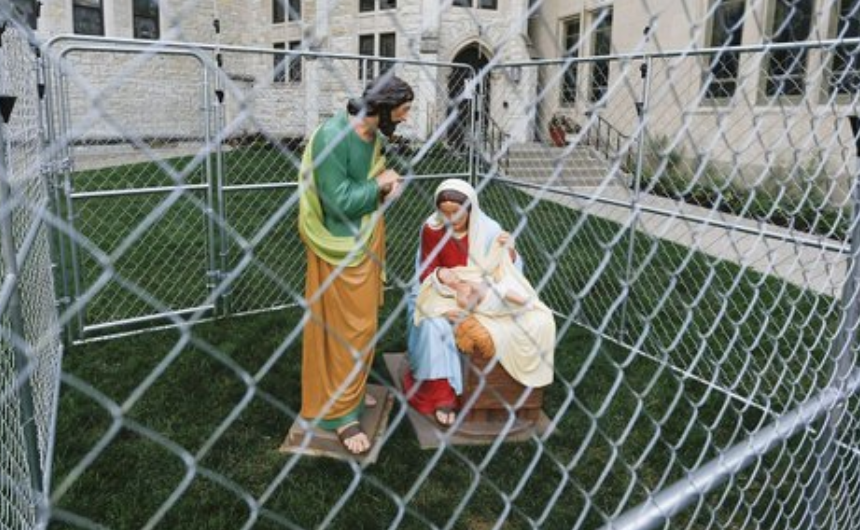
Baby Jesus, Mary and Joseph in a cage?

Everyone seems to talking about that viral religion story, as The Tennessean faith reporter Holly Meyer points out. 

In case you missed it, the Indianapolis Star reports that the three biblical figures "were incarcerated behind a barbed wired-topped, chain link fence on the lawn of Monument Circle's Christ Church Cathedral on Tuesday."

The reason:

The Rev. Stephen Carlsen, dean and rector of Christ Church, said the caged Holy Family is a protest to President Donald Trump's zero-tolerance policy that is holding families in detention centers at the U.S.-Mexico border.

"I know what the Bible said," Carlsen said. "We're supposed to love our neighbors as ourselves."

It's a fascinating story, and I'd urge you to check it out. But for the purposes of this post, I have a side question: Which version of the Bible should a news organization quote in a story such as this?

I'll admit surprise at the one the Gannett newspaper chose to quote:

The Rev. Lee Curtis, who came up with the idea for the demonstration, said the Biblical trio was a family of refugees seeking asylum in Egypt after Jesus' birth. 

"An angel of the Lord appeared to Joseph in a dream, saying, 'Arise, take the young Child and His mother, flee to Egypt, and stay there until I bring you word; for Herod will seek the young Child to destroy Him,'" the Message Bible says in Matthew 2:13-14. "When he arose, he took the young Child and His mother by night and departed for Egypt."

"This family is every family, and every family is holy," Curtis said. 

For those not familiar with The Message, it's a contemporary version in modern English. The religion satire news site Babylon Bee has published stories such as "‘The Message’ Now Available In Popular Comic Sans Font" and "7 Updates ‘The Message’ Totally Needs." Among the proposed updates: Substituting all references to Jesus with "The J-Man." That gives some indication of how seriously (read: not) some take that translation.

I'm not sure I've ever seen The Message be the go-to version quoted in a news story. (I'll eagerly await all the links proving me wrong.) My first thought was perhaps the Star was trying to put the verses in language readers could understand.


Please respect our Commenting Policy

The New York Times 'reports' on an old mantra: Free speech for me, but not for thee

If you are a journalist of a certain age, as well as an old-guard First Amendment liberal, then you remember what it was like trying to get people to understand why you backed ACLU efforts in 1978 to defend the rights of a neo-Nazi group to march through Skokie.

Clearly this march was going to cause pain and emotional suffering, since that Chicago suburb included many Holocaust survivors. But First Amendment liberals stood firm.

If you grew up Southern Baptist in the Bible Belt, it was also hard to explain why you thought Hustler magazine had the right to publish a filthy, sophomoric satire of the Rev. Jerry Falwell, including a fake claim that he had committed incest with his mother in an outhouse.

That case went to the U.S. Supreme Court. As a New York Times report at the time noted, this Hustler piece was clearly satire and the First Amendment wasn't supposed to protect people from feeling offended or even abused by voices in the public square.

The central legal issue is whether, in the absence of the kinds of false statements purporting to be fact on which libel suits are based, a public figure like Mr. Falwell should be able to win damages from a publication that intentionally causes emotional distress through ridicule, tasteless or otherwise.

Several Justices suggested they were grappling with a conflict between the freedom of the press to carry on a long tradition of biting satire, and what Justice Antonin Scalia called the concern that ''good people should be able to enter public life'' without being exposed to wanton abuse in print.

I remember, back then, liberals saying they would be quick to defend the First Amendment rights of conservatives who spoke out on tough, tricky and even offensive issues.

This brings me to one of the most Twitter-friendly stories of this past weekend, a Times report that ran with this rather blunt headline: "Weaponizing the First Amendment: How Free Speech Became a Conservative Cudgel." It's amazing how little religious content is in this report, in light of waves of religious-liberty fights in recent years.

If you are looking for the thesis statement or statements in this article -- which I think was meant to be "news," not analysis -- here it is: 

... Liberals who once championed expansive First Amendment rights are now uneasy about them.


Please respect our Commenting Policy

Another shoe drops: Jonathan Merritt calls it quits at Religion News Service

Let's see: In the Urban Dictionary, the phrase "Waiting for the other shoe to drop" is defined like this (with a joke thrown in for good measure, in the full text): "To await an event that is expected to happen, due to being causally linked to another event that has already been observed."

However, one gets the impression that the words "the other" in that phrase imply the existence of only one other show. It still sounds like the newsroom at Religion News Service contains lots of other shoes and some of them have yet to drop -- following the now infamous meltdown linked to the forced exit of former editor-in-chief Jerome Socolovsky, after clashes with publisher Tom Gallagher, who is best known for his opinion work on the Catholic left.

Lots of digital ink was spilled during that episode, including two lengthy GetReligion posts by our own Julia Duin. Check out, "RNS analysis: How America's one religion wire service melted down over a long weekend (Part I)" and "RNS meltdown II: New media reports, new details and Lilly Endowment confirms $4.9 million grant."

Now there is this, from columnist and blogger Jonathan Merrett: "Why I am leaving Religion News Service after 5 years."

If you follow Merritt's work, you know that he is one of the most important journalistic voices who has emerged on the evangelical left -- both at RNS and at The Atlantic -- especially on issues linked to LGBTQ debates and women's rights.

Now, some of his critics would say the "post-evangelical" left, but I'm not sure that nuance is justified since it is almost impossible to define what the word "evangelical" means, these days. In terms of heritage, Merritt is best understood as a liberal Baptist. Yes, doctrinally liberal Baptists exist and there's a lot of history there. Ask Bill Clinton.

Anyway, Merritt has posted his take on what happened, at his own website. Here is that text:


Please respect our Commenting Policy

Beyond Roe, Bork and Trump: Can Americans find a way to discuss hot moral issues?

I am old enough that I can -- if I focus my mind really hard -- remember what our public discourse was like before the Supreme Court became the only issue in American politics that really, ultimately, mattered.

How did America become a nation in which dialogue and compromise is impossible? Why is the U.S. Supreme Court always ground zero on all of this? What role is the mainstream press playing in this painful equation, especially when covering news linked to religious, moral and cultural clashes?

These kinds of questions are at the heart of this week's "Crossroads" podcast (click here to tune that in), which focuses on the painful state of political life in this age of Donald Trump, an age in which the status of the high court is even more controversial than ever, with Kennedy's retirement serving as another fuse on this bomb. 

But let's back up a minute, to when old folks like me were young. 

Yes, the 1960s were wild times, of course. The war in Vietnam was incredibly divisive and the nation was rocked by assassinations. Tragic divisions over race were real and could not be ignored. 

Still, everything changed for millions of Americans on Jan. 22, 1973. From that moment on the status of Roe v. Wade -- political wars over defending or overturning that decision -- loomed over every nomination to the U.S. Supreme Court and every presidential election, as well. 

Then came October 23, 1987 and the vote on the nomination of Judge Robert Bork to the high court. Bork was a former Yale Law School professor (former students included Bill Clinton and Hillary Rodham) who embraced and taught originalism -- the legal theory that the U.S. Constitution should be interpreted as written by the founders.

If you want to catch the flavor of the debate over Bork, here is the famous statement by Sen. Ted Kennedy: 


Please respect our Commenting Policy

After Kennedy retirement, you'll find thousands of the nation's happiest people in ... Wichita, Kan.

After Justice Anthony Kennedy's retirement announcement Thursday, CNN political analyst Jeffrey Toobin tweeted that abortion will be illegal in 20 states in 18 months.

The Twitter post, expressing the worst fears of abortion-rights supporters, quickly went viral.

But if there is weeping and gnashing of teeth — on the pro-choice side — over the future of Roe v. Wade, the mood is something entirely different among thousands of pro-life advocates gathering in Wichita, Kan., this weekend.

Coincidentally, the National Right to Life committee's three-day national convention started this morning — the day after the Kennedy news shook the nation's political and legal landscape.

This post mainly serves as a public service announcement that regional newspapers — including the Kansas City Star and the Wichita Eagle — are following the convention and have produced some excellent coverage already. 

Today's in-depth preview of the convention by the Star mixes crucial details and relevant context both on the National Right to Life Committee and red-state Kansas itself:

For the first time in its 50-year history, the nation’s largest anti-abortion organization is holding its annual convention in Kansas, a state seen by many in the movement as a model for passing tough abortion restrictions.

The National Right to Life Committee, which has affiliates in every state and more than 3,000 chapters across the country, will open its convention Thursday morning at the Sheraton Overland Park with 90 minutes of speeches by Gov. Jeff Colyer and others.

“There’s a lot of enthusiasm and optimism in the pro-life base right now,” said National Right to Life President Carol Tobias. “We are seeing a lot of young people getting involved. We have a president who is issuing great pro-life orders and actions. And he’s appointing judges to the courts that we believe will strictly interpret the Constitution and not make it up as they go along.”

And yes, the Star notes the significance of Kennedy's retirement:


Please respect our Commenting Policy

Is the open U.S. Supreme Court seat a religion story? Do we even need to ask that?

If you live in Washington, D.C., or have sojourned there in the past, then you know that a high percentage of folks in the Beltway chattering classes wake up every morning with a dose of Mike Allen.

This was true in his "Playbook" days at The Politico and it's true now that he has moved on to create the Axios website, which is must-reading in this troubled Donald Trump era.

So if you want to know what DC folks are thinking about -- after King Anthony Kennedy announced his retirement from the U.S. Supreme Court -- then it's logical to do a quick scan of Allen's punchy offerings today in the "Axios AM" digital newsletter (click here to see it in a browser). At this here weblog, that means looking for religion-beat hooks. It doesn't take a lot of effort to find them. For example:

Behind the scenes: Trump doesn’t personally care that much about some of the social issues, such as LGBT rights, energizing the Republican base over the Supreme Court.

But Trump knows how much his base cares about the court. He believes that releasing his list of potential court picks during the campaign was a masterstroke, and helped him win.

What part of the GOP base is Allen talking about? That's obvious. However, journalists covering this angle really need to see if many cultural conservatives are all that interested in rolling back gay-rights victories at the high court.

Most of the people I know understand that this ship has sailed, in post-Christian American culture, and they are primarily interested in seeing a strong court decision defending some kind of conscientious objection status and/or a clear rejection of government compelled speech and artistic expression. In other words, they would like to see an old-school liberal ruling on First Amendment grounds.

As I have said here many times, I know very, very few religious conservatives who wanted to vote for Trump. However, I heard lots of people say something like this: I don't know what Donald Trump is going to do. But I do know what Hillary Rodham Clinton is going to do. I'm going to have to take a risk. They were talking about SCOTUS and the First Amendment.

Back to Allen:


Please respect our Commenting Policy

Two prominent namers of names inside DC Beltway warrant in-depth religion profiles

Justice Anthony Kennedy’s Supreme Court retirement throws the spotlight on one of the most influential players in Washington, D.C., when it comes to deciding what individuals inhabit the centers of power.  

We are talking about Leonard Leo, executive vice president of the Federalist Society and the go-to guy for names of federal court appointees when Republicans rule the White House.

Alongside Leo, journalists should also be taking a close look at another Republican networker and talent-spotter, Kay Coles James, as of January the president of the Heritage Foundation. Both are devout Christians, a fact the media have reported. But few reporters have explored that aspect of their life stories in any depth, allowing good prospects for fresh, religiously themed features or interviews.

The Federalist Society, where Leo has worked since 1991, boasts a constituency of some 65,000 conservative attorneys, jurists, and law school students. Justice Neil Gorsuch, who provided the pivotal vote in three important 5-4 Supreme Court rulings this week, was on the lists from which candidate Donald Trump promised to choose his Supreme Court nominees in an unprecedented campaign gambit.

Trump’s prime resource in choosing those names was Leo, as recounted in New Yorker profile by Jeffrey Toobin last year. Toobin says Leo “has met and cultivated almost every important Republican lawyer” of this generation. In addition to Gorsuch, he was the man behind the appointments of Chief Justice John Roberts and Justice Samuel Alito.

Leo was the chief Catholic strategist for George W. Bush’s re-election in 2004 and co-chaired Catholic outreach for the Republican National Committee. (The Religion Guy covered for The AP his briefing of Catholic delegates attending the party’s New York City convention.) Despite that partisan affiliation, President Barack Obama along with leaders of both parties in Congress appointed him to chair the U.S. Commission on International Religious Freedom.

Leo tries to attend daily Mass when possible and his “faith is central to all he does,” says Conor Gallagher of the Benedict Leadership Institute.


Please respect our Commenting Policy