People

With all due respect, reports about Biden, the 'McCarrick doctrine' and Mass are not stupid

With all due respect, reports about Biden, the 'McCarrick doctrine' and Mass are not stupid

“The Biden Communion stories are stupid,” proclaims the headline atop a Religion News Service column by Father Thomas J. Reese.

The opinion by Reese, a Jesuit priest and RNS senior analyst, follows a flurry of news reports — which we first mentioned last week — about whether the nation’s second Catholic president might be denied Communion because of his support for abortion rights.

“This is a stupid story for canonical, theological and political reasons,” Reese writes. “First, and foremost, the U.S. Conference of Catholic Bishops does not have the canonical authority to tell (President Joe) Biden that he cannot go to Communion.”

For insight on the canonical, theological and political issues, I’d highly recommend Reese’s column. As for his claim that the news stories are stupid, I’d respectfully disagree. From a journalistic perspective, they are, in fact, highly newsworthy.

Even if much of the coverage could be better, as Clemente Lisi explained here at GetReligion, with the essay then appearing at Religion Unplugged. A key topic being avoided? The role of fallen cardinal Theodore “Uncle Ted” McCarrick in developing the awkward compromise currently in effect here in America.

Another helpful read at Religion Unplugged: Stephen P. Millies, an associate professor of public theology at Catholic Theological Union in Chicago, dissects the power struggle behind the U.S. bishops’ move.

Among this week’s related headlines:

Pelosi’s archbishop says prominent Catholics who support abortion rights should be denied Communion (by Reis Thebault, Washington Post)

How faith groups feel after Biden’s first 100 days (by Kelsey Dallas, Deseret News)

New bishop of Biden’s hometown mum on Communion question (by Nicole Winfield and Luis Andres Henao, Associated Press)

Catholic bishops who want to deny Biden Communion may have to reckon with the pope (by Jack Jenkins and Claire Giangravé, RNS)


Please respect our Commenting Policy

Movie mogul Tyler Perry preaches tolerance to the woke flock at Oscars 2021

Movie mogul Tyler Perry preaches tolerance to the woke flock at Oscars 2021

It was just like one of those inspiring Tyler Perry movie scenes when a believer does the right thing and helps a struggler have a come-to-Jesus epiphany.

Perry was walking to his car after some Los Angeles production work when he was approached by homeless woman.

"I wish I had time to talk about judgment," said Tyler, after receiving the Jean Hersholt Humanitarian Award during the 93rd Academy Awards. "Anyway, I reach in my pocket and I'm about to give her the money and she says: 'Excuse me sir, do you have any shoes?'

"It stopped me cold because I remember being homeless and having one pair of shoes," he added. "So, I took her into the studio. … We're standing there [in] wardrobe and we find her these shoes and I help her put them on. I'm waiting for her to look up and all this time she's looking down. She finally looks up and she's got tears in her eyes. She says: 'Thank you Jesus. My feet are off the ground.' "

Perry, of course, is a movie mogul who has built a 330-acre studio facility in Atlanta used for all kinds of work, including parts of the Marvel epic "The Black Panther." He has created many profitable films of this own, such as "Diary of a Mad Black Woman," "The Family that Preys" and "Madea's Family Reunion," part of a series in which Perry, in drag, plays a pistol-packing, Bible-quoting matriarch at the heart of Black-family melodramas.

It was logical for Perry to receive the Jean Hersholt award, in part because of his rags-to-riches life and his efforts to help churches and nonprofits help the needy. At the same time, it's unlikely that he could ever win a regular Oscar statue since critics and Hollywood elites have long mocked his movies as soapy parables crafted to appeal to ordinary church folks -- Black and White. It isn't unusual, in the final act of Perry movies, for weeping sinners to pull their lives together during Gospel-music altar calls.

Thus, Perry's sermonette was an unusual twist in an Oscar rite packed with political messages and wins by films that few American moviegoers saw or even knew existed.


Please respect our Commenting Policy

Sports Illustrated almost asks: Is Trevor Lawrence too serious about his faith to be a great QB?

Sports Illustrated almost asks: Is Trevor Lawrence too serious about his faith to be a great QB?

If you’re into sports, you know that the National Football League player draft took place a few days ago. And if you’re into football — college or professional — you know that the name called as the first pick in this draft was a foregone conclusion.

The Jacksonville Jaguars won the race to the bottom of the 2020 standings, which allowed them to select one of the most highly rated quarterback prospects ever — Trevor Lawrence of Clemson, a 6-foot-6, 220-pound superstar who lost a total of two games in college.

The assumption was that Lawrence had everything that any NFL executive or coach would want.

Then again, maybe not. Shortly before the crowning ceremony, Sports Illustrated published an eyebrow-raising feature on the quarterback with this double-decker headline:

The Unrivaled Arrival of Trevor Lawrence

The best quarterback to come into the draft in nearly a decade, Lawrence will enter the NFL with the billing of a generational signal-caller, a keen sense of self and a burning desire to prove absolutely nothing.

Now, what did that final phrase mean, the statement that Lawrence had a “burning desire to prove absolutely nothing”?

Maybe it had something to do with his father saying that he told his gifted son: “God has given you a great gift. But you know, at some point when the game’s taken more from you than it’s giving to you, you need to step away.” Or maybe it was this statement by his high-school coach in Georgia: “[Trevor] will play as long as God wants him to.”

Clearly religious faith was a problematic part of this young man’s mental and emotional make-up.


Please respect our Commenting Policy

New podcast: Should religious leaders and the cultural right applaud lousy Oscar ratings?

New podcast: Should religious leaders and the cultural right applaud lousy Oscar ratings?

Pick a headline, just about any Oscar headline.

The ratings for the 2021 Academy Awards were bad. How bad? Here’s the take from the world-weary folks at Entertainment Weekly: “Oscars hit another historic low in ratings.”

The New York Post has been known to produce blunt headlines. Thus: “Oscar ratings drop to an all-time low with unwatchable show.”

But what matters, of course, is what runs in prestige settings such as The New York Times. The big business-desk headline there provided some extra, rather acidic, context:

Oscars Ratings Plummet, With Fewer Than 10 Million Tuning In

Sunday night’s pandemic-restricted telecast drew 58 percent fewer viewers than last year’s record low.

Wait, there’s more bad news:

Among adults 18 to 49, the demographic that many advertisers pay a premium to reach, the Oscars suffered an even steeper 64 percent decline, according to preliminary data from Nielsen. …

[The] Oscars have been on a slide since 1998, when 57.2 million people tuned in to see “Titanic” sweep to best-picture victory.

What’s the religion-news hook in this story, other than the semi-religious role that the Oscar rites play in the cult of Hollywood? That was the subject of this week’s “Crossroads” podcast. Click here to tune that in or head over to Apple Podcasts to sign up for a weekly feed.

Let’s walk through this.


Please respect our Commenting Policy

Ira Rifkin offers Jewish (and Buddhist) thoughts as he lives with the ashes of his son

Ira Rifkin offers Jewish (and Buddhist) thoughts as he lives with the ashes of his son

I shared the following story a year ago, but I thought of it again when reading a stunning piece in the Forward by my GetReligion colleague Ira Rifkin. The headline there is simple, but unforgettable: “The day my son’s ashes arrived in the mail.

Journalists who cover the religion beat know that it includes everything from national politics to local-church politics, from sports to the arts, from fights over ancient doctrines to the latest trends in digital worship. But it’s important to remember the degree to which religious rites, traditions, doubts and questions help define many of the gateway moments in human life.

Before I share a few passages from Ira’s must-read essay, let me return to something that happened in the early 1980s when I was working for the now-deceased Charlotte News. I was writing a story about the last local church that was resisting the use of a hymnal prepared for the merger that created the Evangelical Lutheran Church in America.

It was a battle between the “red book” and the modernized “green book.” Here is a flashback:

At this Charlotte church, I met with an older man who led the fight to retain the “red book.” He had a long list of reasons — historical and theological — for why the old hymnal and prayer book was superior to the new. …

When the interview was over, we walked the center aisle toward the foyer and main exit. At the last pew, he stopped and picked up a battered red hymnal. Tears began running down his cheeks.

“I married my wife with this book,” he said. “Our children were baptized with this book. I buried my wife with this book. … They are not going to take it away from me.”

This man was wrestling with issues that transcended logic. He was dealing with the basic building blocks of his own life and faith, his past and his present. This was an issue that involved both head and heart.

This brings us to overture of Ira’s piece for the Forward:

The ashes came to my home in Maryland from Southern California, shipped via special delivery by the aptly named funeral home Ashes to Ashes. They arrived encased in a rectangular, polished, dark wood box about the size of a loaf of artisan bread. I immediately opened it to make sure it was not empty. It was not.


Please respect our Commenting Policy

The complicated, often painful, Orthodox roots of Prince Philip's faith journey

The complicated, often painful, Orthodox roots of Prince Philip's faith journey

The first nun the Bolsheviks threw into the abandoned mineshaft was best known as the Grand Duchess Elizabeth Feodorovna, the sister of the Russian Empress Alexandra.

After the 1905 assassination of her Grand Duke husband, Elizabeth became an Orthodox nun, giving away her wealth to build hospitals and orphanages. She was executed, in 1918, along with others linked to her doomed brother-in-law, Tsar Nicholas II.

When the nuns didn't drown, a soldier used a grenade. He later testified that "we heard talking and a barely audible groan. I threw another grenade. And what do you think -- from beneath the ground we heard singing! … They were singing the prayer: 'Lord, save your people!' "

Finally, there was silence. The body of St. Elizabeth the New Martyr was buried in 1920 at the Church of St. Mary Magdalene on the Mount of Olives in Jerusalem. Her life inspired many, including her grieving niece, the Greek Princess Alice of Battenberg. Alice was the great-granddaughter of Queen Victoria of England and the mother of Prince Philip, Duke of Edinburgh and for 73 years the husband of Queen Elizabeth II.

The complicated history of the royals, past and present, loomed over the short, dignified funeral for Prince Philip in St. George's Chapel, Windsor -- with only 30 mourners due to COVID restrictions. The prince's liturgical choices shaped an Anglican rite that stressed images of service, eternal hope and the beauties of God's creation.

The man many Brits called the "grandfather of the nation," was born on the Greek island of Corfu in 1921, the fifth child and only son of Prince Andrew of Greece and Princess Alice. He was baptized Greek Orthodox, before his life was rocked by wars and revolutions that shattered his family.


Please respect our Commenting Policy

Thinking about 'Uncle Ted' McCarrick's rise and fall: Did Catholic leaders learn anything?

Thinking about 'Uncle Ted' McCarrick's rise and fall: Did Catholic leaders learn anything?

If you have followed the career of fallen cardinal Theodore “Uncle Ted” McCarrick, you know that for a decade or two he was probably the most influential Catholic leader in the United States — especially with journalists (think “Team Ted”) and gatekeepers in the church hierarchy.

With McCarrick, it wasn’t enough to discuss his evil deeds. That was a tragic, hellish story, but it wasn’t the most important story.

The big question was how he managed to land a cardinal’s “red hat” and a throne in Washington, D.C. — even while, behind closed doors, warning lights were flashing and sirens were sounding in America and in the power centers of Rome.

Once journalists have asked that question, they need to ask (a) who promoted McCarrick, (b) who protected him and (c) who were the McCarrick disciples who used their connections with him to climb the ladders of Catholic power?

This brings us to a think piece at The Catholic Herald in England that received some attention in social media and probably deserved more. The headline: “How McCarricks Happen.”

The big idea: Are we talking about a “bad apple” or about multiple “bad barrels” that consistently produce rotten apples? Thus:

Barrels influence apples, sure: how big the barrel, how tightly packed, one’s position within it, who one’s neighbors are, how regularly the apples get mixed, removed, or replenished. But the apples themselves, good or bad, influence both each other, and collectively, the barrel environment as a whole. Furthermore, while barrels come in different shapes, sizes and materials – as whisky connoisseurs know, outwardly indistinguishable single casks can produce subtly different drops – there are significant commonalities between them.

This is precisely why, to leave barrels behind for a bit, when reading exposés of high-profile sexual predators (and we’ve read more over the past several years than is probably mentally healthy) they start to feel a little samey.


Please respect our Commenting Policy

ISIS executes another Coptic Christian: Once again, this appears to be 'conservative' news

ISIS executes another Coptic Christian: Once again, this appears to be 'conservative' news

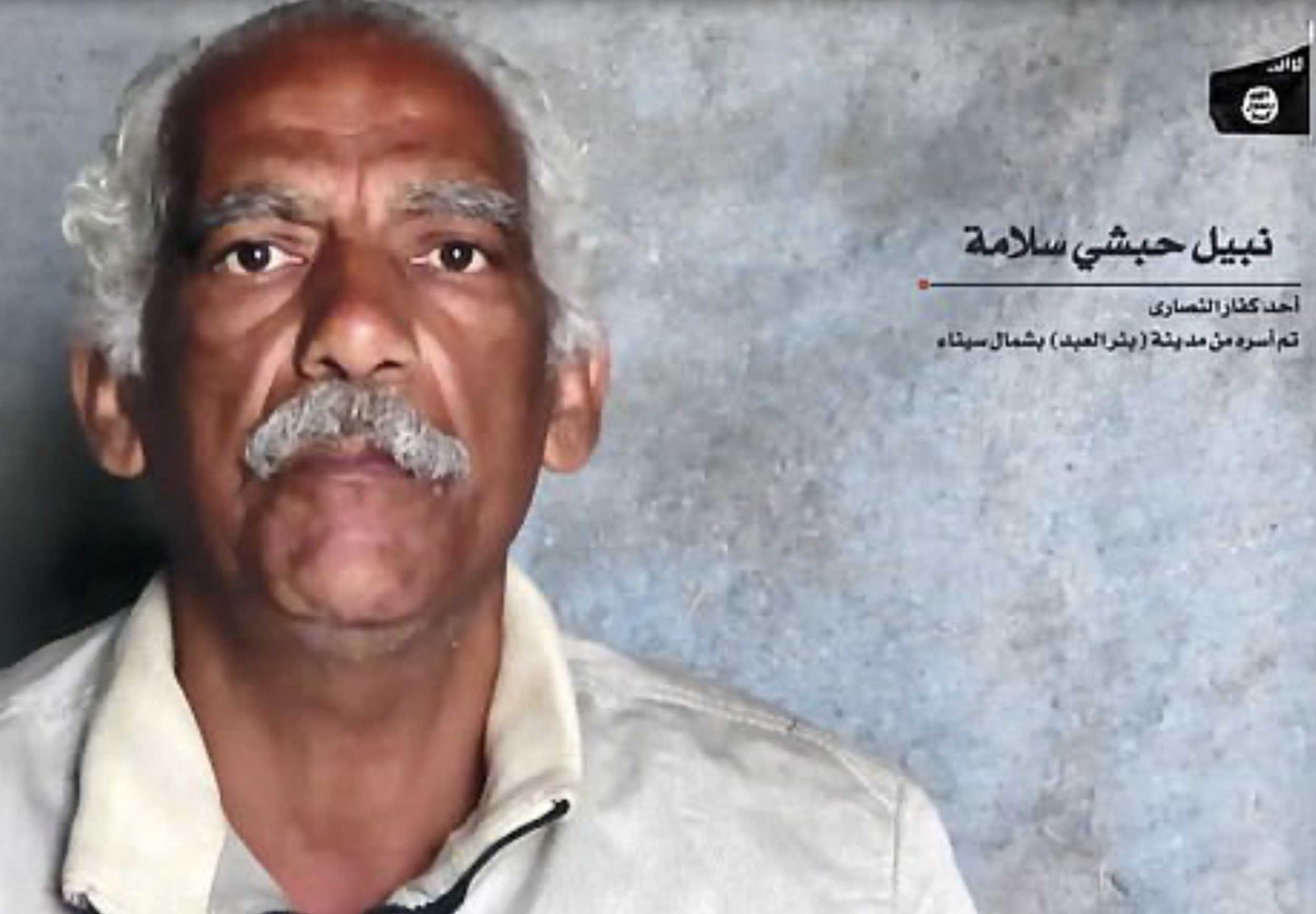
Let’s spend a moment examining a basic (you would think) file produced by a Google News search for this name — “Nabil Habashi Salama.”

Who is this man in the news? Simply stated, he is the latest Coptic Orthodox Christian killed by ISIS.

Does his death matter? Alas, this appears to be a political question, one that shapes basic journalism decisions about what stories are worthy of mainstream coverage.

First things first: Here is the overture of a report about his death published at Christianity Today. The headline: “ISIS Executes Christian Businessman Kidnapped in Egypt’s Sinai.”

The Islamic State has claimed another Christian victim. And Egypt’s Coptic Orthodox Church has won another martyr.

“We are telling our kids that their grandfather is now a saint in the highest places of heaven,” stated Peter Salama of his 62-year-old father, Nabil Habashi Salama, executed by the ISIS affiliate in north Sinai.

“We are so joyful for him.”

The Salamas are known as one of the oldest Coptic families in Bir al-Abd on the Mediterranean coast of the Sinai Peninsula. Nabil was a jeweler, owning also mobile phone and clothing shops in the area. Peter said ISIS targeted his father for his share in building the city’s St. Mary Church.

In a newly released 13-minute propaganda video entitled The Makers of Slaughter (or Epic Battles), a militant quotes the Quran to demand the humiliation of Christians and their willing payment of jizya — a tax to ensure their protection.

Now, what is Christianity Today?


Please respect our Commenting Policy

Zero objectivity: Seattle Times report on Franklin Graham-backed police dinner hits new low

Seattle is in trouble.

People don't feel safe taking their kids into downtown Seattle, even the public parks (they support through taxes). The place is dirty. Mentally ill people wander about. Drug use and crime and widespread. And in the middle of it all are the demoralized Seattle police, who saw one of their precinct stations closed by rioters for three weeks last summer during the infamous CHOP occupation.

So, you’d think that an event honoring these same police would get some good press.

Not so fast. According to the Seattle Times:

The invitation to a free dinner at a four-star hotel in Bellevue starts out by thanking law enforcement officers for their bravery and service and goes on to promise an uplifting message, fellowship and practical wisdom from God’s word.

That invitation showed up in the inboxes of Seattle Police Department employees on Wednesday, according to a copy of the department wide email obtained by The Seattle Times. On Friday, police Chief Adrian Diaz revoked the email invitation because the dinner, billed as a law-enforcement appreciation event, is reportedly hosted by the Billy Graham Evangelistic Association. The invitation was signed by the association’s CEO, Franklin Graham, a conservative, second-generation Christian televangelist who has a history of opposing LGBTQ rights.

Some of you may remember that Graham got negative press treatment this time a year ago for setting up a tent in Central Park that had the temerity to treat COVID-19 patients. Largely ignored was the fact that a local health organization, Mount Sinai Health System, contracted with Graham to set up the tent. Most reports in the local media made it sound like it was as if Adolf Hitler had set up shop.

Despite his organization’s policy that only the caregivers, not the recipients of care, affirm centuries of Christian doctrine that marriage is only between a man and a woman, Graham was demonized as an anti-gay bigot. He couldn’t win; if he didn’t help out, he was neglecting the masses; if he did, he was imposing his beliefs on others.

I am curious if the Seattle Times reporter read this New York Times interview with Graham that said that New York City’s Commission on Human Rights found no evidence that Graham had discriminated against patients and included a link from the editor of a Jewish publication slamming local politicians for their own bigotry.

Now we’re moving the media-bias battle to Seattle. Back to the Times:

The email to SPD employees was sent by the department’s Wellness Unit after being approved by the unit’s lieutenant, according to the original email.

Diaz sent his own department-wide email just after 4:30 p.m. Friday and a message was posted on the department’s online blotter, stating that based on “Graham’s history and affiliations,” concerns had been raised that SPD does not fully support the community’s LGBTQ members.

The article then runs through the usual PR comments by various police officials, a withering quote by Seattle City Council President M. Lorena González (thanks to the council’s defund-the-police actions, a record number of 144 officers have left in the past year), an angry police officer (no doubt the source for the email being forwarded to the Times), an openly gay police officer and so on.

As someone who lives in the Seattle suburbs, the hypocrisy of it all stuns me. Here’s a city that’s overrun with homeless, whose tents are smack in the middle of major tourist attractions (like the city’s gorgeous waterfront), plus crime is surging and even Amazon is decamping for neighboring Bellevue and the media-friendly culture warriors are upset about this?

The police officers are telling local TV stations they are refusing to work for “this socialist city council” and when an outside organization tries to hold an appreciation dinner for the stoic officers who remain, the best the Seattle Times can do is a one-sided report?

Contrasted to the five sources that trashed Graham and his organization, the Times ran no balancing quotes from any local leaders who would offer an opposing point of view.

A sentence saying that Graham’s group didn’t answer an email sent the day before doesn’t cut it. The sponsoring Billy Graham Evangelistic Association is based in Charlotte, N.C., which is three time zones ahead of Seattle. The chances are good that the email arrived too late for anyone in charge to take a look.

Plus, when the reporter can’t find a quote from a prime source, she’s supposed to look for one from a secondary source. Evangelical organizations and churches do exist in Seattle and I can’t believe she couldn’t find a pastor in one of them who could have offered some kind of defense for Graham. Sadly, the Times did away with its religion beat years ago, so apparently the newsroom has no one with the local religious contacts.

Hint: There are plenty of evangelical organizations in town: (World Relief, Union Gospel Mission, Seattle Pacific University, Northwest University for starters) who’ve got talking heads. Start cultivating them.

To get right to the point: The Fellowship of Christian Peace Officers has a Seattle affiliate. I found a contact name and phone number in less than 30 seconds.

Plus, Graham himself recorded a video several months ago explaining why he wants to do these police appreciation dinners in places like Seattle, Portland and Kenosha, Wisc. Surely, a quote could have been lifted from that.

But no. Here we see “Kellerism,” a term created by a GetReligion reader after former New York Times editor Bill Keller implied in a speech there’s no need for balance or fairness when the reporting is about morality, culture, religion, etc. You can read the Keller quotes for yourself right here.

To find the other side of the story, I didn’t need to look much harder than this column by KTTH Radio show host Jason Rantz, who said that Gonzalez’ anti-cop views were at the base of it all. He said in part:

Gonzalez frames her concern over LGBTQ issues, calling out Graham’s religious views as anti-gay. But her concerns are contrived. This is about getting in the way of supporting police officers. In the process, she wins some plaudits from anti-police activists upset she hasn’t done enough to abolish the police.

The event is free for law enforcement officers. It offers appreciation for the work law enforcement does in a city where the Council and a loud activist community turn cop-hating into a sport. It’s also religious in nature, as the invite promises an “uplifting message, encouraging and practical wisdom from God’s Word, live music, and fellowship with other law enforcement officers.”

But because of its religious nature, and Graham’s religious objection to gay marriage, Gonzalez feigned outrage.

Now what the Times and the above column did add is that the event was sponsored by the Billy Graham Evangelistic Association, not by Franklin Graham’s organization Samaritan’s Purse. Yes, the younger Graham signed the invite, but that was his only involvement. But folks out here in western Washington are going to punish him if that’s the last thing they do. The dinner will occur in mid-May and The Stranger, a local lefty site, is encouraging folks to bring their cameras and take photos of whichever police officers decide to attend.

But hey, doxxing is OK when the group is related to Franklin Graham.

I get that journalists can’t help the craziness that reigns in the Emerald City at present. But when it comes to reporting on something like this, at least try — try to include an opposing point of view. Show some respect for people on both sides of public debates. It’s called “journalism.”

I know it’s a stretch. But it can be done. Trust me.


Please respect our Commenting Policy