LGBTQ

Want to trigger Episcopalians? Ask an evangelical superstar to preach at National Cathedral

Want to trigger Episcopalians? Ask an evangelical superstar to preach at National Cathedral

Halfway between Norway and the North Pole, scientists have buried a million seeds and crop samples under a mountain in the Svalbard archipelago -- in case an environmental doomsday comes to pass.

That strategy rings true during "this crazy, chaotic season" when so many are anxious about the coronavirus pandemic, global warming, lost jobs, surging debts and the bitter state of public life, said evangelical megachurch leader Max Lucado, in a recent sermon streamed online by the National Cathedral in Washington, D.C.

“Most of us can't hide out in a bunker, yet threats of calamity may make us try to do so," he said. "If the wrong person pushes the wrong red button -- it's enough to make a person purchase a plane ticket to Svalbard."

But there was a problem. While pre-service publicity stressed that Lucado's books have sold more than 120 million copies and Christianity Today has called him "America's pastor," this invitation alarmed legions of Episcopalians opposed to his history of orthodoxy on sex and marriage. His sermon about God offering comfort in the midst of chaos avoided hot-button topics, but his cathedral appearance triggered an online storm.

Before the event, the Very Rev. Randolph Marshall Hollerith linked the Lucado invitation to the cathedral's history of hosting a variety of religious leaders. This has included evangelicals such the late Billy Graham, Archbishop of Canterbury Justin Welby and megachurch leader Rick Warren of Saddleback Church in Southern California.

"When we only engage with those with whom we agree on every issue, we find ourselves in a dangerous (and lonely) place," wrote the cathedral's dean. "That means this cathedral, and this pulpit, are big enough and strong enough to welcome pastors, rabbis, imams, clergy of every faith. … It does not mean we agree with everything they might believe, but it does mean that we exhibit and inhabit a sense of open handed welcome."

However, Hollerith issued a formal apology in response to the online backlash, noting: "In my straight privilege I failed to see and fully understand the pain he has caused. I failed to appreciate the depth of injury his words have had on many in the LGBTQ community. I failed to see the pain I was continuing. I was wrong."

While Lucado is known as an evangelical moderate, Episcopalians were outraged by a 2004 sermon, and online commentary, stating that he "categorically opposes" gay marriage, as well as his conviction that "homosexual activity" is sin.
Please respect our Commenting Policy

Ryan Burge day: Political tensions rise as secularism grows (yet faith numbers stay strong)

Ryan Burge day: Political tensions rise as secularism grows (yet faith numbers stay strong)

Anyone who has followed GetReligion for nearly two decades knows that we have — over, and over, and over — stressed that the safe middle ground in American life seems to be vanishing.

This is true in religion and it is certainly true in politics.

Now, journalists and news consumers can prepare to dig into two books related to these trends — both linked to the work of names that will be familiar to GetReligion readers.

The first, by GetReligion contributor Ryan Burge, is entitled, “The Nones: Where They Came From, Who They Are, and Where They Are Going.” It will hit the market March 9th. We will come back to Burge in a moment, with links to some of his omnipresent charts and commentary.

The second book is entitled, “Secular Surge: A New Fault Line in American Politics,” and it was written by David Campbell, Geoffrey C. Layman and (here’s the familiar name to most GetReligion readers) John C. Green.

Yes, that John C. Green, the man from the 2007 seminar at the Washington Journalism Center who told a circle of journalists from around the world about emerging research about “religiously unaffiliated” Americans and how this would impact politics and, in particular, the shape of the Democratic Party. The line-graph he sketched on our write-on-wall that day was a foretaste of the stunning 2012 Pew study on the rapid rise of the “nones.”

The key was that the “nones” were the natural political partners of secular voters and believers in the shrinking world of the Religious Left. At some point, however, he said there would be tensions with moderate and even conservative Democrats in the Black church and in Hispanic pews, both Catholic, evangelical and Pentecostal. As I wrote in an On Religion column:

The unaffiliated overwhelmingly reject ancient doctrines on sexuality with 73 percent backing same-sex marriage and 72 percent saying abortion should be legal in all, or most, cases. Thus, the “Nones” skew heavily Democratic as voters — with 75 percent supporting Barack Obama in 2008. The unaffiliated are now a stronger presence in the Democratic Party than African-American Protestants, white mainline Protestants or white Catholics.

“It may very well be that in the future the unaffiliated vote will be as important to the Democrats as the traditionally religious are to the Republican Party,” said Green, addressing the religion reporters. “If these trends continue, we are likely to see even sharper divisions between the political parties.”


Please respect our Commenting Policy

Joe Biden era puts transgender rights atop newsroom agendas (which creates religion news)

Joe Biden era puts transgender rights atop newsroom agendas (which creates religion news)

Among American "social issues," freedom of abortion is long-settled as a matter of law, so foes largely nibble at the edges. Courtroom victories for gays and lesbians have put dissenters on the defensive seeking to protect conscience claims.

Meanwhile, in the Biden-Harris era the transgender debate -- emotion-laden, multi-faceted and religiously weighty -- is moving to the top of the news agenda. {The Guy admits at the start he brings no psychological insight to this complex terrain and has personal knowledge of only two such situations.}

Democrats' zeal is the major new factor. President Joe Biden has said that he believes "transgender equality is the civil rights issue of our time. There is no room for compromise." Last year, Donald Trump appointee Neil Gorsuch made the case for "gender identity" rights in the Supreme Court's Bostock ruling, but this covered only secular employment. During his first hours in office, President Biden issued an executive order that extends this outlook across the board.

The president declared, for instance, that school kids shouldn't have to worry about their "access to the restroom, the locker room, or school sports," nor should adults be mistreated "because how they dress does not conform to sex-based stereotypes." He directed each government agency to spend the next 100 days reframing all gender policies accordingly.

Los Angeles Archbishop Jose Gomez, elected leader of the U.S. Conference of Catholic Bishops, immediately responded that on this and other matters like abortion, America's second Catholic president "would advance moral evils and threaten human life and dignity." Chicago's Cardinal Blasé Cupich assailed Gomez's Inauguration Day statement as "ill-considered." (Click here for GetReligion post and podcast on this topic.)

Then New York's Cardinal Timothy Dolan and four other chairmen of bishops' committees jointly declared that by reaching beyond the Supreme Court ruling Biden "needlessly ignored the integrity of God's creation of the two complementary sexes, male and female," and threatened religious freedom. This protest echoed the 2019 Vatican pronouncement "Male and Female He Created Them (.pdf here).”

A second Biden executive order Feb. 4 defined the new "LGBTQI+" approach in U.S. foreign policy. He directed 15 Cabinet departments and agencies to press other countries to comply with America's new stance, using diplomacy and, as needed, financial sanctions or visa restrictions. The State Department is to report annually on problem nations.


Please respect our Commenting Policy

New podcast: Are tensions between Speaker Pelosi and her archbishop a valid news story?

New podcast: Are tensions between Speaker Pelosi and her archbishop a valid news story?

The following is not a hypothetical case or a parable. This is the heart of the news story that was the hook for this week’s “Crossroads” podcast (click here to tune that in).

Step one: Speaker Nancy Pelosi was a guest on Hillary Clinton’s “You and Me Both” podcast. As you would expect, since this was recorded a week after the stunning January 6th attack on the U.S. Capitol, they spent some time discussing their views on the Donald Trump years.

This led to a discussion about the choices made by pro-life voters in the 2016 election. Here is some crucial material from a Catholic News Agency story about the exchange.

… House Speaker Nancy Pelosi (D-Calif.) said that support of pro-life voters for former President Donald Trump was an issue that “gives me great grief as a Catholic.”

“I think that Donald Trump is president because of the issue of a woman’s right to choose,” she said of abortion, implying that pro-life voters boosted Trump to victory in 2016. She added that these voters “were willing to sell the whole democracy down the river for that one issue.”

Other than the “sellout” implication, the key phrase there is “as a Catholic.”

Step two: The archbishop who — canonically speaking — is charged with overseeing Pelosi’s life as a Catholic believer was not amused by this assertion. Here is another chunk of that CNA report.

“No Catholic in good conscience can favor abortion,” said Archbishop Salvatore Cordileone of San Francisco, Pelosi’s home diocese. … “Our land is soaked with the blood of the innocent, and it must stop.”

Pelosi has long supported abortion despite her Catholic faith. In 2008, she said on NBC’s “Meet the Press” regarding when life begins, “over the centuries, the doctors of the church have not been able to make that definition.” She said that her Catholic faith “shouldn’t have an impact on a woman’s right to choose.” …

Archbishop Cordileone clarified that "Nancy Pelosi does not speak for the Catholic Church. … And on the question of the equal dignity of human life in the womb, she [Pelosi] also speaks in direct contradiction to a fundamental human right that Catholic teaching has consistently championed for 2,000 years.” …

Step three: Write a mainstream news story?


Please respect our Commenting Policy

Inauguration Day showdown: U.S. Catholic bishops remain divided on 'McCarrick doctrine'

Inauguration Day showdown: U.S. Catholic bishops remain divided on 'McCarrick doctrine'

Speaking to an Italian family association in 2018, Pope Francis compared the abortion of children with genetic problems to "what the Nazis did to purify the race. Today, we do the same thing but with white gloves."

A year later, Francis bluntly asked a journalist from Mexico if it's "fair to eliminate a human life in order to solve a problem? The answer to which is, 'No.' Second question: Is it fair to pay a sniper to solve a problem? No. Abortion is not a religious problem. … It is a problem of eliminating a human life. Period."

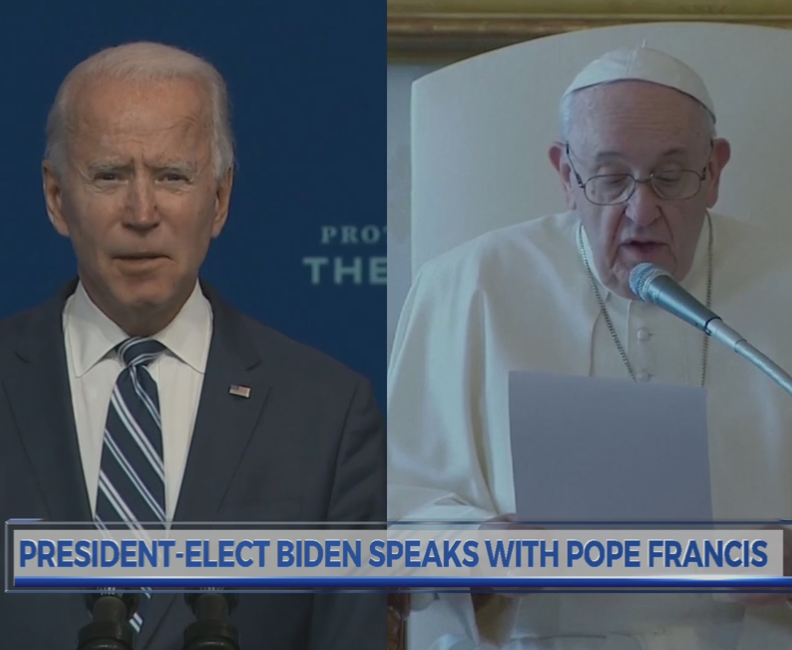
But the pope was careful in his Inauguration Day message to America's second Catholic president, assuring Joe Biden that he would "pray that your decisions will be guided by a concern for building a society marked by authentic justice and freedom, together with unfailing respect for the rights and dignity of every person, especially the poor, the vulnerable and those who have no voice."

The pope's text was examined closely after reports that the Vatican -- on behalf of progressive American bishops -- tried to stop the circulation of a sobering statement from the president of the U.S. Conference of Catholic Bishops. The letter from Archbishop Jose Gomez of Los Angeles addressed the challenge, and blessing, of working with "our first president in 60 years to profess the Catholic faith."

Clearly, Biden's piety had offered "solace in times of darkness and tragedy," said Gomez, leader of America's largest diocese and a crucial voice among Hispanic Catholics. He also praised Biden's "longstanding commitment to the Gospel's priority for the poor."

Nevertheless, Gomez noted that "our new President has pledged to pursue certain policies that would advance moral evils and threaten human life and dignity, most seriously in the areas of abortion, contraception, marriage, and gender. Of deep concern is the … the freedom of believers to live according to their consciences."

Cardinal Blasé Cupich of Chicago fired back on Twitter, attacking this "ill-considered statement on the day of President Biden's inauguration" while claiming "there is seemingly no precedent" for this action by Gomez.

The Pillar, a Catholic news website, reported that the Vatican Secretariat of State intervened to "spike" the statement from the U.S. bishops after objections from Cupich, Cardinal Joseph Tobin of Newark and some other bishops.


Please respect our Commenting Policy

Skeptical thinking (from left) about role of religion in President Joe Biden's big day

Skeptical thinking (from left) about role of religion in President Joe Biden's big day

Back in the early days of GetReligion (we launched on Feb. 2, 2004) I urged reporters not to forget the old Religious Left and, when covering believers in those flocks, not to forget that there is more to their stories than politics. The left is the left because of doctrinal and worship traditions, as well as convictions that align with the New York Times editorial page.

Then something happened that modified my thinking on this subject. Hang in there with me, because I am working my way to an interesting think piece, care of Religion Dispatches. The headline: “The Inauguration’s Beautiful Call for Unity Was Undermined by the Invocation of Religion.”

Faithful readers of GetReligion will remember that, in the summer of 2007, political scientist and polling maven John C. Green spoke at a Washington Journalism Center seminar to a international circle of journalists who came to Capitol Hill to discuss press freedoms in their homelands. But the hot topic of the day was the rise of Sen. Barack Obama of Illinois and whether he could reach the White House. As I wrote in a previous post about that:

The bottom line: Obama was speaking directly to Democrats in the black church, but he was also reaching out to an emerging power bloc in his party — a group Green called the “religiously unaffiliated.” These so-called “nones” were poised to form a powerful coalition with atheists, agnostics and liberal believers.

Green made a prediction that was years ahead of schedule, in terms of the conventional thinking of Beltway politicos. At some point in the future, that growing coalition of secularists and religious liberals was going to cause tensions inside the Democratic Party.

Five years later, when the Pew Forum released its groundbreaking report on religiously unaffiliated Americans, Green raised that issue once again in a public event. Here’s a bite of the “On Religion” column that I wrote at that time.

[The] unaffiliated overwhelmingly reject ancient doctrines on sexuality with 73 percent backing same-sex marriage and 72 percent saying abortion should be legal in all, or most, cases. Thus, the "Nones" skew heavily Democratic as voters — with 75 percent supporting Barack Obama in 2008. The unaffiliated are now a stronger presence in the Democratic Party than African-American Protestants, white mainline Protestants or white Catholics.

"It may very well be that in the future the unaffiliated vote will be as important to the Democrats as the traditionally religious are to the Republican Party,” said Green, addressing the religion reporters. "If these trends continue, we are likely to see even sharper divisions between the political parties."

This brings us to Biden, today’s Democratic Party and some of the challenges he faces, when dealing with moral, cultural and religious issues in American life.


Please respect our Commenting Policy

America remains bitterly divided: But is this country veering closer to another civil war?

America remains bitterly divided: But is this country veering closer to another civil war?

Call it the "Texit" parable.

America's new civil war begins with the Supreme Court overturning Roe v. Wade, creating an abortion-free zone in the Bible Belt and most heartland states.

Enraged Democrats pledge to end the U.S. Senate filibuster and expand the number of high-court justices. After restoring Roe, they seek single-payer health care, strict gun control and sweeping changes in how government agencies approach the First Amendment, with the IRS warning faith groups to evolve -- or else -- on matters of sexual identity. Big Tech begins enforcing the new orthodoxy.

Conservatives rebel and liberals soon realize that most of America's military, including nuclear weapons, are in rebel territory. Then federal agents kill Alabama's pro-life, Black governor -- while trying to arrest him as a traitor. That's too much for Gov. Francisco Gonzalez of Texas, who decides that it's time for a new republic.

David French fine-tuned this "Texit" vision early in 2020, while finishing "Divided We Fall: America's Secession Threat and How to Restore Our Nation." Best-known as a #NeverTrump conservative pundit, most of the Harvard Law graduate's career has focused on old-school First Amendment liberalism -- which in recent decades has meant defending conservative religious believers in religious liberty cases.

The book's first lines are sobering, especially after recent scenes on Capitol Hill.

"It's time for Americans to wake up to a fundamental reality: the continued unity of the United States cannot be guaranteed," wrote French. Right now, "there is not a single important cultural, religious, political, or social force that is pulling Americans together more than it is pulling us apart."

Americans are divided by their choices in news and popular culture. America remains the developing world's most religious nation, yet its increasingly secularized elites occupy one set of zip codes, while most traditional religious believers live in another. In politics, more and more Democrats are Democrats simply because they hate Republicans, and vice versa.

Ironically, cultural conservatives now find themselves hoping that the Supreme Court will protect them, said French, reached by telephone. Conservatives know they have lost Hollywood, academia, America's biggest corporations, the White House and both houses of Congress.

"I constructed the Texit scenario around court packing because that has become their last firewall," said French.


Please respect our Commenting Policy

New podcast: Why the infamous 'McCarrick doctrine' haunted U.S. Catholic bishops this week

New podcast: Why the infamous 'McCarrick doctrine' haunted U.S. Catholic bishops this week

It was a great week to be a Cardinal Theodore McCarrick Catholic.

Now, before anyone gets mad, let me stress that the McCarrick mentioned during this week’s “Crossroads” podcast (click here to tune that in) was not the “Uncle Ted” McCarrick known for bunking with seminarians or the trusted priest or bishop accused of fondling teen-aged boys from families that trusted him.

No, it was Cardinal McCarrick, the consummate networker, trusted fundraiser, ecclesiastical kingmaker and media manipulator. This was the man who, as archbishop of Washington, D.C., created the so-called “McCarrick Doctrine” that protected national-level Catholic politicians whose faith was a crucial part of their lives and images, even if many ancient doctrines didn’t mesh well with their political agendas. This McCarrick also claimed — in a public speech — to have helped elect Pope Francis.

This was the McCarrick whose legacy helped shape the remarkable war inside the U.S. Conference of Catholic Bishops that jumped into clear view on Inauguration Day.

It was easy to see this coming. I wrote about it several weeks ago in this “On Religion” column: “Joe Biden and the U.S. Catholic bishops — Tensions remain about Holy Communion.” And Catholic-press veteran J.D. Flynn clearly knew something big was coming when, a day before the Biden inauguration, he wrote an analysis — “Biden and the bishops. This probably will not go well” — for his new (and essential) website called The Pillar. Check out this lede:

Shortly after President Joe Biden begins his term of office, the U.S. bishops will be derided as culture warriors and abortion obsessives, unwilling to find common ground with the administration of the second Catholic U.S. president.

Sure enough, the elected leader of America’s Catholic bishops issued a letter (hold that thought) criticizing Biden’s actions supporting abortion rights, while hinting at clashes over religious liberty (Hello, Little Sisters of the Poor) and church doctrines on marriage and sex.

This drew an angry social-media response from Catholic progressives — including key men wearing red hats. Their outcry led to this headline in The Washington Post: “As Biden is sworn in, president of U.S. bishops assails him over abortion.”

In a bombshell report, The Pillar noted that the Vatican tried to ban the distribution of the USCCB statement by Gomez — at least until team Pope Francis could release a more politically nuanced letter. That headline: “Vatican intervened to spike US bishops’ Biden statement release.”

But back to the Post. The overture for that report says exactly what one would expect it to say:


Please respect our Commenting Policy

Yearenders-palooza: Ryan Burge (Who else?) charts religion and politics in #2020

Yearenders-palooza: Ryan Burge (Who else?) charts religion and politics in #2020

We now know, apparently, what happens if you force political scientist Ryan Burge into lockdown — but leave the WiFi turned on.

You end up with lots and lots and lots of charts, with most of them focusing on the major role that religion plays in politics and the American public square, in general.

Burge’s work was all over the place during 2020, with good cause. He’s a contributor here at GetReligion, but we keep stressing that journalists (and news consumers) really need to follow his active Twitter feed and his work at the weblog Religion In Public. Here in that blog’s “Year in Review” feature.

Anyway, I wrote Burge and asked him to send me several crucial bytes of his work from 2020, with some quick commentary. You will see that below. I have always appreciated the fact that Ryan’s work tends to poke at stereotypes on the left and the right.

I also asked him for his take on the Top 10 religion-beat news stories and trends of 2020, using the full list of options provided at the start of the Religion News Association poll. I have already offered my own take on that poll here in an “On Religion” column and then here, in a “Crossroads” podcast.

Burge’s commentary on that poll is at the end of this post.

So let’s get started, with Burge’s charts and commentary.


Please respect our Commenting Policy