Catholicism

U.S. bishops, recent popes, Ted McCarrick and the soul of House Speaker Nancy Pelosi

U.S. bishops, recent popes, Ted McCarrick and the soul of House Speaker Nancy Pelosi

After fierce closed-door debates about President Joe Biden and Holy Communion, the U.S. Conference of Catholic Bishops managed to release a muted document last fall that did little to please activists on either side of the church's wars about abortion and politicians in pews.

But one passage in "The Mystery of the Eucharist in the Life of the Church" turned into a ticking clock in the Archdiocese of San Francisco, setting the stage for the current clash between Archbishop Salvatore J. Cordileone and a member of his flock -- House Speaker Nancy Pelosi.

"It is the special responsibility of the diocesan bishop to work to remedy situations that involve public actions at variance with the visible communion of the Church and the moral law," noted the bishops. "Indeed, he must guard the integrity of the sacrament, the visible communion of the Church, and the salvation of souls."

Cordileone's diocese includes the 12th Congressional District of California. After six private attempts to reach Pelosi, he released a May 20 statement telling her that "you are not to present yourself for Holy Communion and, should you do so, you are not to be admitted to Holy Communion, until such time as you publicly repudiate your advocacy for the legitimacy of abortion and confess and receive absolution of this grave sin in the sacrament of Penance."

The archbishop built his case with quotes from Pope Francis, Pope St. John Paul II and the now-retired Pope Benedict XVI, as well as Canon law stating that Catholics who "obstinately persist in manifest grave sin" are "not to be admitted to Holy Communion."

The speaker's words and actions, he added, suggest she isn't worrying about papal authority. Pelosi, the mother of five children, recently told the Seattle Times that the "personal nature of this is so appalling, and I say that as a devout Catholic. They say to me, 'Nancy Pelosi thinks she knows more about having babies than the pope.' Yes, I do. Are you stupid?"

Please respect our Commenting Policy

U.S., world religious press suffers big hit with plans to shutter Catholic News Service

U.S., world religious press suffers big hit with plans to shutter Catholic News Service

The Catholic press — in print, online and television — is one of the most active and vibrant sources of news about trends and current events in U.S. Catholic life and the Catholic world as a whole.

It is often well-funded and essential to understanding Catholicism, but the changing journalism landscape — spurred on by the Internet — has made it tough for religious media to thrive, even if they have large and loyal audiences.

But, as we are seeing in the news market as a whole, readers are becoming more and more loyal to news sources with strong editorial points of view linked to the wide rifts in American Catholicism. This makes it hard for journalists to speak to readers on both sides.

This trend manifested itself recently with the pending closures of two highly venerated and popular Catholic news organizations: Catholic News Service and Catholic New York.

Catholic New York was one of those publications that used CNS stories. That’s one thing that connected the two. The other was that both news organizations were run by the church hierarchy.

CNS, founded in 1920, is a wire service with reporters and editors that write up stories for subscriber newspapers across the country. The other, Catholic New York, was the official newspaper of the archdiocese and one of the largest of its kind in the country in terms of geographical reach and circulation.

CNS announced two weeks ago that it was shutting down a main part of its operation in “a dramatic reorganization of its communications department” — including the closure of the Washington, D.C., and New York offices.

In meetings with newsroom staff, James Rogers, the chief communications officer of the United States Conference of Catholic Bishops, said the Washington office would be closed at year’s end. The Rome bureau will remain open and continue to report on the Vatican.


Please respect our Commenting Policy

Top U.S. evangelical seminaries, and seminaries in general, face critical financial issues

Top U.S. evangelical seminaries, and seminaries in general, face critical financial issues

On Memorial Day weekend in 1944 an adventurous group of evangelical Protestants filled the rented Orchestra Hall to launch "Chicagoland Youth for Christ."

The preacher for that day was an unknown greenhorn from a modest suburban church, the Rev. Billy Graham by name. Soon Youth For Christ was staging rallies every week at the Michigan Avenue musical shrine, with Graham as its first full-time evangelist. On Memorial Day weekend 1945, an even more audacious breakthrough event drew 60,000 or more to Soldier Field.

What was the origin of America's oft-rambunctious, complex and remarkably successful evangelical Protestant movement as we have come to know it?

Some will cite the 1942 formation of the National Association of Evangelicals by conservatives — including many in mainline Protestant churches — fleeing the old "fundamentalist" brand. But The Guy contends it was those Chicago spectacles leading into a nationwide "parachurch" organization with Graham as its charismatic leader.

The media and their audiences tend to see evangelicalism in terms of star preachers, megachurches, media, music, missions and more recently immersion in Republican political wars. Oh, yes, and scandals.

But the movement cannot possibly be understood apart from its beliefs as propounded by thinkers at graduate-level divinity schools and the students they trained. Their impact has been profound, and global in scope.

Three multi-denominational seminaries led the way, and their current woes — part of negative trends in theological education as a whole — are worth substantive journalistic analysis.

* Fuller Theological Seminary in Pasadena, California was the pioneer, founded in 1947, with Graham as a long-time backer and board member.


Please respect our Commenting Policy

Yes, NPR editors, Holy Communion isn't a semi-Baptist 'symbolic' rite for Catholic believers

Yes, NPR editors, Holy Communion isn't a semi-Baptist 'symbolic' rite for Catholic believers

If you read an early version of the National Public Radio story with this headline — “An archbishop bars Pelosi from Communion over her support for abortion rights” — you may have done a spit take of whatever beverage you were drinking and, thus, damaged your computer keyboard. How much damage does this do to smartphones and iPads? Beats me.

Clearly, some personnel in the NPR newsroom — perhaps pros at the politics desk — need refresher courses on church-history basics. It appears that someone at NPR thinks that Catholic doctrines about the mysteries of Holy Communion are very similar to Baptist beliefs about the ordinance that is usually called the Lord’s Supper.

Let’s start at the beginning.

The Catholic archbishop of San Francisco says that U.S. House Speaker Nancy Pelosi is no longer allowed to receive Communion because of her vocal support for abortion rights.

Salvatore Cordileone, the conservative archbishop, said he'd previously made his concerns known to Pelosi, D-Calif., in an April 7 letter after she promised to codify into federal law the right to abortion established by the Supreme Court in Roe v. Wade. Cordileone said he never received a response from Pelosi.

Here comes the crucial language that launched quite a few tweets, along with several heated emails to GetReligion:

Cordileone notified members of the archdiocese in a letter on Friday that Pelosi must publicly repudiate her support for abortion rights in order to take Holy Communion — a ritual practiced in Catholic churches to memorialize the death of Christ, in part by consuming a symbolic meal of bread and wine.

The key word there is “symbolic.”

That’s a very low-church Protestant word in this context. Ditto for the word “memorialize.”


Please respect our Commenting Policy

Pizza, beer and guys talking books: Lessons from the Hall of Men on the Kansas plains

Pizza, beer and guys talking books: Lessons from the Hall of Men on the Kansas plains

WICHITA, Kan. — The Hall of Men fits the name, with meetings offering beer, cigars, an open bar, some kind of guy food (think pizza) and lots of chatter around a giant wooden table.

But then there are the evening prayers, icons, Bible readings and lectures about authors whose portraits hang in this “Christian speakeasy.” The names include C.S. Lewis, Flannery O’Connor, W.H. Auden, Dorothy Sayers, Fyodor Dostoevsky, J.R.R. Tolkien and many others. Johnny Cash and Bob Dylan are there, as well.

This group has met twice a month for a dozen years and most of the faithful are Orthodox, Catholic and Lutheran, with plenty of evangelicals at special events. The authors honored are selected after an informal process that usually starts during fellowship before and after lectures, with men talking about books that have touched their lives.”

The whole thing is affected by having that bookstore right next door,” said Pastor Geoff Boyle, a Missouri-Synod Lutheran long active in the project. “The man behind the front counter is used to having these conversations and obviously knows all about the books the guys are talking about. The books are right there and, if they’re not, they will be soon.”

“That bookstore” is Eighth Day Books, which draws customers from across the nation to an old three-story house with 46,000 new and used books — 27,000 titles — shelved and stacked anywhere that will hold them, including the basement “Hobbit Hole” packed with children’s literature. The white-haired man behind the counter is owner Warren Farha, an Orthodox believer with family ties to Lebanon.

This isn’t a “Christian bookstore” complete with knick-knacks, inspirational posters and religious self-help books — but “Eighth Day” is a reference to the Resurrection of Jesus.

Farha created the store in 1988 and selects all the books, with the help of an ecumenical network woven into the Eighth Day Institute and its conferences, newsletters, podcasts and groups such as the Hall of Men and the Sisters of Sophia.

“My goal has always been to be fair to the great traditions,” said Farha, in his office in the bookstore’s attic. “We have classics in history, literature, poetry, church history, theology and philosophy – Christian writings through the ages. … I’m always listening to people who GET the template for what we’re doing here.

“Great books from different traditions are on the shelves right next to each other, even if they clash in ways that we need to discuss.”


Please respect our Commenting Policy

Left and right: Where do U.S. religious groups stand on abortion-rights issues?

Left and right: Where do U.S. religious groups stand on abortion-rights issues?

THE QUESTION:

Where do major U.S. religious groups stand on the contentious abortion issue?

THE RELIGION GUY’S ANSWER:

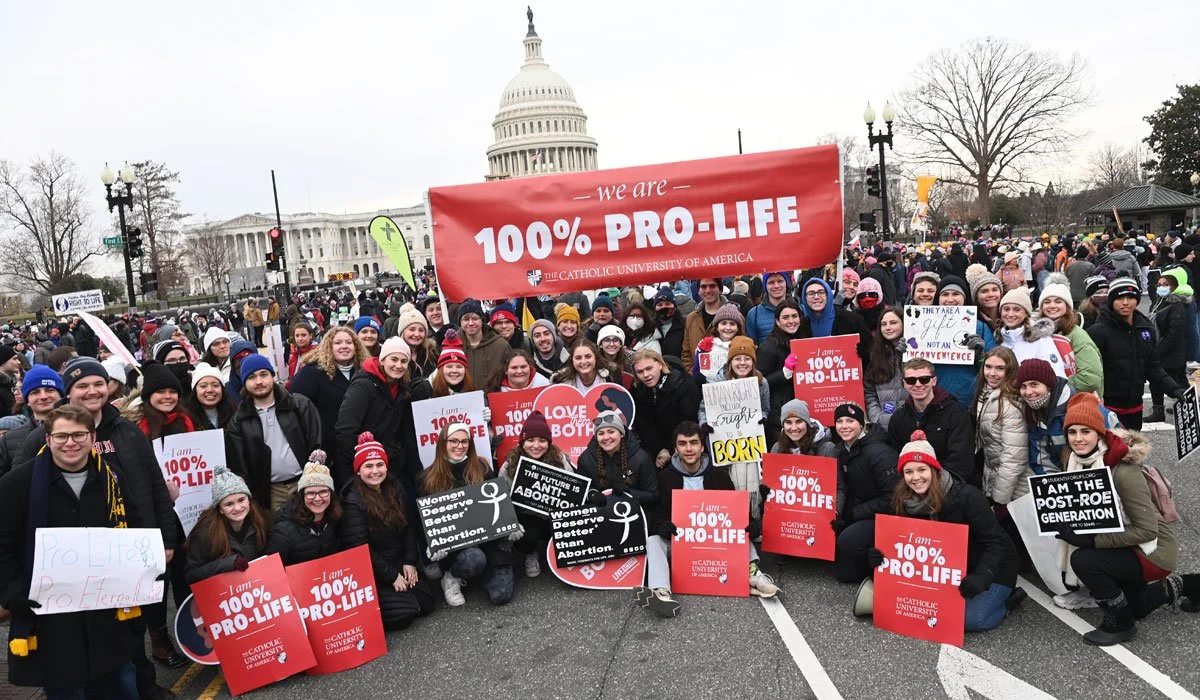
If the U.S. Supreme Court enacts that draft decision leaked to Politico, within weeks abortion policies will be returned to the 50 states for decision, adding to contention. Religious groups often consider the claims of the two lives, mother and unborn fetus, rather than this as simply a woman’s “decisions about her own body” per Vice President Kamala Harris’s formulation. Here are summaries of some major religious views.

It’s well-known that the Catholic Church, the largest religious body in the U.S. (and worldwide), profoundly abhors abortion, A 1965 decree from the world’s bishops at the Second Vatican Council declares that “from the moment of its conception, life must be guarded with the greatest care,” and calls abortion and infanticide “unspeakable crimes” against humanity. The church’s Catechism says the same and dates this belief back to Christianity’s first century (citing Didache 2:2 and Epistle of Barnabas 19:5).

These statements do not permit any exceptions. But a 1993 ruling from the Vatican office on doctrine, approved by Pope John Paul II, allowed removal of a woman’s uterus (hysterectomy) in “medically indicated” cases that “counter an immediate serious threat to the life or health of the mother” even though sterilization results. A 2019 follow-up defined other rare cases. Since abortion is only the directly intended killing of a fetus, some moral theologians would apply this principle when loss of a fetus is a “secondary effect” of necessary surgery.

America’s Eastern Orthodox hierarchy has joined with Catholic leaders to affirm “our common teaching that life begins at the earliest moments of conception” and is “sacred” through all stages of development. However, America’s 53-member Assembly of Canonical Orthodox Bishops acknowledges “rare but serious medical instances where mother and child may require extraordinary actions.”

At the opposite end of the spectrum, the Unitarian Universalist Association (UUA) advocated nationwide abortion on demand fully a decade before the Supreme Court’s Roe v. Wade liberalization, stating that limitations are “an affront to human life and dignity.” It specifically endorsed abortion rights in cases of “grave impairment” of the mother’s “physical or mental health,” a child’s “serious physical or mental defect,” rape or incest, or any “compelling reason — physical, psychological, mental, spiritual or economic.”


Please respect our Commenting Policy

Did the Washington Post profile of Karen Swallow Prior help critics understand her or not?

Did the Washington Post profile of Karen Swallow Prior help critics understand her or not?

It’s hard to do a critique of an elite-media feature about someone who is a real online friend.

But, in this case, there’s an issue that — at least to me — cannot be avoided in the glowing Washington Post religion-desk feature that ran the other day with this headline: “Karen Prior has worked for Roe's overturn for decades. This isn't what she'd hoped to feel.

Most fans of the “Notorious KSP,” I would imagine, loved this piece.

At the same time, I’m sure her worst critics loved it as well — for reasons linked to the journalism issue that I would like to spotlight in this post. It helps to understand that Prior has critics (and friends) who disagree with some things that she says and does and then she has critics that basically don’t want her to exist.

Meanwhile, anyone — worthy critics and supporters — who has followed KSP’s work through the years with any kind of an open mind knows the strength of her logic and (dare I say it) art when defending centuries of Christian doctrines about life issues, as well as marriage and sexuality. But to grasp that side of her life, and how it fits into the total package of her apologetics, people need to actually read or hear her address those topics.

This Post piece focuses, for the most part, on her actions and beliefs that have fueled controversy about her among some evangelicals (like me, she was #NeverTrump #Never Hillary in 2016). A more balanced profile of her would have included quoted material that would have — with good cause — offended, well, most Post readers and editors. Hold that thought, because I will come back to it.

The piece starts with Prior’s feelings of elation at the news that the U.S. Supreme Court appears to be poised to overturn Roe v. Wade.

Prior was shocked and thrilled. But within minutes the deep divisions and differences in priorities among antiabortion advocates came into view. After being put aside for decades as they worked together to overturn Roe, they had become impossible to ignore. While Chief Justice John G. Roberts Jr. took pains to say the leaked opinion may not be the final one, experts on abortion in America say even the potential of Roe’s demise is a turning point for the movement. If Roe falls, what does it mean to be for life now?

For Prior, it means much more than overturning Roe. It means more support for child care and pregnant women as well as supporting sex abuse victims, vaccinating as many people as possible against the coronavirus, and helping start and run an inner-city high school in Buffalo. But not all antiabortion activists agree and lately have begun splintering over next steps, such as whether to classify abortion as homicide and restrict contraception, as well as whether issues outside of reproduction even qualify as part of the “pro-life” cause.

Once again, this is an old, old story that is presented as something essentially new and, thus, linked to COVID-19, the Trump era and all kinds of “now” things. In reality, debates among evangelicals, and especially Catholics, about what it means to be “consistently pro-life” go back to the 1980s or earlier.


Please respect our Commenting Policy

Pro-abortion rights activists hit Catholic churches, but you probably didn't read about it

Pro-abortion rights activists hit Catholic churches, but you probably didn't read about it

If there was ever a doubt that Americans are living in two, separate news universes, then the past two weeks certainly crystallized that reality even more than the polarizing presidential elections of 2016 and 2020.

Americans who lean left politically, comfortable with reading just The New York Times or Washington Post, have been treated to apocalyptic news stories and opinion pieces — it is often hard to tell which is which — stemming from the leak of the draft decision that could overturn Roe v. Wade.

Did you know that gay marriage is now at risk? Did you know that this incarnation of the U.S. Supreme Court is illegitimate? For these elite news organizations and their readers, reversing the right to abortion is just the first attack by fascist Republicans — you wait and see.

On the right, conservatives who watch opinion shows on Fox News Channel or read Brietbart can’t get enough of how President Joe Biden has been an abject failure, particularly when it comes to inflation.

Have you seen how high gas prices are? Did you read about the baby formula shortage? To those news organizations, it’s all about fixing these problems by “owning the libs” by getting the GOP in control of the House and Senate in the November midterm elections.

I have friends on both sides of the political aisle and it’s shocking to me how much one side doesn’t know about what the other is reading and thinking. It often takes weeks for stories that one side repeatedly reported on to ever make it into the pages and onto screens of the other side.

It’s not a failure of our politics. Those have always been polarized. This is a failure of journalism.

Let me explain how these two news universes (while great for the bottom line of news organizations catering to their bases) led to a major news story being totally ignored by many mainstream news sites.

The protests — deemed an issue with “a lot of passion” by the White House — over abortion spilled over into houses of worship, especially Catholic churches. Is the First Amendment right to protest on private property more important than freedom of religion? Not according to the Constitution, and that’s what the news media should be concerned with reporting, not with managing narratives.

It’s therefore not a surprise that pro-abortion rights folks protesting outside churches — and in some cases disrupting Mass — received little to no coverage in most mainstream national news organizations.


Please respect our Commenting Policy

Catholic doctrine has always rejected abortion: But what about Catholics in pews today?

Catholic doctrine has always rejected abortion: But what about Catholics in pews today?

It may be the most important U.S. Supreme Court decision of the last fifty years.

A leaked draft of a majority opinion, written by Justice Samuel Alito, would effectively dismantle the legal framework around abortion that was established in the 1973 decision Roe v. Wade. In its wake, states would have almost complete freedom to regulate abortion however they saw fit, including enacting a total prohibition.

Among those who study American religion and politics, it’s long been established that the earliest political voices seeking to restrict access to an abortion were members of the Catholic Church. For centuries, the catechism has taught that life should be protected at all stages — from conception to natural death. Thus, the tens of millions of American Catholics should be the standard bearers for the pro-life movement in the United States.

But here is an important question for journalists: Will most Catholics applaud the end of Roe? The data tells a nuanced story about how the average Catholic thinks about the issue of abortion access. As always, it’s important to note if polls pay any attention to how often Catholics attend Mass.

Looking back to the time period immediately after the Roe v Wade decision in 1973, it’s clear that the vast majority of Catholics were not comfortable with the concept of a woman obtaining an abortion for any reason, which not was out of step with how the average American felt.

For instance, in 1985 about 35% of Catholics were in favor of abortion demand. It was 39% of the general public. In the 1990s and 2000s, abortion opinion was relatively stable, but then things began to shift in 2010. From that point forward, the share of Catholics who supported abortion began to rise, which paralleled a shift in the overall opinion of the American public.

By 2021, fifty-three percent of Americans supported abortion on demand along with forty-five percent of Catholics. But, it’s worth noting that the contours of the two lines run in almost perfect unison. As the country moved left on abortion, so did the average Catholic.


Please respect our Commenting Policy