Catholicism

Still thinking about Latin Mass wars: With help from The Pillar and America magazine

Still thinking about Latin Mass wars: With help from The Pillar and America magazine

The Latin Mass story is not going away.

At this point, the question is where this emotional and more than symbolic conflict is going.

It’s clear that there is a small flock of traditional Catholics who view the familiar cadences of the Tridentine Rite Mass as an escape from the reforms — some would say modernization efforts — of the Second Vatican Council. But it also obvious that many bishops believe that this is not the case for the majority of the Catholics (especially young Catholics) who prefer the beauty of the Latin Mass.

Meanwhile, it’s clear that many powerful Vatican leaders, including Pope Francis, see use of the traditional Latin Mass as a powerful wedge issue that divides Catholics and they want to see it go away.

The question: Will the renewed efforts to crush the Tridentine create more dissenters, instead of smothering them?

This brings me to this weekend’s “think pieces” — drawn from two very different sources — the progressive Jesuit magazine America and The Pillar, a more conservative news and commentary site.

First, consider this essay at America: “I love Pope Francis’ commitment to dialogue — which is why his Latin Mass restrictions confuse me.”

Author Gregory Hillis begins by praising the Pope Francis encyclical “Fratelli Tutti,” focusing on its call for unity — built on “genuine dialogue rooted in love.”

The big question: Where is the loving dialogue about use of the Latin Mass?

We cannot be closed to others, Pope Francis taught, whether they be political or ideological opponents or whether they be people yearning to find a new life as immigrants. A “healthy openness never threatens one’s identity,” he wrote (FT 148). Too often we deny “the right of others to exist or to have an opinion,” and as a result, “their share of the truth and their values are rejected” (No. 15). Instead, Pope Francis urged us “to give way to a dialogic realism on the part of men and women who remain faithful to their own principles while recognizing that others also have the right to do likewise.” This, he continued, “is the genuine acknowledgment of the other that is made possible by love alone.”

Please respect our Commenting Policy

New podcast: Top Godbeat story of 2021? Look for Jan. 6 religion hooks (#DUH)

New podcast: Top Godbeat story of 2021? Look for Jan. 6 religion hooks (#DUH)

beat stories.

Trust me, I understand that preparing the ballot for this poll is a thankless job. One of the hardest tasks is finding a way to describe some of the broader trends during any given year. It’s easier — most of the time — to describe singular events.

During this week’s “Crossroads” podcast (CLICK HERE to tune that in), host Todd Wilken asked me to describe some of the patterns that I have seen in the RNA poll results through the decades.

Trend No. 1 is clear: Name the biggest political story of the year and look for a religion angle. After all, politics is the true religion of many folks who run newsrooms.

Trend No. 2 works about 76% of the time: What did the pope do this year, especially if it has any implications for U.S. political fights over moral and social issues (see trend No. 1).

Trend No. 3 comes and goes: What did liberal leaders of the Seven Sisters of Mainline Protestantism proclaim about sex and did it cause new revolts that might split their churches? Every now and then, the Southern Baptists slip in with battles over sex, race or politics (newsworthy topics, in other words).

In light of these trends, it was easy to predict that the RNA poll’s top story for 2021 would be:

Religion features prominently during the Jan. 6 assault on the U.S. Capitol by pro-Trump insurrectionists. Some voice Christian prayers, while others display Christian or pagan symbols and slogans inside and outside the Capitol.

That’s actually a careful wording and, in particular, note that the RNA leaders refrained (this must have been hard) from including a reference to “white evangelicals.”

The key, in this description, is the tension between “prominently” and “some,” as in the folks saying “Christian” prayers. It’s safe to assume that this is the rebel that they had in mind (as quoted in one of my “On Religion” columns):


Please respect our Commenting Policy

When is the Midnight Mass? All humor aside, there's history (and news) linked to this rite

When is the Midnight Mass? All humor aside, there's history (and news) linked to this rite

Once upon a time, before the creation of the Internet, there were these very, very powerful and all-knowing professionals known as “church secretaries.” Yes, I know that they have evolved into office managers and web czarinas.

But, long ago, if anyone needed to know something about church life, or really needed to reach the pastor (this is before smartphones, too), they called the “church secretary,” who basically served as an air-traffic-controller for everything happing in the church family.

Back in the 1980s, I wrote a news piece for The Rocky Mountain News (#RIP) about the question that church secretaries in Catholic parishes used to dread hearing over and over during the three or four days ahead of Christmas Eve. That question, of course, was: “When is the Midnight Mass?”

Honest. People would ask that and, truth be told, the Midnight Mass, in some parishes, doesn’t start at midnight. Hold that thought, because we will come back to it.

But this post, in the week before Christmas (for most Christians in America), is about the importance of the Midnight Mass and other Christmas Eve and Christmas services. You see, there are potential news stories here. Let’s discuss several of them, briefly.

First, there is an interesting fact that I learned long ago from the late Lyle Schaller, a Mainline Protestant maven who was an often-quoted expert on church growth and, as the Mainline world imploded, church survival. The easiest way to sum up the Christmas news angle that I learned from him is to share the top of a 2015 tribute column that I wrote about his work (“Lyle Schaller, the church fix-it man in rapidly changing times”):

All pastors know that there are legions of "Easter Christians" who make it their tradition to dress up once a year and touch base with God.

What can pastors do? Not much, said the late, great church-management guru Lyle Schaller, while discussing these red-letter days on the calendar. Rather than worrying about that Easter crowd, he urged church leaders to look for new faces at Christmas.


Please respect our Commenting Policy

Religion's impact on global migrant crisis: RNS concludes that it's Gordian Knot complicated

Religion's impact on global migrant crisis: RNS concludes that it's Gordian Knot complicated

Globalization has been a decidedly mixed bag.

On the plus side, it’s managed to knit diverse people together economically and, to a lesser degree, culturally. But it’s also further divided others along religious, political, race, and class lines.

It’s introduced us to a myriad of once exotic consumer products at relatively cheaper prices (cheaper for many Westerners, that is). Globalization has also brought us fresh ideas and life choices that — while I certainly don’t agree with every new view put forth — has enormously enriched my own life experience.

On the negative side — and this is huge — it’s allowed multi-national corporate boards (and shareholders) to escape the full weight of responsibility for the enormous environmental degradation their decisions have produced in exploited regions thousands of miles distant from their posh corporate headquarters.

Also, let’s not forget the foreign workers, including child laborers, exploited by unscrupulous employers trying to satisfy their Western customers insatiable demands for rock bottom prices.

For the United States and other Western nations, globalization’s complex outcomes has produced still another key Gordian Knot dilemma. I’m referring to the vast numbers of desperate human refugees heading, most often without proper documentation, to the United States, Europe, Australia — and even to neighboring countries that may be only relatively better off.

The latter group includes situations American news media rarely cover. They include Nicaraguans fleeing to Costa Rica and South Africa’s burgeoning refugee population comprised of hopeful immigrants from a variety of sub-Saharan African nations.

Is it any surprise to anyone with a working knowledge of Homo sapiens that we demand globalization’s creature comforts without us wanting to deal with those actual Homo sapiens that globalization has negatively impacted.


Please respect our Commenting Policy

So what is 'Christmas,' anyway? These days, Siri knows more than many believers

So what is 'Christmas,' anyway? These days, Siri knows more than many believers

This question rocks the Internet year after year: Is "Die Hard" a "Christmas movie"?

How about "Frosty the Snowman," "Home Alone," "Elf" or "A Bad Moms Christmas"? Is "A Christmas Story" really a "Christmas" story? What about those Hallmark Channel visions of romance, complicated families and wall-to-wall holiday decorations?

The answer to these questions, and many others, hinges on how Americans answer another question: What is "Christmas"?

Ask that question to an iPhone and Siri will quote Wikipedia: "Christmas is an annual festival commemorating the birth of Jesus Christ, observed primarily on December 25 as a religious and cultural celebration among billions of people around the world."

Most people know that much of the story, according to a new survey by Lifeway Research in Nashville. Nearly 75% of Americans say Jesus was born more than 2,000 years ago in Bethlehem and even more believe that Jesus is the Son of God the Father.

After that, things get fuzzy.

"Lots of people celebrate Christmas, but some have no interest in celebrating the birth of Jesus Christ," said Scott McConnell, executive director of Lifeway. "But even some of the people who do take the Christmas message seriously don't understand what it means. …

"This is a story that hasn't changed for 2,000 years, yet many people struggle to tell the story and get the details right. Many don't know why Jesus was born."


Please respect our Commenting Policy

New podcast: Baptisms are in the headlines, at the moment, for better and for worse

New podcast: Baptisms are in the headlines, at the moment, for better and for worse

Believe it or not, baptism is in the news.

In this case, we have some good news and some bad news.

What do you want to hear first, the good news or the bad news? In this week’s “Crossroads” podcast (click here to tune that in) we went with the good news first.

When I say “good news,” I am referring to a New York Times story that is kind of fun and contains tons of good information. However, this is a story that takes a trend in some of those giant, modernized evangelical megachurches and tries to turn it into a Big Idea piece. Hold that thought.

The headline: “Horse Troughs, Hot Tubs and Hashtags: Baptism Is Getting Wild.” Here is a big block of the thesis material:

Performing the age-old Christian ritual in a more informal style “conveys this isn’t your grandmother’s church,” said Drake Osborn, pastor of teaching and liturgy at Grace Church in Waco, Texas. His congregation moved into a former bowling alley in 2016 but never considered installing a built-in baptistery. Instead, Grace Church uses a foam model bought online for about $2,500.

The shift has taken place as many pre-21st-century symbols of church life have fallen out of fashion in evangelical culture, especially among churches that are expanding or building new facilities. Sanctuaries are now “worship centers,” and steeples and stained glass are out. Natural light is often eschewed in favor of a black-box theater aesthetic optimized for flashy audiovisual experiences and online streaming.

It is not just the architecture that is changing. Contemporary evangelical baptisms are often raucous affairs. Instead of subdued hymns and murmurs, think roaring modern worship music, fist pumps, tears and boisterous cheering. There are photographers, selfie stations and hashtags for social media. One church in Texas calls its regular mass baptism event a “plunge party.”

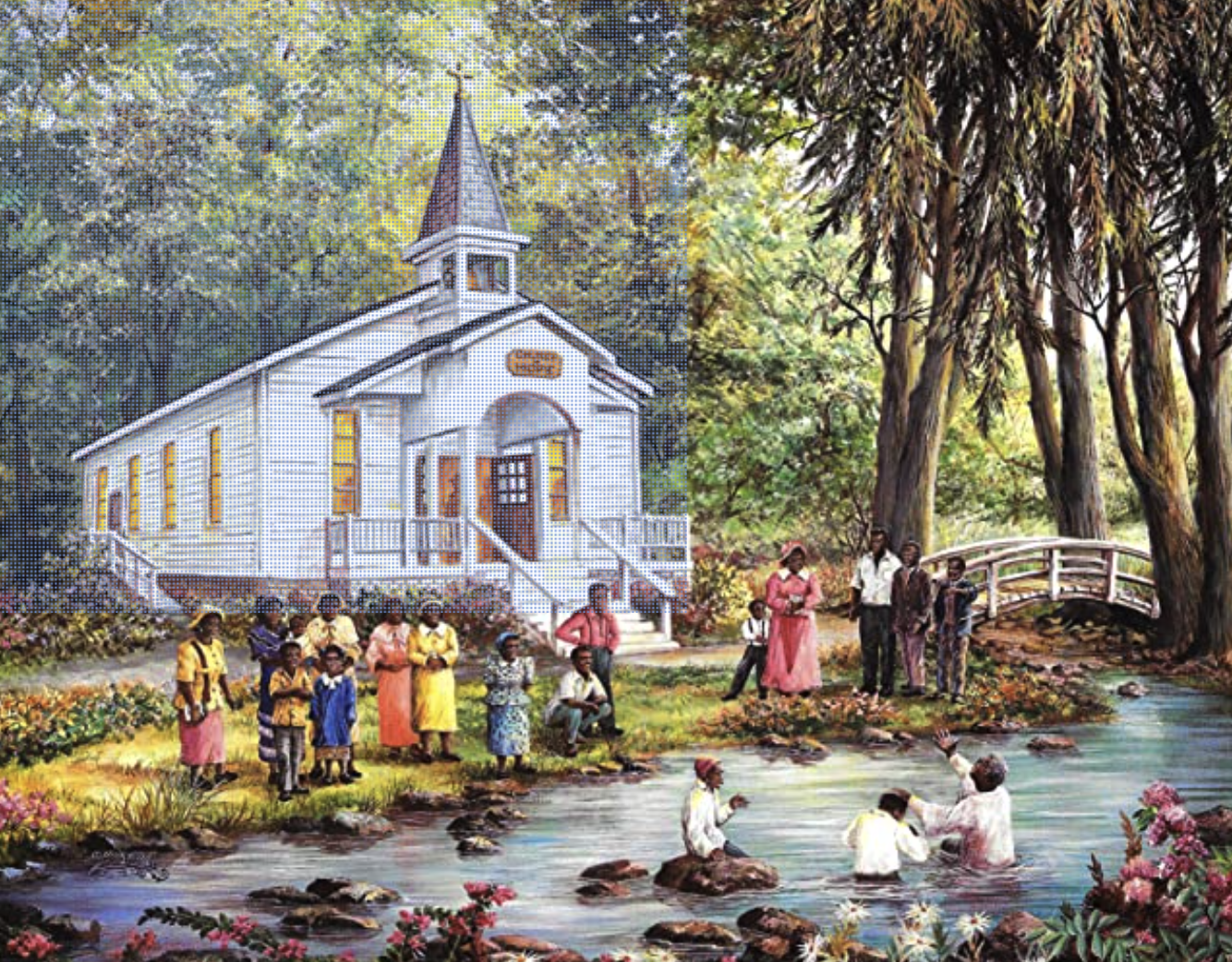
Well now. It may be true that “evangelical baptisms” are getting a little bit “raucous,” but that’s a rather strange statement to make in light of baptism traditions down the years in Black evangelical and Pentecostal churches.


Please respect our Commenting Policy

Why the press loves Santa Claus and the case for more news about St. Nicholas of Myra

Why the press loves Santa Claus and the case for more news about St. Nicholas of Myra

We are currently in “the most wonderful time of the year,” as the popular Christmas song by Andy Williams goes. For many Christians, however, the four weeks leading up to Christmas Day are marked by Advent, a time of prayer in preparation for the birth of Jesus. In Eastern churches, this season is called Nativity Lent.

Advent is one of those religious customs largely ignored by the mainstream press. Many newspapers and TV networks are more preoccupied with the economics around the season — Black Friday marks the beginning of the shopping-mall season for them — and things like trendy Advent calendars (which these days are largely devoid of any religiosity) and Santa Claus, the hero previously known as St. Nicholas.

In fact, the things the mainstream media value this time of year are starkly different from the message worshippers in ancient Christian traditions get in church during Sunday liturgies in the weeks preceding December 25th.

This is not something that’s entirely new. Even as a child, I could sense a disconnect between the materialism around me growing up in New York and the Christmas I celebrated at home featuring a Nativity crèche and Advent wreath. The Peanuts Christmas special had Charlie Brown bemoaning commercialization of the season — and that aired in 1965 (and network executives worried that it was too religious, even back then).

Where are we in 2021? Amid talk of supply-chain issues, inflation, the ongoing pandemic and political bickering in Washington (with politicians posing with guns on their Christmas cards), it looks pretty bleak out there.

This time of year is yet another reminder of what mainstream media values and the divide over what most Americans think and believe. This is where the Catholic press is of great value to help frame not just what’s important, but also what is more connected to the traditions and reality of this time of year.

In particular, it’s interesting to look for coverage of the backstory of Santa Claus. Hold that thought.

Let’s start here. Scanning various news sites the last two weeks led me to notice a larger trend.


Please respect our Commenting Policy

Plug-In: Americans favor religious exemptions for COVID-19 vaccine mandates — sort of

Plug-In: Americans favor religious exemptions for COVID-19 vaccine mandates — sort of

What a difference a year makes.

Or not.

Fifty-two weeks ago, this news topped Weekend Plug-in.

Sound familiar?

Trump calls COVID-19 vaccine ‘a medical miracle,’ but many religious people are skeptical

Guess what? Many religious people remain highly skeptical of the vaccines, despite their strong effectiveness at preventing serious illness, hospitalization and death from COVID-19.

Which leads us to this week’s news: a new public opinion poll on religious exemptions to the vaccines.

Religion News Service’s Jack Jenkins reports:

WASHINGTON (RNS) — A new poll reveals most Americans are in favor of offering religious exemptions for the COVID-19 vaccines, yet express concern that too many people are seeking such exemptions. In the same survey, more than half of those who refuse to get vaccinated say getting the shot goes against their personal faith.

The poll, conducted by the Public Religion Research Institute and Interfaith Youth Core and released Thursday (Dec. 9), investigated ongoing debates about COVID-19 vaccines as well as emerging divisions over whether religious exemptions to the shots should even exist.

According to the survey, a small majority (51%) of Americans favor allowing individuals who would otherwise be required to receive a COVID-19 vaccine to opt out if it violates their religious beliefs, compared with 47% who oppose such religious exemptions.

See additional coverage of the poll by the Washington Times’ Mark A. Kellner, a former contributor at GetReligion, and NPR’s Megan Myscofski.


Please respect our Commenting Policy

In search of the elusive liberal evangelical: Is this tiny flock worthy of big news coverage?

In search of the elusive liberal evangelical: Is this tiny flock worthy of big news coverage?

I was listening to a podcast the other day and the host asked a guest a question that I have heard way too many times over the last year — “Why did you decide to focus only on conservative evangelicals?”

I fully admit that a lot of my work does focus on conservative evangelicals. Why? Because, in the current political landscape, there’s not a more important force in American politics. The nones are too disorganized at this juncture to have a systemic impact. Catholics and Mainline Protestants are too politically divided to be considered anything close to a coherent voting bloc.

The fact is simply this: 13% of all American adults in 2020 were white evangelical Republicans.

No other group comes even close to that size. Nine percent of Americans are nothing in particular Democrats — but that’s not an easy group to wrap your arms around. There are twice as many white evangelical Republicans as there are white Catholic Republicans. For every Democratic atheist, there are 2.5 white evangelical Republicans.

But, I wanted to devote some time trying to look at the other side of the evangelical coin: those who describe themselves as politically liberal. Because the Cooperative Election Study is so large, even if that group is a relatively small percentage of the population, it’s still possible to do in-depth statistical analysis of liberal evangelicals.

Of all self-identified evangelicals, 58% describe themselves as conservative, 29% indicate they are moderate, while 13% say they are liberal. If that is restricted to just white evangelicals: 8% are liberal, 24% are moderate, and 68% say they are conservative.

That’s obviously much different than the general population. In 2020, 30% of all Americans said they were liberal, along with 28% of just white respondents.


Please respect our Commenting Policy