Catholicism

Abortion-rights groups planning 'Hail Mary' efforts to block Texas law? #REALLY

Abortion-rights groups planning 'Hail Mary' efforts to block Texas law? #REALLY

Faithful followers of this website know that many, many of the news reports we critique are based on tips from readers.

These emails are important to me because, frankly, there is no way for us to follow as many media sources as our readers do, combined. This is especially true now that our team, due to finances, is smaller than it was for the previous decade or so.

From time to time, readers will react to something as simple as a horrible headline or a single rage-inducing phrase in a news report. There’s no way that I can respond to all of these, but here is a recent case that I think deserves a mention.

Read the top of this CNN piece (“The Justice Department's uphill battle against Texas' abortion ban“) and try to spot the issue that ticked off a reader:

In its lawsuit challenging Texas six-week abortion ban, the Justice Department is throwing a Hail Mary pass to get over the procedural stumbling blocks that have thwarted other attempts to block the ban in court.

The lawsuit, filed … in a federal court in Austin, relies on a novel strategy in seeking to halt enforcement of the ban, which was designed specifically with the goal of evading review of federal courts.

The arguments that the Justice Department is presenting on the merits -- that the law violates Supreme Court constitutional precedent on abortion rights -- are on solid ground. But the question is whether its lawsuit can get around the same procedural issues that doomed the earlier federal lawsuit brought by abortion clinics.

What’s the problem?

Please respect our Commenting Policy

What was the goal of Gov. Kathy Hochul's 'God gave us the vaccine' sermonette?

What was the goal of Gov. Kathy Hochul's 'God gave us the vaccine' sermonette?

In an age in which satire and news often overlap, it was hard to know what to make of this headline: "New York Atheists Claim Religious Exemption From Vaccine After Governor Claims That It's From God."

This was satire, care of the Babylon Bee website. But the barbed humor focused on real quotes from the governor of New York that raised eyebrows on the cultural left and right.

"We are not through this pandemic," said Gov. Kathy Hochul, at a New York City megachurch. "I prayed a lot to God during this time and you know what -- God did answer our prayers. He made the smartest men and women, the scientists, the doctors, the researchers -- he made them come up with a vaccine. That is from God to us and we must say, thank you, God. ...

"All of you, yes, I know you're vaccinated, you're the smart ones. But you know there's people out there who aren't listening to God. ... I need you to be my apostles. I need you to go out and talk about it and say, we owe this to each other. We love each other."

Clearly, the governor said, getting vaccinated was the best way to obey God in this crisis.

Writing at The Friendly Atheist website, Beth Stoneburner argued that this was not the kind of church-state sermonette that should trouble atheists and other secularists.

"Is it a speech that atheists will appreciate? Probably not," she noted. "But as far as a politician using the language of faith to reach an audience that desperately needs to get vaccinated -- but might not because other prominent Christians are feeding them lies -- it's arguably effective."

If this blast of God-talk from a Democrat "helps Christians get vaccinated when some of them might choose otherwise, then perhaps that outweighs any criticisms people may have of her speech," said Stoneburner.

At the same time, Hochul's explicitly Christian remarks on vaccines drew little or no news coverage, as opposed to the media firestorms that often greet faith-based statements by Republicans attempting to win the support of conservative Christians in similar settings.


Please respect our Commenting Policy

Crucial question in all those newsworthy abortion debates: When does life begin?

Crucial question in all those newsworthy abortion debates: When does life begin?

THE QUESTION:

When does life begin?

THE RELIGION GUY'S ANSWER:

Those four words are regularly posed in the current abortion debate, so let's scan the lines in pregnancy that have been drawn by experts — religious and secular — in the past.

Pre-scientific cultures spoke of "quickening," typically between 16 and 18 weeks, when the mother first feels the unborn child moving in her womb. A famous example involves the unborn John the Baptist in biblical Luke 1:41. Some ancient Jewish authorities in the Talmud, and Roman and Greek philosophers, supposed that the unborn child "formed" earlier, at 40 days.

Then there's "viability," when a fetus can live on its own outside the womb, typically reached around 23 or 24 weeks, or somewhat earlier or later in individual cases. The U.S. Supreme Court legalized abortion before that point in its 1973 Roe v. Wade decision, and after viability when there are risks to the mother's health, broadly defined.

The high Court on December 1 hears a case from Mississippi, which defied the Roe ruling and bars abortions after 15 weeks on grounds that the fetus experiences pain by then. A Missouri law, also under court challenge, puts a ban at eight weeks when "everything that is present in an adult human is now present in your baby," according to the American Pregnancy Association. The Court temporarily left in place a ban in Texas (likewise in 13 other states) after six weeks, when pulsations can be diagnosed at what eventually becomes the fully formed heart.

Many modern Christians believe that life begins at conception (sperm first meets egg) or implantation (fertilized egg attaches to the mother's womb) while some put the line a bit later at twinning (after which multiple pregnancies do not occur).

Note the brief filed last month in the Mississippi case by pro-choice religions including "mainline" Protestant churches, non-Orthodox Judaism, Unitarian Universalists and others. It says "numerous religious traditions posit that life begins at some point during pregnancy or even after a child is born."


Please respect our Commenting Policy

New podcast: Those Southern Baptist sex-abuse battles are not just about Southern Baptists

New podcast: Those Southern Baptist sex-abuse battles are not just about Southern Baptists

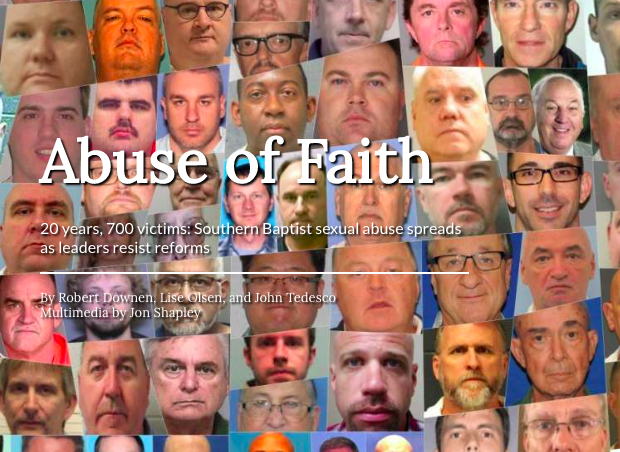
The Southern Baptist Convention’s ongoing fights about how to handle sexual-abuse claims against ministers and other church personnel and volunteers is a perfect example of the kind of story that drives newspaper editors crazy.

It’s big and complicated and it seems like something crazy or important (or both) happens every other day. But it also seems like it’s impossible to yank a big, dramatic headline out of this sprawling, complicated story.

The story never seems to end and the amount of background material needed — in story after story after story — makes it impossible to cover this stuff in tidy 500-word stories. But if a newsroom skips a few of the major developments, that makes it even harder to get back in the game and explain to readers what is happening. Oh, and did I mention that newsroom managers pretty much have to assign a reporter to this story full-time or near full-time? That’s expensive in this day and age. Obviously, this reporter has to have religion-beat experience and speak fluent Southern Baptist.

At the same time, in my experience, there will almost always be one or two editors who say (or think) something like this: “I know the SBC is huge and there are billions of dollars involved and we have lots of Southern Baptist churches (and maybe a college) in our news territory, but … I don’t ‘get’ why this story really matters to average readers. I mean, it’s not about sports or politics or something important (to me).”

As a Charlotte editor once told me, when I was poised to break a national-level SBC story in the early 1980s: Nobody reads this stuff but fanatics and every time you write about it we get too many letters to the editor.

This brings us to this week’s “Crossroads” podcast, which focuses on why the SBC’s struggles with sexual-abuse are important, and NOT just to Southern Baptists (click here to tune that in). The key is to identify major stories LINKED to sexual-abuse scandals that involve ethical, moral, legal and theological issues that can be seen in religious groups of all kinds (and many secular nonprofits and organizations as well). To illustrate this, let me tell you a story about an important evangelical counseling pioneer — the late Dr. Louis McBurney, founder of the Marble Retreat Center in Colorado.


Please respect our Commenting Policy

Pope's preferred airline goes bust: Alitalia's demise way more than a business story

Pope's preferred airline goes bust: Alitalia's demise way more than a business story

I have many fond memories of family trips to Italy that took place each summer during my childhood. Those summer pilgrimages to visit family and friends also included connecting with the place of my parents’ birth as well as seeing some of the country’s stories sites.

Visiting Vatican City for the first time in 1990 (when I was 14) remains one of the best memories. I would visit there again numerous times — including as a news reporter — in the decades that ensued.

Those New York-Rome trips involved flying with Alitalia, Italy’s national carrier. The airline — known for its nearly-impeccable safety record and sometimes appalling customer service — will officially close on Oct. 15. The announcement, made this past summer, marks the end of an era for an airline founded in 1946. it also marked the end of an era for my family, who were loyal to this brand to a fault.

Why is this a topic for GetReligion?

The airline’s demise and the start of a new one named ITA is a business story with a religion angle that too many news organizations ignored over the past few weeks. There was plenty of coverage regarding ITA buying new planes, potential layoffs and Italian government subsidies that kept the airline afloat for decades.

That religion angle? You see, my family and I weren’t the only loyal Alitalia customers over the years. The most famous has been the pope. It was in 1964, when Pope Paul VI traveled to Israel, when Alitalia became the pontiff’s official airline.

Alitalia put on plenty of miles under the papacy of now-St. Pope John Paul II, who visited 129 countries during his 27 years as head of the Roman Catholic church. The plane used by the pope — known in the press as “Shepherd One” as a way to compare it to the president’s “Air Force One” — continued to be used by Pope Benedict XVI and now Pope Francis. It’s also aboard these flights that the pope holds a news conference and always makes news.

Alitalia and the papacy will forever be intertwined.


Please respect our Commenting Policy

Keeping up: Ongoing 'woke' pronoun wars reach into the world of God-talk

Keeping up: Ongoing 'woke' pronoun wars reach into the world of God-talk

This Memo is a twofer, offering both a lively story theme to pursue plus an issue that is now affecting the work of every stylebook and copy editor in the American media.

An older campaign by feminists — including those working in the world of liturgy — sought to shun male pronouns, particularly when either gender is meant, in favor of plural they-them-their usage with singular antecedents. This increasingly common wording is of course grammatically incorrect given the structure of the English language, and can be confusing for readers.

That's now combined with the effort of transgender and "non-binary" advocates to suppress gender-specific adjectives by applying that same "singular they" along with newly crafted pronouns. A list of such neologisms recommended at the University of Wisconsin-Milwaukee, said to be non-exhaustive, covers ae, e, ey, fae, per, sie, tey, ve xe, ze and zie. So, for example, with "xe" the variants to parallel she-her-hers-herself are xem-xyr-xyrs-xemself.

As you would expect, references to God himself -- or is that "themself"? -- is now part of this debate.

Religion News Service ran a column last week from one of its regulars, Mark Silk, headlined "Why our preferred pronoun for God should be 'they'." He thinks calling God "they," not "he," and similar verbal tactics have become "imperative."

How would other progressives respond? His proposal was immediately publicized in a tweet from RNS's Catholic columnist, Jesuit Father Thomas Reese and the online comments began flowing.


Please respect our Commenting Policy

Elephant in sanctuary: Spot the news hooks in shocking changes facing Cincinnati Catholics

Elephant in sanctuary: Spot the news hooks in shocking changes facing Cincinnati Catholics

Let’s do the math. When discussing the future of the American Catholic Church, Joe Biden isn’t the biggest issue on the table. Biden’s liberal Catholicism may be a symptom of larger issues — and since it’s political, it’s easier to cover — but it isn’t the issue that’s going to lock the doors of many parishes from coast to coast, but especially in blue culture zones.

The big issue? Actually, it’s several connected issues — and the elephant in the living room (or sanctuary) is that links them. Hold that thought.

The obvious issues? The priest shortage. Declining enrollment rates in Catholic schools. Closed parishes. You can also add declining Mass attendance numbers in many, but clearly not all, parishes. I would add the collapse in the number of Catholics going to Confession.

This brings us to a very important Cincinnati Enquirer story with this headline: “'Change is difficult': Cincinnati Archdiocese launches shakeup that reaches almost every parish.” Here’s the overture:

The Archdiocese of Cincinnati … launched one of the most ambitious reorganizations in its 200-year history, potentially changing when and where almost a half-million Catholics attend Mass, school and other activities connected to their faith.

Known as Beacons of Light, the restructuring process will combine the archdiocese’s 208 parishes into 60 “families of parishes,” which will begin sharing priests and resources as early as next year.

Unlike past attempts to remake the archdiocese, which rarely got out of the planning stages, Beacons of Light is backed by Archbishop Dennis Schnurr and will in some way touch almost every Catholic and priest in the archdiocese’s 19 counties.

The goal, church officials say, is to eventually unite the 60 new parish families into single parishes.

So, the goal is 60 parishes instead of 208?


Please respect our Commenting Policy

Does church attendance reduce political polarization? Not among White conservatives

Does church attendance reduce political polarization? Not among White conservatives

There are some concepts in political science that have just become impossible to ignore. Whether it’s leading a classroom discussion, talking to a member of the media, or just chatting with friends about the current state of the world, I can’t help but bring it all back to political polarization.

Put simply, it’s the idea that American society has become more politically tribalized, with Democrats huddled in the far left corner of the political spectrum and Republicans doing the same on the right side of the scale with a huge chasm between the two. And, the two parties loathe each other — not just disagreeing, but believing that if the other party wins an election, it will lead to the end of the Republic.

Compromise becomes impossible in a world in which you see the other side not only as wrong, but also as the enemy. The inherent problem is that our democratic processes grind to a halt without a level of bi-partisan support.

There’s been a ton of great research done on measuring the level of polarization in the United States Congress by using DW-NOMINATE scores. The results indicate that both parties have moved away from the center, but that is more pronounced among the GOP than among the Democrats. This visual (it comes from this paper) is one I use in class to show just how bad it’s gotten.

But, I wanted to take a different approach here. I wanted to see just how much polarization is perceived by the average American, how that has changed over time, and how religion plays a role in that perception.

Here’s how I did it.

Since 2012, the CCES has asked respondents a battery of questions that require them to place the Democratic Party, the Republican Party, and themselves on an ideology scale running from 1 (very liberal) to 7 (very conservative), with the moderate option described as “middle of the road.” For my purposes someone has a polarized view of the world if they describe either the Democrats as “very liberal” or the Republicans as “very conservative.” In essence, they are saying: “that political party can’t get any more extreme.”


Please respect our Commenting Policy

New podcast: Yes, New York's governor urged church folks to be her 'apostles' backing vaccines

New podcast: Yes, New York's governor urged church folks to be her 'apostles' backing vaccines

Hey news consumers, remember that time when President Donald Trump stood in front of a church (sort of in an urban war zone), held up a Bible and the world went nuts?

Chances are good that you heard about it. However, as a refresher, here are 66,100,1000 Google references to this incident, as well as as an imperfect collection of other Trumpian news involving the word “Bible.”

Or remember that time when Trump — long-time member of the liberal Presbyterian Church (U.S.A.) and probably, in terms of private life, one of the most secular presidents in American history — went to Liberty University to court evangelicals and said this (care of an NPR report):

"We're going to protect Christianity. I can say that. I don't have to be politically correct," he thundered at the beginning of his speech at the conservative evangelical university.

Then he moved on to cite "Two Corinthians 3:17, that's the whole ballgame. ... Is that the one you like?" Trump asked. "Now the Lord is that Spirit: and where the Spirit of the Lord is, there is liberty."

Over at Google, there appear to be a mere 2,380,000 references to this “Two Corinthians” incident.

Truth is, politicians often say and do strange things while courting support in religious settings that are way outside their own cultural comfort zone.

This brings us to this week’s “Crossroads” podcast, which focuses on the coverage — actually, the lack of coverage — of the recent visit that New York Gov. Kathy Hochul paid to the Christian Cultural Center, a massive and very influential predominantly African-American megachurch in Brooklyn. Click here to get that podcast, or head over to Apple Podcasts.

Now, there was more to this political-religious event than the hilarious typo in the rushed transcript of the governor’s remarks produced, apparently, by a staff member. Check out the opening words here: “The phrase be to God, this is the day the Lord has made. Amen, amen.”

Let’s assume that the governor actually said “praise be to God.”


Please respect our Commenting Policy