Catholicism

Papal splash: Persecuted Iraqi Christians get long-awaited spotlight with Francis visit

Papal splash: Persecuted Iraqi Christians get long-awaited spotlight with Francis visit

By the time this runs, the pope will have flown home from Iraq after a historic trip that apparently went without a hitch. Popes John Paul II and Benedict XVI both wanted to go to Iraq; Francis actually went and did it.

There were so many reasons not to go: The pandemic, the security situation and the potential for misunderstanding or disaster. But Iraq put on an impressive show, keeping the pope safe, creating venues at which he spoke (the tableau in Mosul was particularly dramatic) and accommodating a press corps of several dozen reporters.

Which leads to mentioning how difficult covering a papal trip really is. I’ve covered two U.S. papal trips (John Paul II in 1987 and Benedict XVI in 2008); one papal election in Rome (Benedict, 2005) and spent plus two weeks in northern Iraq (July 2004), so I have a feel for the conditions. Covering a pope is a succession of 18-20-hour days spent getting checked over by security, traveling to the event, covering it and then filing your story and doing the research for the next day’s story.

Even the timing was tricky. The pope had to dodge major religious holidays along with national ones such as Nowruz, the Persian new year that’s also observed in Iraq and is on the first days of spring. He also had to avoid coming much past April as that part of the world is scorching for half of the year. (When I was there in July, it was 111 degrees).

Listen here to CNN’s Vatican correspondent Delia Gallagher as she talks about waiting in Rome for the papal plane with 75 other journalists, all of whom, she said, were vaccinated. Notice the band playing the hymn “Joyful, Joyful We Adore Thee” when the pontiff came down the stairs to the tarmac. I’m sure that tune was a new one for the Baghdad airport.

I also caught this NBC report about reporters taking an Iraqi military plane to get to Ur. I hope to hear more about what it was like to report from Iraq.

News outlets with Baghdad and Rome bureaus understandably had the best ringside seats to the visit and it was the foreign correspondents, not these outlets’ religion beat reporters, who got to cover the trip.

Even Religion News Service’s and the Associated Press’ Vatican reporters had to cover the event from Rome, so I am very curious as to who these 75 journalists were who actually got on the plane.

Putting on such a trip was quite the production, according to a detailed 25-minute special report by alJazeera, which informed us that Iraq employed 10,000 members of its security forces to make sure nothing went wrong.

I’ll open with the Washington Post’s account of the pope’s arrival.

Please respect our Commenting Policy

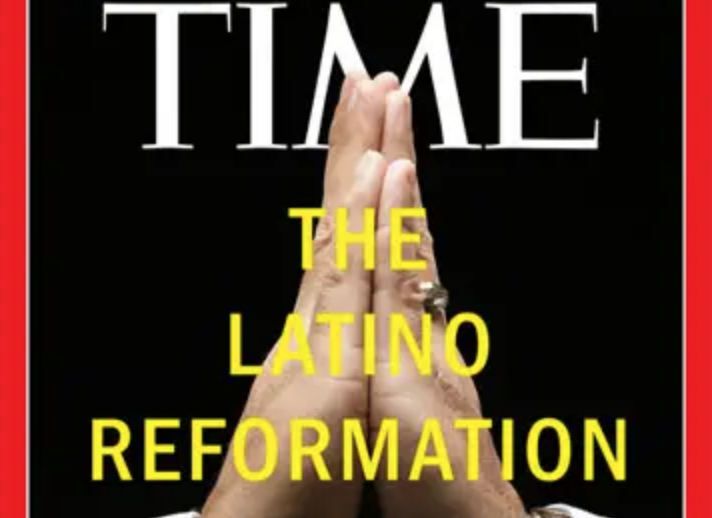
Why are Latinos veering into GOP? It's all about money, money, money (and zero faith)

Why are Latinos veering into GOP? It's all about money, money, money (and zero faith)

I know, I know. If you have read GetReligion for the past four-plus years, you know that we’re convinced that the rise of the Latino evangelical voter (often paired with traditional Catholic Latino voters) is an emerging story in American public life.

Part of this story is the rise of Pentecostalism in the Spanish-speaking world (classic Pew Research Center study here) and another part is linked to the defense of Latino family values (to use a loaded phrase).

There’s much more to this story than the role these voters played in Donald Trump’s surprising (to some) showings in some Florida and Texas zip codes. Click here (“New York Times listens to Latino evangelicals: 'Politically homeless' voters pushed toward Trump”) and then here (“Concerning Hispanic evangelicals, secret Trump voters and white evangelical women in Georgia”).

To be blunt about it, it appears that political-desk reporters are struggling with this issue, in part because it undercuts some themes in long-predicted demographic trends backing Democrats. You can see that in the recent, oh-so-predictable New York Times story that ran with this massive double-decker headline:

A Vexing Question for Democrats: What Drives Latino Men to Republicans?

Several voters said values like individual responsibility and providing for one’s family, and a desire for lower taxes and financial stability, led them to reject a party embraced by their parents.

The story is getting some Twitter attention because of this magisterial statement of woke Times doctrine:

Some of the frustrations voiced by Hispanic Republican men are stoked by misinformation, including conspiracy theories claiming that the “deep state” took over during the Trump administration and a belief that Black Lives Matter protests caused widespread violence.

But it’s more important to focus on the bigger picture, which is that this trend is all about Latino men wanting to get rich by being part of the American dream. The overture is long, but essential:


Please respect our Commenting Policy

Another shot of controversy: New Catholic questions about Johnson & Johnson vaccine

Another shot of controversy: New Catholic questions about Johnson & Johnson vaccine

My wife has lupus and autoimmune diseases that make her high-risk if infected with COVID-19. Because of that, we’ve adhered strictly to masking, distancing and other safety precautions. For nearly a year, we’ve not attended an in-person worship assembly or eaten inside a restaurant.

After reporting from all 50 states and 15 nations in my career, I’ve done all my work from home since flying to Tennessee to cover deadly tornadoes last March. That was right before the coronavirus lockdown hit America in the middle of that month.

Last week, I mentioned my excitement to roll up my sleeve for the first of two Moderna shots. And on Thursday, our family got an extra dose of hope: Tamie received a Johnson & Johnson single shot, the coronavirus vaccine recommended by her rheumatologist because of her life-threatening reactions to medications last year.

Ironically, my wife was able to schedule her last-minute appointment on the same day that Religion Unplugged managing editor Meagan Clark and I moderated an online panel on the COVID-19 vaccines and religion.

A key focus of the panel: conflicting and sometimes confusing statements issued by U.S. Catholic bishops on the morality of the newly approved Johnson & Johnson shot.

“Leaders at the U.S. Conference of Catholic Bishops are discouraging Catholics from using the new Johnson & Johnson COVID-19 vaccine if given a choice, citing the use of cells with a distant link to abortion in the development of the vaccine,” reported Religion News Service national reporter Jack Jenkins, one of the panelists.

Jenkins offered excellent insight on the diversity of Catholic responses to the vaccine debate, from individual bishops to the Vatican.

Panelist Clemente Lisi, who analyzes Catholic news for Religion Unplugged, noted: “Unless you’re a scientist, this is a very difficult thing to understand. … I think most people are getting this (news) through headlines, through Twitter, and I think it may cause some misunderstanding.”

Many Americans have no choice which COVID-19 vaccine to receive, Lisi stressed. Stopping the virus’ spread, he added, could itself be construed as a pro-life act.


Please respect our Commenting Policy

New podcast: Yes, cover RFRA; but Equality Act coverage has also been quiet on local stories

New podcast: Yes, cover RFRA; but Equality Act coverage has also been quiet on local stories

What we have here is a logical question that journalists (and news consumers) should be asking at this point in coverage of debates about the Equality Act. It’s also one of the questions that “Crossroads” host Todd Wilken and dissected during this week’s podcast (click here to tune that in).

That question: How many religious health organizations, schools, recreation centers, homeless shelters, campgrounds, day-care centers and other forms of faith-driven ministries and nonprofit groups are located in the zip codes covered by the newsrooms of your local media outlets?

Earlier this week, I wrote a post (“Puzzle: Many reporters ignoring Equality Act's impact on this crucial Schumer-Kennedy legislation”) noting that a few mainstream news organizations have covered the ways in which the Equality Act would edit or even crush the Religious Freedom Restoration Act (RFRA) of 1993, which passed in the U.S. Senate vote of 97-3. That vote symbolized both the bipartisan nature of that legislation and stunning left-right coalition of sacred and secular groups that supported it.

That remains a valid angle for coverage. However, the more I thought about this topic, and the more Equality Act reports that I read, the more I focused in on another “quiet zone” in the mainstream news coverage — including at the local and regional levels.

For starters, let’s look at two pieces of a major New York Times report on the Equality Act:

It was the second time the Democratic-led House had passed the measure, known as the Equality Act, which seeks to amend the Civil Rights Act of 1964 to add explicit bans on discrimination against lesbian, gay, bisexual and transgender people in both public and private spaces.

Now, that’s remarkably broad language. What kinds of groups and institutions, pray tell, are included under “both public and private places”? And remember this old journalism mantra: All news is local.

Later on, the story adds:

In a landmark decision in June, the Supreme Court ruled that the 1964 civil rights law protects gay and transgender people from workplace discrimination, and that the language of the law, which prohibits discrimination on the basis of sex, also applies to discrimination based on sexual orientation and gender identity. House Democrats sought to build on that ruling with the Equality Act, which would expand the scope of civil rights protections beyond workers to consumers at businesses including restaurants, taxi services, gas stations and shelters.


Please respect our Commenting Policy

Attention news editors: Are German Catholic bishops poised to become liberal Luthers?

Attention news editors: Are German Catholic bishops poised to become liberal Luthers?

Germany’s Catholic bishops embarked on a series of conversations in 2018 aimed at reforming church teachings. It was an ambitious, if not audacious, effort addressing everything from homosexuality, priestly celibacy and the ordination of women.

As always, the word “reform” — in this context — means modernizing ancient church doctrines.

Conservative Catholics across the world decried the prospect. The tensions that arose at that time — and still simmering today — even caused some to warn that a permanent split could occur.

Indeed, the dreaded “s-word” — schism — can be used to describe the current moment. It was just last year that a high-ranking prelate argued that pushing such changes could lead to a “German national church.”

That’s a big news story — period. Over the past three years, the bishops in Germany haven’t been shy about making headlines — in Catholic-market publications. The question is when their proposals will draw major coverage by professionals in major newsrooms, including television networks.

Meanwhile, Pope Francis has elevated women at the Vatican, but he hasn’t endorsed such progressive doctrinal proposals — although his papacy has emboldened the Germans to push for such changes.

The church across the West has suffered tremendously due to secularism and the clergy sex scandal, especially in Germany. None of these German innovations, along with the alleged cover-ups, has helped matters. Still, the German bishops have continued to propose “reforms” in the past few weeks — with a series of moves that could forever change Roman Catholicism.

These latest pronouncements have received attention in the U.S. press, primarily in conservative religious publications. There are exceptions, but overall these fast-moving developments have gone unnoticed as of late.

These moves come as the church in Germany continues to lose members. In 2019, for example, over 272,000 Catholics quit the church.


Please respect our Commenting Policy

Yo, Nashville Tennessean: What does 'people of faith' mean in a political argument?

Yo, Nashville Tennessean: What does 'people of faith' mean in a political argument?

When I arrived at the Rocky Mountain News (RIP) long ago — think early ‘80s — I quickly learned that the city-desk team had an informal way of checking the Colorado pulse on religious issues.

Basically, they were interviewing clergy at the churches in downtown Denver. That was pretty much it. They would also call the Denver Catholic archdiocese (rather progressive at that time) and the “local seminary,” as in the already “woke” Iliff School of Theology, nationally known as an edgy United Methodist campus. It appeared no one knew about the larger Denver Seminary (evangelical) only a few blocks from Iliff.

What kind of churches were downtown? Almost all of them were mainline Protestant congregations and very few of them were showing any sign of life, in terms of attendance and growth. But they were nearby and most were progressive, so that was that. Why talk to folks at the region’s growing megachurches?

Hang in there with me. I am working toward a recent Nashville Tennessean article that ran with this headline: “Hundreds of people of faith call on Tennessee's Republican congressional delegation to repudiate lies about election fraud.” The key question: Define “people of faith”?

Back to Denver, for one more comment. Early on, I attended a press conference linked to the Colorado Council of Churches. Here is how I described what happened in a post back in 2013:

The key was that the organization … was claiming that it spoke for the vast majority of the state's churches. The problem was that, by the 1980s, the conversion of the Colorado Front Range into an evangelical hotbed (including evangelicals in many oldline Protestant bodies) was well on its way. Also, a more doctrinally conservative Catholic archbishop had arrived in town, one anxious to advocate for Catholic teachings on public issues on both sides of the political spectrum. …

Still, it was an important press conference that helped document one side of a religious debate in the state.

Near the end of the session, I asked what I thought was a logical question: Other than the Roman Catholic Archdiocese of Denver, did any of the CCC leaders present represent a church that had more members at that moment than during any of the previous two or three decades?

Well, hey, I thought it was a fair question.


Please respect our Commenting Policy

Puzzle: Many reporters ignoring Equality Act's impact on this crucial Schumer-Kennedy legislation

Puzzle: Many reporters ignoring Equality Act's impact on this crucial Schumer-Kennedy legislation

I have been following the Equality Act coverage and, so far, a crucial piece in this puzzle has been missing.

Thus, here is a one-question pop test. That question: Name the piece of stunningly bipartisan legislation — vote was 97-3 in U.S. Senate — from the Bill Clinton era that will be gutted by passage of the Equality Act? Hint: It was introduced in the House by Rep. Chuck Schumer (D-NY) on March 11, 1993, and in the Senate on the same day by the late Sen. Ted Kennedy (D-MA).

We are, of course, talking about the Religious Freedom Restoration Act (RFRA). In today’s advocacy-media age that would, of course, be the “Religious Freedom” Restoration Act, complete with “scare quotes.”

The key is the impact the Equality Act would have on religious parachurch groups, social ministries, hospitals and educational institutions, from preschools to universities.

Now, does everyone agree on how the Equality Act would impact the First Amendment rights of religious believers and their doctrine-defined ministries?

Of course not. There are strong, credible voices on both sides of that debate that deserve serious, accurate, informed coverage by the mainstream press. However, this process — let’s call it “journalism” — would require newsroom managers to admit that this issue exists.

That’s why Andrew Sullivan — one of the world’s best-known gay public intellectuals — called the introductory Washington Post Equality Act story a “press release” (think PR) for the Human Rights Campaign. Here is that story’s description of the legislation’s impact:

The Equality Act would amend existing civil rights laws, such as the Civil Rights Act of 1964 and the Fair Housing Act, to explicitly ban LGBTQ discrimination in the workforce, housing, education, credit, jury service and other areas of American life.

If passed, the legislation would provide the most comprehensive LGBTQ civil rights protections in U.S. history, advocates say, significantly altering the legal landscape in a country where more than half of states lack explicit legal protections on the basis of sexuality or gender identity. …


Please respect our Commenting Policy

Keep the Bible in one hand, a newspaper in the other: Tips for stressed-out preachers

Keep the Bible in one hand, a newspaper in the other: Tips for stressed-out preachers

“You preach with the Bible in one hand and the newspaper in the other.”

That’s what Bishop Timothy Clarke, an Ohio senior pastor, said in a recent front-page feature by Danae King, the Columbus Dispatch’s religion writer.

It’s an idea that originated with the late Karl Barth, one of the most influential theologians of the 20th century. Barth put it this way: “Take your Bible and take your newspaper, and read both. But interpret newspapers from your Bible.”

Barth’s concept was a prominent theme of a Facebook Live panel discussion organized this week by the Siburt Institute for Church Ministry at Abilene Christian University in Texas.

“We used to think the hard part was interpreting the Bible, but now we've decided the hard part is interpreting the newspaper,” quipped Randy Harris, one of the co-hosts, along with Carson Reed, of the discussion on “Light, Truth and Fake News.”

The panel — on which I was honored to speak — aimed to help stressed-out ministers make sense of the news in a time of polarization and conspiracy theories.

“Read broadly. Value truth,” urged Cheryl Mann Bacon, a Christian Chronicle correspondent and retired journalism chair at Abilene Christian. “Be compassionate when you share it, but be courageous when you share it.”

Co-host Harris is a longtime preacher and spiritual director who works with the Siburt Institute.

He advised: “Pay attention to local news. We can get caught up with what's happening in Washington, but there's stuff that's happening in your town that needs a response. The second thing is, to ministers: You've made a commitment to read the news through a certain lens, and that's the lens of a crucified and risen Messiah.”


Please respect our Commenting Policy

'Follow the science': Is there room for Catholic voices in COVID-19 news coverage?

'Follow the science': Is there room for Catholic voices in COVID-19 news coverage?

The phrase “follow the science” may very well be one of the most annoying to emerge from this pandemic. It’s proudly used by politicians, often to talk down to the rest of us when they are trying to chide political conservatives or religious people (not always the same thing) on an array of issues.

Was New York’s Gov. Andrew Cuomo “following the science” when his executive order last year forced elderly patients with COVID-19 be returned to nursing homes rather than kept in hospitals? He eventually reversed the order — but his administration remains in hot water after admitting they covered up the number of nursing home deaths. At least he didn’t fly to Cancun in the middle of all of it.

While he received wave after wave of positive press coverage, Cuomo’s actions last year were anti-science, since understanding how the virus was spreading at the time was critical to stopping it nationwide. The U.S. Attorney in Brooklyn and the FBI are now investigating the matter.

“Follow the science” is a phrase that has been used by politicians and mimicked by the mainstream press. A Google News search of the phrase yields 203,000 mentions. In mainstream news outlets, particularly last year when Donald Trump was president, the phrase became an attack on the administration’s handling of the virus. Post-Trump, the phrase continues to be one that journalists, especially in newsrooms like The New York Times are eager to quote.

This piece — “Studies Examine Variant Surging in California, and the News Isn’t Good” — began like this:

A variant first discovered in California in December is more contagious than earlier forms of the coronavirus, two new studies have shown, fueling concerns that emerging mutants like this one could hamper the sharp decline in cases over all in the state and perhaps elsewhere. …

“I wish I had better news to give you — that this variant is not significant at all,” said Dr. Charles Chiu, a virologist at the University of California, San Francisco. “But unfortunately, we just follow the science.”

This pandemic may have led to the wide use of this feel-good phrase, allowing government officials (copying what they hear from scientists) to exert enormous powers. However, other politically polarizing issues — such as abortion, transgender rights and climate change — have also led to its overuse. For many journalists, it means something like this: We have the truth on our side, while the rest of you believe in conspiracy theories. It’s a way to stifle debate, while offering lopsided news coverage.

What does it mean for journalism and particularly the impact of Catholic voices in news stories?


Please respect our Commenting Policy