Baptists

Wait a minute: How is a sermon on the Second Coming linked to shootings in Atlanta?

Wait a minute: How is a sermon on the Second Coming linked to shootings in Atlanta?

The hellish shootings in Atlanta have unleashed fierce debates combining questions about sex, sin, salvation, repentance, race and various combinations of all of those hot-button topics.

The debates center, of course, of statements by Robert Aaron Long — the suspect in the killing of eight people, including six Asian women — and his complicated and troubled history as a young member of Crabapple First Baptist Church in Milton, Ga., a Southern Baptist congregation.

Eventually, court testimony will provide hard facts about this case. At this point, all the evidence is that Long was raised as a conservative Christian, was active in his church youth group and that he abandoned his faith and then, quite literally, all hell broke loose in his personal and family life. Long has said that a “sex addiction” drove him to frequent massage parlors and his family, apparently, sent him to a Christian counseling center for treatment. His conservative Christian parents “threw him out of the house” the night before the shootings, according to reports in the Washington Post and elsewhere.

Like I said, on-the-record details will emerge. Right now, I want to raise a journalism question or two about coverage of the SBC congregation that is involved in this story. What do we know about this church and, well, how do we know what we know? One Post story notes the following, quoting a solid, factual source:

The evangelical congregation’s minister, the Rev. Jerry Dockery, is an energetic preacher who advocated for a socially conservative brand of Christianity that, as the church bylaws put it, views “adultery, fornication, homosexuality, bisexual conduct, bestiality, incest, polygamy, pedophilia, pornography, or any attempt to change one’s sex, or disagreement with one’s biological sex” as “sinful and offensive to God.”

This isn’t shocking material, if you know anything about traditional forms of Christianity. It would be easy to find specific quotations from recent Catholic popes — including Pope Francis — condemning behaviors such as these, and more.

This congregation is also connected to several doctrinally conservative organizations or movements linked to SBC life, such as the Founders Ministries. All of this leads me to a specific sermon reference discussing the end of the world and Christian teachings about the second coming of Jesus Christ. Oh, and if you stop and think about it, this includes the church’s pastor — indirectly — offering a warning about Christians worshipping political leaders such as Donald Trump.

Say what?


Please respect our Commenting Policy

Plug-in: Debates about race, religion follow shooting of eight, Including six Asian women

Plug-in: Debates about race, religion follow shooting of eight, Including six Asian women

Was race a motive in Tuesday’s killings of eight people — including six Asian women — at three Atlanta-area massage parlors?

Was religion?

These are among the questions after the arrest of a White suspect with ties to a Southern Baptist church.

Despite police downplaying the role of race, the shootings have stirred national fear amid “reported record numbers of hate crimes and incidents of harassment” against Asian Americans, note the Los Angeles’ Times’ Jaweed Kaleem and Richard Read.

The first details concerning 21-year-old suspect Robert Aaron Long’s faith background were vague, with the Daily Beast indicating that “he was big into religion.”

But then Washington Post religion writer Sarah Pulliam Bailey interviewed his youth pastor:

As a teenager, Long would stack chairs and clean floors at Crabapple First Baptist Church in Milton, Ga., said Brett Cottrell, who led the youth ministry at Crabapple from 2008 to 2017. Long’s father was considered an important lay leader in the church, Cottrell said, and they would attend morning and evening activities on Sundays, as well as meetings on Wednesday evenings and mission trips.

“There’s nothing that I’m aware of at Crabapple that would give approval to this,” Cottrell said in an interview, referring to the shootings. “I’m assuming it’s as shocking and numbing to them as it has been to me.”

Today, a front-page story by a team of New York Times reporters, including religion writer Ruth Graham, focuses on Long’s battle against a “self-described sex addiction”:


Please respect our Commenting Policy

New podcast: Early clue that Liberty may return to being a 'normal' Christian university?

New podcast: Early clue that Liberty may return to being a 'normal' Christian university?

Here’s a question for journalists and news consumers who remain interested in the future of the complicated, complex world of evangelical Protestantism: Now that Donald Trump is out of office, does it matter who becomes the next president of Liberty University?

Note that this question assumes that the future of Liberty is important — as a mainstream news story — if it is linked to politics, as opposed to questions about the future of Christian higher education.

There is another way to state this question: Would it be important if Liberty returned to the conservative Christian style and image of its founder, the late Rev. Jerry Falwell, instead of the high-energy, openly political agenda of Jerry Falwell, Jr.? In other words, the focus would be on conservative Christian beliefs and education, as opposed to political clout. That’s the question that was at the heart of this week’s “Crossroads” podcast (click here to tune that in).

If you followed the life and work of Jerry Falwell, Sr., you know that he was (#DUH) quite political. But this wasn’t an agenda that dominated the daily life and academic priorities of his university. Liberty was a conservative Baptist university and, for the most part, acted like one.

That changed under Jerry Falwell, Jr., of course. Consider this chunk of an “On Religion” column about that:

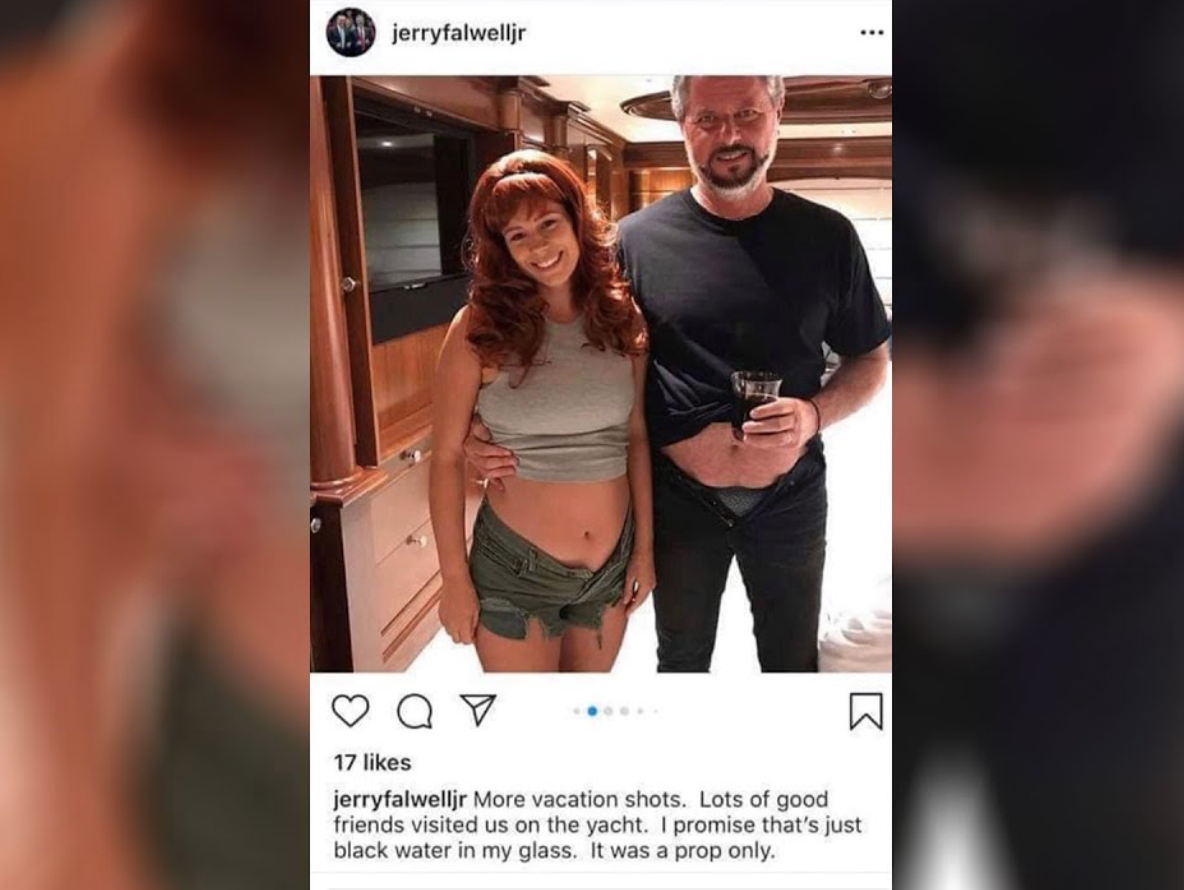
… Falwell Jr. developed a swashbuckling style that caused heat, especially when linked to race, guns, jets, politics, yachts and his specialty – real estate. Controversies about his de facto partnership with President Donald Trump thrilled many Liberty donors, alumni, parents and students, while deeply troubling others.

Many Christian college presidents are super-pastors who provide ties that bind to denominations, churches and networks of believers. Falwell Jr. — a lawyer — turned into a dynamic entrepreneur who courted powerful conservative politicos.

On regular Christian campuses, there "are higher expectations for presidents than members of the faculty, and members of the faculty live with greater expectations than students," noted religious-liberty activist David French, writing at The Dispatch.

"Liberty flipped this script. The president lived life with greater freedom than his students or his faculty. …”

This brings me to a fascinating news feature that ran the other day in The New York Times under this double-decker headline:

Conservative Activist Charlie Kirk Leaves Liberty University Think Tank

The Falkirk Center, named for its founders, Jerry Falwell Jr. and Charlie Kirk, was the center of evangelical Trumpism. Now, both are gone.


Please respect our Commenting Policy

Surrounded by lions: Is there a backstory to Beth Moore's divorce from Southern Baptists?

Surrounded by lions: Is there a backstory to Beth Moore's divorce from Southern Baptists?

So far, 2021 has been pretty hospitable for some good religion stories, beginning with a Jan. 6 assault on the U.S. Capitol that included some conservative religious folks. On the heels of that story was an exposé on Christian finance guru Dave Ramsey written by Bob Smietana, the former Religion News Service editor-in-chief-turned-national-reporter .

Smietana had spent several years writing for the Southern Baptist-owned Lifeway Research. Someone (there?) tipped him off about a March 3 tweet by Lifeway’s biggest author, Beth Moore, saying she had cut her ties with the organization. Naturally, he wondered if there was more to it. According to several of his tweets, a spokeswoman for the sometimes reclusive Moore called him, asking if he’d like an interview.

Moore was fleeing the ship and Smietana was the lucky scribe who got to break the story.

Since then, the news has been pounced on by the religion-writing teams at the New York Times and Washington Post, industry publications such as Christianity Today and a variety of Southern Baptist outlets. Why? Because it’s not just about one celebrity Christian pulling up the stakes.

Rather, it’s become a judgment on an entire denomination about how it’s handled women’s issues, sexual abuse and former President Donald Trump.

Let’s begin with the actual RNS story, which begins with how Moore was considered the model Southern Baptist because of her powerful Bible studies that ministered to millions, but didn’t cross paths with the denomination’s strictures against women preaching. She also fulfilled other unwritten rules for popular women’s speakers on the Christian circuit: She was attractive, slim, married and a mom.

Then came President Trump.

Moore’s criticism of the 45th president’s abusive behavior toward women and her advocacy for sexual abuse victims turned her from a beloved icon to a pariah in the denomination she loved all her life. …

Because of her opposition to Trump and her outspokenness in confronting sexism and nationalism in the evangelical world, Moore has been labeled as “liberal” and “woke” and even as being a heretic for daring to give a message during a Sunday morning church service.


Please respect our Commenting Policy

Plug-in: Beth Moore, Southern Baptist trolls and a scoop that stunned Godbeat Twitter

Plug-in: Beth Moore, Southern Baptist trolls and a scoop that stunned Godbeat Twitter

In a little-noticed, late-night Twitter conversation on March 3, prominent author and speaker Beth Moore indicated that her Living Proof Ministries had ended its longtime partnership with Lifeway Christian Resources, a Southern Baptist Convention publishing house.

“Adored them but SBC baggage got to be too much,” Moore tweeted, matter-of-factly. “It was heartbreaking.”

A tip about the social media posts to Religion News Service national reporter Bob Smietana set in motion one of the year’s biggest religion news scoops.

Smietana called and set up an interview with Moore, who told him March 5 — last Friday — that she is “no longer a Southern Baptist.” After talking to Moore, the veteran religion writer then spent a nervous few days doing additional research and reporting — hoping no other journalist would learn about his in-depth exclusive.

When RNS published Smietana’s piece Tuesday, traffic quickly overwhelmed the wire service’s website, and the story became a trending topic on Twitter.

By Thursday, the Trump critic’s split with Southern Baptists was front-page news in the New York Times (read the story by Ruth Graham and Elizabeth Dias) and just missed the front page of the Washington Post (see the A2 coverage by Sarah Pulliam Bailey and Michelle Boorstein).

Other interesting follow-up coverage includes Holly Meyer’s report for USA Today, Kate Shellnutt’s story for Christianity Today and Ashlie D. Stevens’ analysis for Salon.

P.S. Kudos to RNS’ Emily McFarlan Miller for her front-page photo of Moore in the New York Times.


Please respect our Commenting Policy

Spot the theology issue: Top hymns of a year in which COVID-19 touched everything

Spot the theology issue: Top hymns of a year in which COVID-19 touched everything

It's a hymn that the faithful start singing whenever a Baptist church organist plays the opening chords -- because everyone knows it by heart.

All together now: "When peace like a river attendeth my way. When sorrows like sea billows roll. Whatever my lot, Thou hast taught me to say. … It is well, it is well, with my soul."

Chicago attorney Horatio Spafford wrote those words after losing his son to scarlet fever and then, a few years later, all four of his daughters in an 1873 shipwreck. His wife, Anna, survived and her telegram home from England began: "Saved alone. What shall I do?"

No one should be surprised that worship leaders frequently turned to "It Is Well With My Soul" as their people wrestled with the coronavirus pandemic, said the Rev. Roger O'Neel, who teaches in the worship and music program at Cedarville University in Ohio.

"People were feeling their way in 2020," he said. "It wasn't just the pandemic and people being locked down worshipping in (online) streamed services. We were also facing all the bitter political conflicts in our nation and the racial divisions that we were experiencing. …

"People were trying to find hymns that would speak to all of that, to the pain that everyone felt last year."

Faithlife, a Bellingham, Wash., company that publishes online worship and Bible study tools, recently released a report covering 2020 trends spotted in its Proclaim software. "It Is Well With My Soul" topped the hymns list, with usage increasing 68% after the pandemic hit.

The classic hymn "Great Is They Faithfulness" came next, with a 64% increase. It begins: "Great is Thy faithfulness, O God my Father, there is no shadow of turning with Thee; Thou changest not, Thy compassions, they fail not. As Thou hast been, Thou forever wilt be. Great is Thy faithfulness! … Morning by morning new mercies I see; All I have needed Thy hand hath provided -- great is Thy faithfulness, Lord, unto me."


Please respect our Commenting Policy

'Total Woman' redux: Obscure white evangelical says stupid things and it's national news

'Total Woman' redux: Obscure white evangelical says stupid things and it's national news

About the time that I started teaching journalism in Washington, D.C., I saw a movie in which Beltway professionals (including speechwriters) played a rather cynical bar game. I think the movie was “Speechless,” with Michael Keaton and Geena Davis.

If my memory is correct, the game was called “Spot the soundbite.” The goal was to watch a long, complicated political speech and then to accurately predict the tiny, often sensational 5-10 second “bite” that would make it into television news reports.

The message, of course, was that substance and nuance didn’t mean much in public life. Emotions and feelings linked to a fleeting soundbite — which could be funny or emotional or whatever — were what mattered. All together now: “Where’s the beef!” It was also clear that it was easy for journalists to pick good, sharp soundbites from “good” candidates and bad, stupid soundbites from “bad” candidates.

This brings us to this week’s “Crossroads” podcast (click here to tune that in), in which host Todd Wilken and I discussed the latest example of a preacher getting caught, in the age of YouTube and social media, failing to understand the rules of “Spot the soundbite.”

I heard about this epic news story when a former student — who has national print and television experience — sent me a wry email that said: “It’s weird that this random preacher’s sermon merits an NBC News story, no?” Indeed. In the world of short attention spans and tiny online news reports, this sermon by an unknown preacher, in a tiny church, in the middle of nowhere, in an obscure denomination, deserved a 900-word report.

My witty former student knew, of course, why this sermon received lots of national news coverage — including staff (not wire service) coverage in The New York Times (we will get to that shortly).

Yes, this preacher said some genuinely bizarre and disturbing stuff about women and marriage, especially when viewed through a #ChurchToo lens. However, was it national news that an unknown pastor said these things? Well, it is if the sermon contains the word “Trump” and this pastor can be turned into an archetypal symbol of white evangelicals in flyover country, the rubes many journalists blame for electing Orange Man Bad in the first place.

This preacher did not understand how to play “Spot the soundbite.”


Please respect our Commenting Policy

Another shot of controversy: New Catholic questions about Johnson & Johnson vaccine

Another shot of controversy: New Catholic questions about Johnson & Johnson vaccine

My wife has lupus and autoimmune diseases that make her high-risk if infected with COVID-19. Because of that, we’ve adhered strictly to masking, distancing and other safety precautions. For nearly a year, we’ve not attended an in-person worship assembly or eaten inside a restaurant.

After reporting from all 50 states and 15 nations in my career, I’ve done all my work from home since flying to Tennessee to cover deadly tornadoes last March. That was right before the coronavirus lockdown hit America in the middle of that month.

Last week, I mentioned my excitement to roll up my sleeve for the first of two Moderna shots. And on Thursday, our family got an extra dose of hope: Tamie received a Johnson & Johnson single shot, the coronavirus vaccine recommended by her rheumatologist because of her life-threatening reactions to medications last year.

Ironically, my wife was able to schedule her last-minute appointment on the same day that Religion Unplugged managing editor Meagan Clark and I moderated an online panel on the COVID-19 vaccines and religion.

A key focus of the panel: conflicting and sometimes confusing statements issued by U.S. Catholic bishops on the morality of the newly approved Johnson & Johnson shot.

“Leaders at the U.S. Conference of Catholic Bishops are discouraging Catholics from using the new Johnson & Johnson COVID-19 vaccine if given a choice, citing the use of cells with a distant link to abortion in the development of the vaccine,” reported Religion News Service national reporter Jack Jenkins, one of the panelists.

Jenkins offered excellent insight on the diversity of Catholic responses to the vaccine debate, from individual bishops to the Vatican.

Panelist Clemente Lisi, who analyzes Catholic news for Religion Unplugged, noted: “Unless you’re a scientist, this is a very difficult thing to understand. … I think most people are getting this (news) through headlines, through Twitter, and I think it may cause some misunderstanding.”

Many Americans have no choice which COVID-19 vaccine to receive, Lisi stressed. Stopping the virus’ spread, he added, could itself be construed as a pro-life act.


Please respect our Commenting Policy

That painful issue of SBC culture -- is 'Southern' more important than 'Baptist'?

That painful issue of SBC culture -- is 'Southern' more important than 'Baptist'?

When megachurch pastor J.D. Greear became the 62nd president of the Southern Baptist Convention he saw all kinds of statistics headed in all kinds of directions.

After decades of growth, America's largest Protestant flock faced steady decline as many members joined thriving nondenominational evangelical and charismatic churches. Ominously, baptism statistics were falling even faster. On the other side of the 2018 ledger, worship attendance and giving to SBC's national Cooperative Program budget were holding strong.

But one set of numbers caught Greear's attention, he told the SBC's executive committee, as he nears the end of his three years in office.

"Listen, I made diversity … one of my goals coming into this office, not because it's cool, or trendy, or woke," he said. "It's because in the last 30 years the largest growth we've seen in the Southern Baptist Convention has been among Black, Latino and Asian congregations. They are a huge part of our future. … Praise God, brothers and sisters."

Greear's blunt, emotional address came during a Feb. 22 meeting in Nashville in which SBC leaders ousted two churches for "affirming homosexual behavior" by accepting married gay couples as members and two more for employing ministers guilty of sexual abuse.

Those issues loomed in the background during Greear's remarks, which ranged from a fierce defense of the SBC's move to the right during 1980s clashes over "biblical inerrancy" to his concerns about "demonic" attacks from social-media critics who are "trying to rip us apart."

"I've read reports online that I was privately funded by George Soros with the agenda of steering the SBC toward political liberalism," he said. "My office has gotten calls from people who say they've heard that I am friends -- good friends -- with Nancy Pelosi and that we text each other regularly, that I am a Marxist, a card-carrying member of the Black Lives Matter movement and that I fly around on a private jet paid for by Cooperative Program dollars."


Please respect our Commenting Policy