
GetReligion.org - GetReligion » “The press . . . just doesn’t get religion.” — William Schneider
member of beliefnet's blogheaven

Recent Posts

Phony outrage over “phony theology”? | A blot on ESPN’s escutcheon? | Stalking the mythical ‘Catholic vote,’ yet again | Thin Mints on thin ice? | When gossip makes the front page | A tale of two rallies | Stunning gap in Sun story on new cardinal | How many woman priests? | The Jeremy Lin factor | St. Athanasius rolls around in grave | 2012 Archive >


Saturday, April 30, 2011
Posted by Bobby Ross Jr.
Share

Religion News Service has an interesting trend piece, via The Star-Ledger in Newark, N.J., on growing acceptance of autistic children in church.

Having reported myself on the topic — and having witnessed the tears of parents whose special-needs children were rejected at church — I was pleased to see the story.

On the positive side, the report is filled with compelling anecdotes and the kind of shoe-leather details that characterize the best newspaper writing.

The top of the story:

CALDWELL, N.J. (RNS) Halfway through a Mass in Caldwell College’s campus chapel, Chase Keith rose to his feet for one of the most challenging parts of a challenging day.

It required the boy from Basking Ridge, N.J., to offer his hand to strangers in the traditional sign of peace. With his mother whispering in his ear and guiding his arm, the 7-year-old stuck out his small hand toward a fellow parishioner.

“How you? Peace,” Chase said.

Afterward, his mother slipped him a Goldfish cracker as a reward for his correct behavior. Chase had gone through months of intensive training with a specialist to get to this point — where he could sit through a Catholic Mass with his family.

My major concern with the story, however, relates to the nut graf. Honk if this approach sounds familiar:

Chase, who has autism, is among a growing number of children with developmental disabilities who are being welcomed at religious services.

Autism is particularly acute in New Jersey, which has the nation’s highest rate of autism, affecting about one in every 94 children, compared to the national rate of about one in every 150 children.

That’s a great summary of the story — a terrific news peg — if it’s true. If.

Where is the attribution for the claim that a growing number of children with developmental disabilities are being welcomed at religious services? Is the source a survey? An expert? The reporter’s own observations? The story never says. And the story also never provides any concrete data to back up the claim.

No reason is given, either, for New Jersey’s high rate of autism. Why exactly does that state have so many more cases of autism than other places?

The other thing that struck me about the story is that it reports entirely on Masses at Roman Catholic churches, yet makes broad statements about churches in general. The story moves from reporting exclusively on Catholic churches to this graf:

Other religions have also made efforts to be more inclusive of children with developmental disabilities, though the programs are usually local and not well-known, advocates say. Some synagogues have programs to help children with autism make their bar or bat mitzvah.

Who are those advocates? The story doesn’t say.

This piece is a nice read but suffers from a lack of concrete information to back up its thesis.

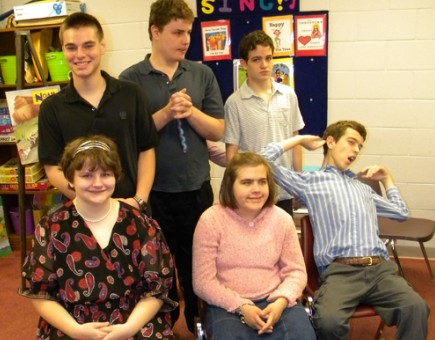
Image: Children involved with a ministry for special needs at a North Carolina church.

Page Icon Posted at 2:17 pm | Print Print | Permalink | Trackback | Comments (9)
divider

9 Responses to “Nice read, squishy nut graf”

  1. Jerry says:

    No reason is given, either, for New Jersey’s high rate of autism. Why exactly does that state have so many more cases of autism than other places?

    There is no known cause for autism so you’re asking for more than is known.

    I wonder if the comment about ‘backward chaining’ is linked to this blog posting http://blog.christianitytoday.com/women/2011/01/is_your_church_open_to_autism.html which also mentioned something similar?

    Like or Dislike: Thumb up 0 Thumb down 0

  2. Bobby says:

    There is no known cause for autism so you’re asking for more than is known.

    Am I supposed to know that? Or should the story tell me?

    Like or Dislike: Thumb up 0 Thumb down 0

  3. Jerry says:

    Am I supposed to know that? Or should the story tell me?

    That’s the old question about estimating the knowledge of the reader. Perhaps I’m wrong, but I think it’s common knowledge that there is no known cause for autism. But I don’t think it would have hurt and perhaps helped for a short mention of that fact.

    Like or Dislike: Thumb up 0 Thumb down 0

  4. Hector_St_Clare says:

    Re: There is no known cause for autism so you’re asking for more than is known.

    It depends what you mean by ‘cause’, but increasing age of the father is highly associated with autism. Men who father a child in their 40s have a five times higher risk of a child with autism than men who father a child while in their teens or twenties. (None of this, of course, is meant as a criticism of men who, for whatever reason, aren’t able to marry or become fathers at a younger age. Having children, whenever you are able to, is a really good thing to do. There are risks, though, and we should be aware of them).

    Like or Dislike: Thumb up 0 Thumb down 0

  5. Bobby says:

    So, theoretically, New Jersey’s rate could be higher because men are older when they father children?

    Like or Dislike: Thumb up 0 Thumb down 0

  6. Sarah Webber says:

    As a resident of NJ and mother of an autistic son, the state’s rate is probably higher, at least in part, because the services available to us are so good. We had incredible therapists during our time in Early Intervention (before the age of 3) and then when we were transferred to the programs in our township’s schools, the services got even better. I sing the praises of his teacher to the principal, gush about his case manager to anyone who will listen, hug his former case manager whenever I see her, pray regularly for the Director of the Child Study Team, etc. Autism is incredibly painful to experience as a family, but all the support from the state makes it survivable.

    I should also mention that our church also has a ministry to provide buddies for our kids (our son is autistic while our daughter has a Sensory Processing Disorder) so that they can attend Sunday school with their peers and we can go to the main service and everybody can have a great worship experience. It was founded by the head pastor and his wife because their youngest son has Down’s Syndrome. So my son wasn’t exactly the founding member, but the program, I’m sorry to say, has had to expand dramatically in recent years as many of my friends’ children have been diagnosed with other developmental disabilities, but our Children’s Ministry Director and her assistants have recruited heavily and it’s a rare Sunday when they don’t have enough buddies to cover all the classes. And this is in a vibrant church of about 500 people.

    My husband and I figure that in 30-40 years, we will have a better understanding of autism and what causes and why no version of autism is the same, even among siblings. We don’t expect to understand it all, ever, though. It’s on my list of questions to ask God when I meet him after my death. There are too many variants, which is why some diet or medicine-based therapies will work for a few kids, but not most (chelation, pro-biotics, gluten-free, etc.). The great news is that cognitive behavioral therapy, like is used in my son’s school, helps a great deal. We hope some day our son will “pass for normal” but understand he will always be different, in essentials.

    Like or Dislike: Thumb up 3 Thumb down 0

  7. Bobby says:

    Very interesting background, Sarah. Thanks for sharing.

    Like or Dislike: Thumb up 0 Thumb down 0

  8. Julia says:

    In the early 70s I knew a mother with a young child just diagnosed with autism. In those days, it was believed that autism develops in a normal child because of a cold mother who fails to emotionally attach to her child. The formerly vibrant friend was devastated at this news and was never the same again. So horrible and sad. I wonder how she took the news when the experts decided it wasn’t the mom’s fault, after all. No wonder there is now a reluctance to name the cause. I’ve been suspicious of statements assigning the “cause” of diseases and syndromes and conditions ever since.

    Like or Dislike: Thumb up 0 Thumb down 0

  9. Joel says:

    Other religions have also made efforts to be more inclusive of children with developmental disabilities…

    More inclusive than what? Is there any church (or synagogue or what have you) that’s exclusive of children with disabilities?

    This is the problem with using phrases like “increasing” or “growth.” A trend toward something is also a trend away from its opposite. If there’s a “a growing number of children with developmental disabilities who are being welcomed,” then logically there must be a shrinking number of them being turned away. The reporter cites one established case and the rest is vague references to disapproving parishioners or priests. Yet I’d be very surprised if these weren’t rare exceptions.

    (Disclaimer: I have Tourette’s, and so does my oldest son, who also has Asberger’s. Our anecdotal experience suggests that they are indeed exceptions, and certainly not the policy of any church.)

    My guess is that what’s growing is the reporter’s awareness of something that’s been the norm all along.

    Like or Dislike: Thumb up 1 Thumb down 0