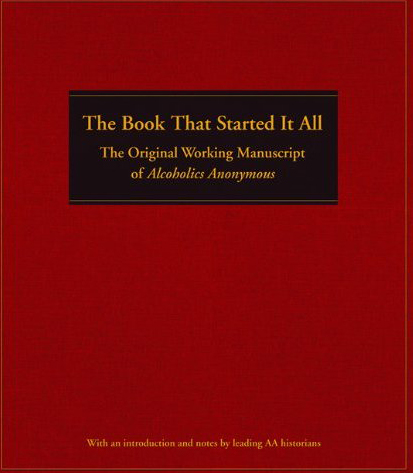
It’s the Holy Grail. It’s the holy writ. It’s as if the words “had appeared from somewhere on high.”
“The Book That Started It All” will be released to the public on Friday, and there’s a media storm a-brewin’.
If you’d like a copy, go outside first thing in the morning and wait for the heavens to open up and deliver it to you. Or if you’d prefer, try Amazon and Barnes & Noble.
The big deal is the release of the original working manuscript of the Big Book, the Bible of Alcoholics Anonymous. Now, this news is probably not quite the level of knowing which commandments were rejected before God settled on The Top 10 Thou Shalts and Thou Shalt Nots, but it’s big nonetheless. And yes, there’s a highly significant religion angle.
The top of the story from ABC News:
For decades, addicts have adhered to Alcoholics Anonymous’ 12 steps and the book that lays them out, informally known as the Big Book, as if the words in it had appeared from somewhere on high.
But it turns out that the original manuscript, written in 1939 by AA co-founder Bill Wilson, was heavily edited to make it less religious and more welcoming to people who did not consider themselves Christians. The original is being published next week as “The Book That Started it All.”
Sid Farrar, the editorial director of Hazelden Publishing, which is publishing the manuscript, called it “one of the more important documents in the movement.”
“This shows the book didn’t come down from heaven,” he said. “It wasn’t written by one person, but it was this remarkable group process.”
After being hidden for 70 years, the edits of the Big Book show there was debate, largely unknown until now, about how overtly to reference God and Christianity in the group’s tenets.
Michelle Boorstein of The Washington Post explains:
The group’s decision to use “higher power” and “God of your understanding” instead of “God” or “Jesus Christ” and to adopt a more inclusive tone was enormously important in making the deeply spiritual text accessible to the non-religious and non-Christian, AA historians and treatment experts say.
The editors softened Step 7 of AA’s renowned 12 Steps for example, by deleting a phrase that evoked church worship. “Humbly, on our knees, asked Him to remove our shortcomings - holding nothing back,” became “Humbly asked Him to remove our shortcomings.”
In the first chapter, a sentence that read “God has to work twenty-four hours a day in and through us, or we perish,” was edited to replace “God” with “faith,” and a question was added: “Who are we to say what God has to do?”
The Associated Press and the Minneapolis Star-Tribune offer other insightful coverage.
The basic tenor of the coverage: AA made a brilliant decision not to focus its 12-step program on a single faith (Christianity) and Higher Power (Jesus).
From ABC News:
Because it’s not exclusive, the text has since been adopted by many diverse faiths and also by those who struggle with addictions other than alcoholism, from drugs to gambling to sex.
The ABC report does include an alternative voice — from left of center, that is:
An alternative to AA called Smart Recovery, which was founded in 1994 and has about 600 meetings across the country, doesn’t use spirituality or religion in its program. AA is the biggest treatment program by far, with more than 2 million members.
“We have no objection to a higher power, but what we teach is not connected to that,” said Tom Horvath, Smart Recovery’s president. “That would be like if you’re going to medical school to learn how to treat cancer. I don’t care if you pray about it, but that’s not what I’m going to teach. It’s an entirely secular approach.”
ABC’s right-of-center voice? Sorry, but I caught no reference to Celebrate Recovery, which rejects AA’s concept of addicts choosing their own concept of a Higher Power and teaches that Jesus is the only sufficient Higher Power. Celebrate Recovery, associated with Rick Warren and Saddleback Church, has been implemented in more than 3,500 churches, according to a recent news story.
To her credit, Boorstein’s piece notes that AA’s 12-step program “has been retooled by groups ranging from Chabad (for Jews) to Rick Warren’s Celebrate Recovery (for evangelical Christians).”
She tacks on a dissenting voice at the end of her story:
Jack Cowley, a former prison warden who worked with AA for decades and now helps run faith-based prison programs, said the manuscript reflects “a cop-out” on Wilson’s part, to make an inherently religious process “the least confrontational.”
“The power is in the understanding of how Christ can apply these [steps],” Cowley said. “It’s the scripture where the power is, it’s not AA… . This is the same thing we’re doing today. We’re downplaying the faith issue to get more people.”
It’s interesting that much of the coverage focuses on AA’s role as a “spiritual but not religious” organization. AA, of course, is not a church. Then again, maybe it is.
A Time magazine writer explains:
While many AA members sincerely believe that the program is “spiritual, not religious,” and people from many faiths — even atheists — have found it helpful, as I wrote earlier, federal courts have unanimously ruled that coercing people to attend AA violates the constitutional separation of church and state.
By all means, click the links and read the stories. Is the coverage fair and the religion angle handled adequately? Do you see any ghosts?
|
| Posted at 3:31 pm | Print
| Permalink | Trackback |
Comments (20) |


September 30, 2010, at 4:26 pm
I didn’t know this was news. Earlier drafts of “Alcoholics Anonymous” have been around for years. I thik the best explanation of AA’s lack of overt religiosity comes from Father Meletios Webber in the book, “Steps of Transformation- An Orthodox Priest Explores the Twelve Steps”.
“In the course of the steps God himself becomes anonymous. God has to enter the veil of anonymity, since it is only in that form that He can be accepted by the alcoholic. God meets the alcoholic in the only form that the alcoholic is prepared to meet Him.” - Pg. 70
I don’t know that it is reasonable to compare AA and the much, much smaller atheist or religiously affiliated twelve step groups. Smart Recovery has 600 meetings across the country. I live in a mostly rural California county with almost 400 meetings a week in English and Spanish. I know San Francisco has 700 AA meetings a week. AA held an international convention in San Antonio, Texas this spring that was attended by 75,000 people from 90 different countries. I’m sort of pleased to add that a google search shows almost no press coverage for this event.
Finally, is “Alcoholics Anonymous” the “Bible of Alcoholic Anonymous”? I don’t think so. Like all of AA’s publications it represents a set of ideas that AA’s disparate membership has been able to reach agreement on. That’s all.
Like or Dislike:
0
0
September 30, 2010, at 5:43 pm
Jon, assume that’s a typo and you meant is “the Big Book” the “Bible of Alcoholics Anonymous”? Right?
Like or Dislike:
0
0
September 30, 2010, at 7:58 pm
I looked at various news stories and did not find anything I’d call a ghost except for one thing. I would have liked to see not only the ‘gee whiz’ announcement but also a bit of real life background about what the Anonymous groups are all about:
As part of a weight loss program I attended three meetings of Food Addicts in Recovery Anonymous a couple of years ago. What I experienced during those three meetings was that the attendees were living the Biblical injunction to be their brother’s (and sister’s) “keeper”.
An excerpt from http://foodaddicts.org/gratitude.html shows the spirit of what they are about:
Like or Dislike:
0
0
October 1, 2010, at 8:01 am
As to whether the Big Book is the bible of AA, the answer is an emphatic yes. There are passionate defenders of every word, and even groups which spend their time in exegesis. The best proof I can give of the reverence many people have for it is that when Bill Wilson said he had further thoughts and wanted to rewrite it, he was told that if he did he would be thrown out of AA.
Like or Dislike:
0
0
October 1, 2010, at 8:03 am
There are a few ghosts in here:
Patrick H. of Las Vegas knows that chapter well. He’s four years sober with help from AA, and he’s also an atheist.
“I kind of have a cafeteria plan, where you take the things that work for you and discard the things that don’t work,” he said.
from http://today.msnbc.msn.com/id/39408523/ns/today-books/
This, combined with Joe & Charlie’s recounting of “How it Works,” give me a chuckle. Of all the millions of AA members, they find one of the atheists who has relatively little sobriety.
Like or Dislike:
0
0
October 1, 2010, at 12:06 pm
Interesting insight, Jerry.
Thanks for your perspective, Thomas.
Appreciate you highlighting that ghost, Steve.
Like or Dislike:
0
0
October 1, 2010, at 2:29 pm
Bobby: Jon is not making a typo. The proper title of the “big book” is Alcoholics Anonymous.” His statement is perfectly correct.
I think the printing of the heretofore unpublished “original manuscript” raises many questions, especially as it is being published for profit by Hazeldon. How did Hazeldon obtain access to this? The text will be interesting nonetheless.
Steve, while the AA interviewed is no old-timer, like it or not, AA is a “cafeteria” program beyond not drinking. A prominent slogan is “Take what you like and leave the rest” particularly in Al-Anon. That’s what makes AA accessible to Christians of any stripe, Muslims, Buddhists, or atheists.
The “spiritual, not religious” claim is important around the fellowship. Like most of society younger (ie, post 1960s) AAs are less likely to participate in organized religion and many think it superior to be “spiritual, not religious.”
But the BB does tell AAs to see where religious people are right and encourages return to one’s faith with a renewed vigor.
Courts are calling AA religion (eg., a conviction based on subpoenaed AAs’ testimony, overturned) and continue to send folks with slips to be signed at meetings.
Like or Dislike:
0
0
October 1, 2010, at 2:32 pm
So, a friend of Lois Wilson’s sold this to Hazeldon and both profit from it. It should have been deeded to AA archives.
Like or Dislike:
0
0
October 1, 2010, at 2:34 pm
Ah, finally a post works. I have had several posts not take. I had a lot to say. I guess it’s a message from God.
One note: The proper title of the “big book” is “Alcoholics Anonymous”. Jon’s sentence is perfectly correct.
Like or Dislike:
0
0
October 1, 2010, at 4:42 pm
Excuse me, what is meant by SMART Recovery is ‘left of center’?
Is having a program that is based on Science, one that tracks and changes to reflect changes and new discoveries somehow ‘left’? I mean, seriously, what a nonsensical statement.
Like or Dislike:
0
0
October 1, 2010, at 4:46 pm
Peggy, not sure why your comments didn’t work immediately, but looks like they all showed up. Thanks for the clarification on the “Big Book” title.
Dean, in the context of this story, the AA program with its generic Higher Power is the center. To the left of that would be a program with no Higher Power. To the right would be a program with a defined Higher Power. That is what I meant. If that’s a “nonsensical statement,” it’s not the first of my lifetime, unfortunately.
Like or Dislike:
0
0
October 1, 2010, at 5:00 pm
Why label either as ‘left’ or ‘right’?
I would imagine simply pointing to the obvious differences from AA might be sufficent to establish that their is a range, of not only opinions, but of options as well.
Like or Dislike:
0
0
October 1, 2010, at 7:20 pm
Bobby: I hope you delete the duplicative ones!
Like or Dislike:
0
0
October 2, 2010, at 11:36 pm
I also tried to post on this thread twice, but they disappeared and haven’t reappeared. I though I might be on the Don’t-let-this-moron-post list, but maybe not.
Anyway, my comment on the NYT and ABC News article is just that despite presenting this manuscript as something new, they really say little that anyone who’s gone to some AA meetings wouldn’t know.
First, I saw a facsimile of a early manuscript about 10 years ago. I don’t know that it was the “original”, but it was certainly early. There were 10 or 14 steps, or something other than 12. The way I heard it, the 12 Steps started as six words: Find God, Clean House, Help Others.
Also, the debates over religion in the early groups is pretty well-known. You can hear a lot of stories, some of which are probably true.
The initial influence of the Oxfprd Group waned not due to religious indifference (or “inclusivity” to use the contemporary term), but due to a focus on sobriety. The way I heard it, an atheist got sober and stayed sober, much to the chagrin of the oldtimers, who thought of God in traditional, theistic terms. So they changed it to “God as we understood him”. Some now say “God as we understood God”. The point of the AA “higher power” is to counter the core problem of addiction: “self-will run rampant”. All that means is that the narcissism of the addict must give way to “something great than ourselves”. As a Christian, my “higher power” is the God and Father of Our Lord Jesus Christ. But one can sober with any higher power. And that’s all any AA person can claim, as a member of AA.
All of which is to say that this new book, despite the reporters presenting it as some kind of Dead Sea Scrolls of AA, or maybe the latest gnostic “gospel, probably will hold interest for awhile, but basically as a artifact - a costly one at $65.
Like or Dislike:
0
0
October 3, 2010, at 12:48 am
One slogan is “take what you want, and leave the rest.” Another slogan, however, is “Work the Steps of Die.” Another (from Wilson, 12x12) is “Unless each A.A. member follows to the best of his ability our suggested Twelve Steps to recovery, he almost certainly signs his own death warrant.”
There is some very specific theological assertions in the 12 Steps. For example, I am helpless and can only be “restored to sanity” by the Higher Power. I confess my sins before God, and God will remove my character defects. Despite some vagueness of wording, the 12 steps are making some very specific assertions about the nature of God: God (a.k.a., the Higher Power) is the One to Whom I confess my sins, the One who will restore me to sanity, the One to Whom I will pray, the One who will remove my defects of character, and the One that will provide me with a spiritual experience.
The Twelve Steps are inextricably bound with very specific ideas about the nature of God and God’s relationship to Man.
Like or Dislike:
1
0
October 3, 2010, at 1:38 pm
As a psychologist who has spent 19 years with SMART Recovery. BTW, SMART is an acronym for Self-Management And Recovery Training. In that time I have witnessed the successes resulting from offering people a choice, a non-religious option, an option based on the best science that a lay group can offer. In my practice I am able to offer even more of the best-practices approach that is both secular and science-based, but I still refer my clients to SMART Recovery.
I also support referring people to: Women for Sobriety, or SOS, or LifeRing Secular Recovery. SMART Recovery is not the only non-12-Step group as these uninformed sources imply with their limited coverage of a greater movement. The big message should be “There are many pathways to recovery” rather than ‘Our group has more meetings than your group’ which says nothing about the huge number of people who do not benefit from the 12-Steps even when they are put forth as the only way.
I encourage all those who are truly more concerned about people than promoting one True Path and a religio-spiritual agenda of faith in a Higher Power (whatever It is called), to learn about the other paths I have noted here. I’m sure those paths would be more open in terms of meetings and online support if the media and these blogs would offer more than one choice, then speak of those who rejoice in the success they have found in their groups.
Like or Dislike:
0
0
October 3, 2010, at 2:52 pm
As an individual who has enjoyed 12 continuous years of contented abstinence from alcohol, and who is a member of the board of directors of SMART Recovery, I applaud Dr. Steinberger’s post. I believe it is critically important that individuals desiring to recover from addiction be educated about the variety of pathways to recovery. AA and its 12 step progeny are helpful to many people, but many do not benefit from those programs. Tragically, often such individuals are led to believe that 12 step is the only valid approach, and that there is no hope for them outside that pathway. It breaks my heart to think of how many people have failed to receive effective treatment because they simply could not fit themselves within the 12 step paradigm.
Like or Dislike:
0
0
October 3, 2010, at 2:58 pm
Hey folks, just a reminder that GetReligion is interested in journalism/media coverage of religion. This is not the site to debate which methods of addiction recovery work best.
Like or Dislike:
0
0
October 3, 2010, at 9:50 pm
Steve -
Well, when doing an article about whether AA is religious or not, shouldn’t they ask an atheist AA member or two?
Like or Dislike:
0
0
October 18, 2010, at 1:17 am
As one of the few A.A. historians who actually contributed to the editing and commentary concerning “The Book That Started It All,” I welcome the release of this valuable part of the A.A. history puzzle. My extended comments, one by one, are and will be posted on my blog http://www.mauihistorian.blogspot.com.
For now, the most significant revelation that the manuscript itself establishes is that a “Dr. Howard” tried in vain to have “God” shoved out of the book and his idea of “faith” subsitituted in its place. Thus the manuscript shows that an effort was made to remove the word “Heavenly Father” from the important last line of Dr. Bob’s story on page 181 of the Big Book and substitute “faith” in its place. But Dr. Bob would have none of it. Neither, apparently, did the others like Wilson and Parkhurst who championed the manuscript. For very very often, the word “God” was circled, obviously for delation in favor of susbsituting “faith” instead. The efforts seem uniformly to have failed. And today, the word “God,” descriptions of Him as Creator, Maker, Heavenly Father, Father of Lights, and Father remain. In short, the attempt by some physician to insert universal faith into the heart of the Big Book FAILED. And some of the other items will be discussed as time goes by. God Bless, Dick B. http://www.dickb.com
Like or Dislike:
2
0