
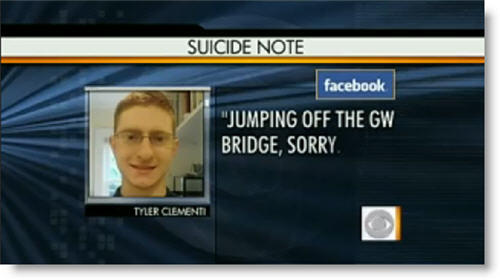
 It is with a certain sense of fear and trembling that I note that The New Yorker has published a long, detailed and emotionally devastating feature story on the Rutgers University case involving Dharun Ravi and the late Tyler Clementi. The double-deck headline on this "Reporter At Large" feature by Ian Parker is simple and eloquent:
The Story of a Suicide
Two college roommates, a webcam, and a tragedy
The crunch passage in this story is going to mystify some people and infuriate others.
As it turns out, this tragedy was quite complex and, in the end, if focused more on a digital and cultural disconnect between two people, more than an clash of beliefs. Even the prejudices at the heart of the story are hard to label. Thus, readers are told:
Clementi’s death became an international news story, fusing parental anxieties about the hidden worlds of teen-age computing, teen-age sex, and teen-age unkindness. ABC News and others reported that a sex tape had been posted on the Internet. CNN claimed that Clementi’s room had “become a prison” to him in the days before his death. Next Media Animation, the Taiwanese company that turns tabloid stories into cartoons, depicted Ravi and Wei reeling from the sight of Clementi having sex under a blanket. Ellen DeGeneres declared that Clementi had been “outed as being gay on the Internet and he killed himself. Something must be done.” ...
It became widely understood that a closeted student at Rutgers had committed suicide after video of him having sex with a man was secretly shot and posted online. In fact, there was no posting, no observed sex, and no closet.
This riveting story does, however, contain a religion angle and, if I am reading the story correctly, it appears that information that emerges in the future could add more details linked to faith. However, it appears -- as I suspected at the time -- that religion played no role whatsoever in the despicable actions and prejudices of Ravi. Here is a key paragraph from a post in which I urged reporters to seek religious facts related to this tragedy, not more speculation about motives and influences.
... Before we get pulled off the journalistic issues here, please note that I am actually saying that journalists need to probe the facts of these stories. Journalists need to find out if the bullying trends, right now, are linked to students who are acting on religious motives or acting on other motives. I, for one, suspect that the actions of the Rutgers students accused of broadcasting a sexual encounter between the late Tyler Clementi and another male were more inspired by reality television (think the sludge of “Jersey Shore,” if you must) than by religious doctrines.
The bottom line: Were these cyber-punks bar hoppers or members of a dorm Bible study? At Rutgers?
As it turns out, the only evangelicals involved in this case were inside the Clementi home.
 How do readers know that? The following passage from the feature is part of the reporter's attempt to offer practical, factual details about many of the cultural differences between the homes and communities that shaped these two young men.
Ravi drove a BMW in high school; Clementi didn’t have a car. Jane Clementi is a nurse. Joseph Clementi runs the public-works department in the nearby town of Hawthorne. They have two older sons, both of whom returned home after finishing college. Jane Clementi is active in the local Grace Church, which is affiliated with Willow Creek, the evangelical megachurch near Chicago. ...
An acquaintance who memorialized Clementi online wrote, “Tyler never said very much or interacted with the rest of the youth group at the church I attended with him.” This post is accompanied by a photograph of Clementi on a church outing in 2007. Sitting on a bus, he is staring at the camera; behind him, a girl is laughing and putting on lipstick. He seems out of step even with his own bright-orange T-shirt, which reads “Daytona Beach.”
As previously reported, Tyler Clementi did out himself to his parents shortly before heading to college. It is clear that his mother was disappointed, but also very supportive. There is no evidence -- at this point -- that his declaration changed his relationship with his parents. They seemed to relate to him in the same manner as before. After all, the family already included one gay son.
The details of the Internet-driven conflict between Ravi and Clementi are too detailed to mention here. In the end, it is clear that this is a Web-based tragedy -- in part because the roommates seem to have said next to nothing to each other of substance in face-to-face contacts. I will not attempt to summarize the any of the details in this mulch-layered report.
So what can be said? It appears that -- for reason of social class and technology, more than anything else -- Ravi was annoyed by Clementi, when this does appear to have been the case with his other gay associates or friends. This disconnection turned into cruelty that, when seen in detail, was shockingly mundane and banal. There were few, if any, known signs that Clementi was traumatized -- until he jumped.
The contents of Clementi's final handwritten note remain sealed. There could be additional details emerge and journalists will attempt, I am sure, to report them.
As I said in the lengthy and at times constructive comments thread after my earlier post on this subject, reporters are simply going to have to seek the facts in these kinds of cases and follow them wherever they go. That is going to be painful for people to write and others to read. Tragic stories are like that.
Once again: Comments should focus on the journalism issues in The New Yorker story. Thank you.