
GetReligion.org - GetReligion » “The press . . . just doesn’t get religion.” — William Schneider
member of beliefnet's blogheaven

Recent Posts

Church and the single life | Did the pope soften his stance on nuns? | Splitting the Catholic labels really fine | Old Catholics vs. the pope | Didn’t CNN fact check the holy popsicles? | Slow-pitch screamer on the Godbeat | In the end, Summer worked hard for her Lord | Same-sex marriage, celebration and “core values” | Has Time printed the worst Anglican article ever? | That Gray Lady Catholic same-sex unions scoop 2.0 | 2012 Archive >


Friday, January 13, 2012
Posted by tmatt
Share

Just what we needed, another mainstream media controversy about who is a Christian and who is not. This is getting ugly.

No, this is not another post about clashes between Mitt Romney insiders and the various brands of religious conservatives that are gathered, this time around, under the anybody-but-Mitt umbrella.

No, this time we have a problem out there at the very top of the journalistic food chain.

You see, it seems that there is at least one reporter and/or one copy editor at The New York Times who believes that Catholics are not Christians. Yes, you read that right.

Well, that’s one option for an amazing statement of fact that made it into print the other day. There is also a chance that the Times believes that either Southern Baptists or United Methodists are not Christians.

Anyway, one thing is sure. Some professional journalists at the Times seem to think that the believers in these three large and influential flocks are not part of the same religion. This means that they are not all Christians.

What in the heckfire, you should be asking, is the picky one talking about this time?

Now, I know that the GOP primary in South Carolina usually produces some wild politics and wild journalism and that these shenanigans are often linked to religion. Trust me, I get that. This time, one early salvo in the Great Gray Lady’s coverage of that political rodeo ran under the headline, “In South Carolina, Challenges Await on Ideology and Faith.”

Yes, the emphasis is on Mitt and his struggles to reach the Tea Party and religious conservatives. That sounds like this, in a passage that the Times crew probably has stored in a macro file so that reporters can insert it with a click of a button:

With little left to lose, Newt Gingrich and Gov. Rick Perry of Texas are already assailing him as a heartless job killer in South Carolina, a state hit far harder by the economic downturn than Iowa and New Hampshire were.

But just fending off that attack may not be enough. He is also heading smack into an issue that has followed him through his national
political career: his Mormon faith and the suspicion many evangelical Christians have of it.

This leads us to the pivotal, bizarre reference:

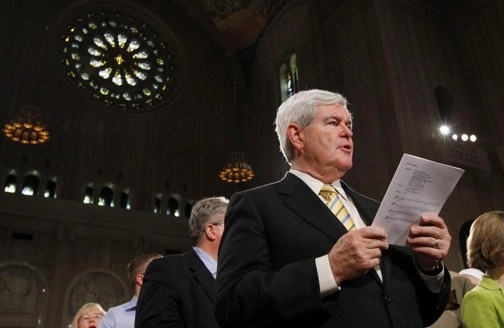
Mr. Perry made a point of appealing to evangelical voters with a giant prayer rally in Texas shortly before he announced his presidential campaign and has shown crosses in his advertisements; Mr. Gingrich, who is on his third marriage and third religion, has visited with pastors to assure them of his new but deep Roman Catholicism and his apologies to God.

OK, folks, it’s time for Religion 101. Class is now in session.

Christianity is a religion.

Judaism is a religion.

Islam is a religion.

Hinduism is a religion.

This is rather obvious stuff. Right?

Catholicism is a church, the biggest church that is part of the ancient tap root of the religion that is Christianity.

The Southern Baptist Convention is a convention, an association of highly independent congregations that work together — when they wish to do so — at the local, associational, state and national levels. The United Methodist Church is the largest of the denominations that historians often call the “Seven Sisters” of liberal American Protestantism. Both of these huge flocks are also part of the religion that is Christianity.

Gingrich has changed pews three times, each time joining a larger branch of Christianity.

He has not changed religions three times. That is simply wrong.

This is the kind of issue that is so basic that it is not even covered in the Associated Press Stylebook. This fact is simply too basic for that.

Duh. Correction please?

Page Icon Posted at 12:00 pm | Print Print | Permalink | Trackback | Comments (19)
divider

19 Responses to “Gingrich hops from religion to religion?”

  1. Cliff says:

    A comment about one of your comments: By describing the SBC as a “convention” do you mean that it is not also a denomination?

    The SBC’s founding documents (and later records) use the term “denomination” to describe the SBC. Historians also refer to the SBC as a denomination - hence the popular description of the SBC as “the largest Protestant denomination in the United States”

    Well-loved. Like or Dislike: Thumb up 4 Thumb down 0

  2. Joanie Casey says:

    Wonderful, succinct and straight-to-the-point post. Thank you for clarifying the distinction and relationship between the Christian religion and the many churches that attempt to disseminate it’s Truth. I particularly like the sentence, “Catholicism is a church, the biggest church that is part of the ancient tap root of the religion that is Christianity.”

    Well-loved. Like or Dislike: Thumb up 6 Thumb down 0

  3. Jeff says:

    A college freshman in Religion 101 knows more about religion than many reporters at The New York Times, and I suspect that religion is not the only subject about which some New York Times reporters would fail to pass a freshman exam.

    Well-loved. Like or Dislike: Thumb up 10 Thumb down 4

  4. tmatt says:

    CLIFF:

    You are right. I simply used the word “convention” to draw a line between the SBC and the United Methodists, simply noting some variety in the forms.

    There are, however, Baptists who INSIST the SBC is not a denomination. That’s a topic some will debate.

    Well-loved. Like or Dislike: Thumb up 4 Thumb down 0

  5. Mollie says:

    When the New York Times wrote that W.B. Yeats was the author of a passage in Hebrews (since corrected), I wrote:

    It is funny, though, to have the paper that wants to issue a religious litmus test to political candidates fail the entrance exam on Biblical literacy.

    This isn’t an issue of Biblical literacy but the point stands. Editor, heal thyself!

    Well-loved. Like or Dislike: Thumb up 13 Thumb down 2

  6. Sean says:

    Sorry to add a note of disagreement, but the word “religion” is broader than you give it credit for. If someone asked Newt what “religion” he is, he might very well answer “Catholic.” If he did, no one would misunderstand him. Catholicism may also be part of the Christian religion, but to describe someone’s religion as Catholic strikes me as perfectly acceptable usage. The same goes for Baptist.

    Now, if someone answered “Shia” to the question, that sounds a little more odd to my ears, but perhaps that’s because the English language has had much less occasion to analyze the different parts that make up Islam than it has Christianity.

    So basically, I think Catholocism, “Baptistism” (to coin a word) and Christianity can all be described as “religions” in English. I take it you disagree, but this is really a matter of English usage, isn’t it? Is it really as cut-and-dried simple as you claim?

    Well-loved. Like or Dislike: Thumb up 12 Thumb down 7

  7. tmatt says:

    SEAN:

    Sorry, but the goal in journalism is to use words as precisely as possible, not as vaguely as possible.

    It is definitely an insult to tell members of these three churches that they are in different religions.

    Now, if you asked an individual, “What is your religion?” and the person elects to go more specific than is needed, that is totally understandable.

    The Times should — as newspapers do all the time — have said that Newt has changed his church affiliation three times, or that he has been part of three branches of Christianity. There are all kinds of smooth ways to say this accurately.

    Well-loved. Like or Dislike: Thumb up 10 Thumb down 1

  8. Jerry says:

    Your point is obviously correct for those that use common definitions of the word Christian. Maybe the NY Times searched for are catholics christians and turned up this article (and many others like it):

    10 Scriptural Reasons Roman Catholics Are not Christian
    http://www.born-again-christian.info/catholics.htm

    I do cut ignorant reporters a wee bit of slack given that the definition of who is a Christian and who is not is controversial in some quarters. And the level of ignorance on the internet about this topic is to my eyes larger than usual.

    Hot debate. What do you think? Thumb up 4 Thumb down 4

  9. tmatt says:

    JOANIE:

    Well, I wrote that sentence as an Eastern Orthodox Christian. It takes one to know one.

    ;-)

    Well-loved. Like or Dislike: Thumb up 5 Thumb down 1

  10. David Rupert says:

    Many of the different labels of churches grew out of just history. The Swedes banded together. The Irish and so on. Some are geographic. But ultimately, Christian faith groups share the Christian faith. And to report otherwise and perpetuate ignorance is just … lazy.

    David, http://www.Redletterbelievers.com

    Hot debate. What do you think? Thumb up 2 Thumb down 6

  11. Will says:

    Having once written to the Times to complain about a piece which referred to Catholicism, Protestantism and Judaism as “three faiths”, implying they were all equally distant from each other, I am sensitive to this.

    But if they had written that “Gingrich has belonged to three different denominations”, would you complain about THAT? :-)

    Well-loved. Like or Dislike: Thumb up 6 Thumb down 0

  12. tmatt says:

    You refer, perhaps, to George’s post the other day?

    http://www.getreligion.org/2012/01/is-the-catholic-church-a-denomination/

    Simply stated, there are Catholics who would complain — with historical justification — about that reference. There are FEW Southern Baptists who might complain, but not many.

    And there are ways to make that point without any kind of dispute. Why not use the simple, accurate language?

    Like or Dislike: Thumb up 3 Thumb down 0

  13. Passing By says:

    I ran Jerry’s are catholics christian google. The first page (10 links) included the link Jerry provided, which derives from Jack Chick, as did another on the page. There was a couple of other similar links, then four pro-Catholic apologetics. The other two links were basically informational, one to a Wiki article that identifies the RCC as a “Christian Church”.

    My point being that if a reporter settled on anything from Jack Chick, said reporter would have to be grossly incompetent or simply malicious. My suspicion is that the Times reporter was neither.

    Like or Dislike: Thumb up 3 Thumb down 1

  14. carl says:

    Saying that someone changes ‘religion’ makes him seem more calculating and utilitarian then simply saying he changed ‘denominations.’ The former may be used to imply he has no real use for the new religion per se, but only the benefit he may derive from being associated with it. This is especially true if he changes ‘religions’ more than once. …

    Like or Dislike: Thumb up 0 Thumb down 5

  15. Bain Wellington says:

    If I might pick up remarks @6 and @15, the Catholic Church has long held (see citations at CCC 818) that all who have been justified by faith in Baptism are members of Christ’s body, and have a right to be called Christian.

    But the terms “Christian”, “Christianity” and “the Christian religion” have to be handled with some subtlety.

    Mr. Gingrich has evidently changed his religious convictions twice. Since (again, according to Catholic teaching) man’s social nature itself requires that he should give external expression to his internal acts of religion: that he should share with others in matters religious; and that he should profess his religion in community, it follows, does it not, that he has changed religion twice? See DH, n.3

    As a basic human right, he is entitled to practise and profess his religion in public and in private. The religion which he practises and professes now is not that which he practised and professed in his youth, is it?

    If you had asked Blessed John Henry Newman if he had changed his religion in 1845, he would have affirmed as much – see Discourse 12 of the Discourses to Mixed Congregations [1849] where he contrasts the Catholic Church with “all religions that ever were” - including the Anglican communion which he refers to as “the Established religion”.

    This usage (“religion” as applying to the corporate beliefs, life, and activity not only of non-Christians but also of non-Catholic Christians) can be observed in the 1983 revision of Canon Law (see canon 1366, for example) as also in the assertion that the Catholic Church is the one true religion (DH, n.1).

    Well-loved. Like or Dislike: Thumb up 5 Thumb down 0

  16. JWB says:

    Here’s a sentence from Mark Twain’s autobiography: “During his apprenticeship in St. Louis he joined a number of churches, one after another, and taught in their Sunday-schools—changing his Sunday-school every time he changed his religion.” Does tmatt think that Twain was wrong to write the sentence that way? Does he have a better command of the English language than Twain did? Perhaps usage has changed somewhat since Twain’s time, so a phrase like “changed his religion” could properly refer to intra-Christian changes of affiliation back then but it can’t now. That’s an empirical question which requires empirical investigation and consideration of evidence. Has tmatt conducted any sort of search of recent writing (say google books, or a nexis-like database of newspaper stories) to see to what extent recent writers have or have not used “changed his religion” or similar phrases to refer to that sort of situation? How many examples of recent usage consistent with the NYT usage would it take for tmatt to change his mind?* Or would such counterexamples simply be taken as further confirmation that he is right and everyone else is wrong?

    *Here’s a sentence from a memoir published in 2004 (The Growing Seasons: An American Boyhood Before the War, by Samuel Hynes): “We had two religions in our house—Nellie’s Catholicism, which was everyday, audible, and public, like the radio, and my father’s Presbyterianism, which was silent and private.” I was once told by an elderly Anglo-Catholic priest that when he was in seminary (which must have been around 1950) they sang a song to the tune of a then-current Pepsi jingle that began “Seabury-Western hits the spot / Two religions, that’s a lot” — which made sense only if the High and Low factions of the Episcopal Church were categorized as separate “religions.” It was, of course, a joke, but perhaps a helpful reminder that many words can have broader and narrower meanings according to context.

    Well-loved. Like or Dislike: Thumb up 6 Thumb down 1

  17. bob says:

    I know a fair number of people who have converted to one variety of christian from another and have no problem at all calling the old one a “different religion”. Details on demand. The NYT may have spoken with some ignorance about basic christian beliefs but a lot of people who do know those things would use the same terminology.

    Like or Dislike: Thumb up 2 Thumb down 0

  18. Julia says:

    FWIW

    I’m watching the re-runs of The Tudors on BBC and the characters are always mentioning “The Old Religion” when discussing the people who are recusants.

    Like or Dislike: Thumb up 0 Thumb down 0

  19. Eric says:

    I don’t see any problem with calling Catholicism a different religion than evangelicalism or, more broadly, Protestantism, even though in a sense they’re only different expressions of Christianity.

    If Gingrich had converted to Mormonism or Unificationism or Jehovah’s Witnesses-ism, for example, would you consider that a different religion — and, from a journalistic perspective, why or why not?

    OK, then, suppose a candidate had switched from a type of Pentecostalism (such as Assemblies of God) that believes in a traditional definition of the Trinity to one that doesn’t (such as the United Pentecostal Church). Would that be switching religions, or denominations, or what?

    Again, from a journalistic perspective, what would you consider a “branch of Christianity”?

    I agree that the graf about Gingrich switching religions three times was awkward at best; I would have probably said he switched his religious affiliation, which is more neutral. But it seems to me that by objecting so strongly to considering Catholicism a different religion that you’re opening a can of worms that as a journalist you’d rather avoid.

    Like or Dislike: Thumb up 1 Thumb down 0