
GetReligion.org - GetReligion » “The press . . . just doesn’t get religion.” — William Schneider
member of beliefnet's blogheaven

Recent Posts

Church and the single life | Did the pope soften his stance on nuns? | Splitting the Catholic labels really fine | Old Catholics vs. the pope | Didn’t CNN fact check the holy popsicles? | Slow-pitch screamer on the Godbeat | In the end, Summer worked hard for her Lord | Same-sex marriage, celebration and “core values” | Has Time printed the worst Anglican article ever? | That Gray Lady Catholic same-sex unions scoop 2.0 | 2012 Archive >


Sunday, March 20, 2011
Posted by tmatt
Share

What you think of the following Calgary Herald story will largely depend on how you answer the following two questions.

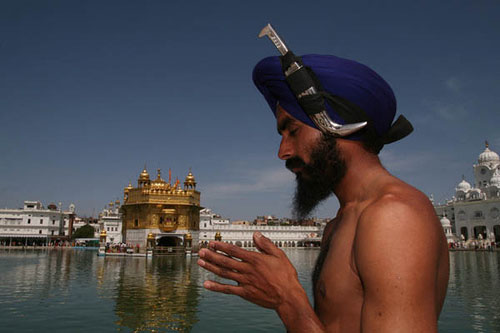
First, do you know what a “kirpan” is?

Second, do you know much about the role that the “kirpan” plays in the traditions and faith of Sikh believers?

This story may provide enough information for readers who do not know the answer to that first question to make sense of the horrible event covered in this report. But there is no way in the world that it contains enough information and context to allow readers who cannot answer the second question to make sense of what happened.

Talk about not getting religion!

Now, with all of that said, here is the top of the report.

A Calgary man has been charged with murder in India after his wife was killed days after their son’s wedding, according to police and media reports out of that country.

Police there say Gurdial Singh, who reportedly has lived with his wife and family in Calgary for about a year, also injured a son who tried to help his mother following a fight in a village in Punjab. The 57-year-old man and his wife, Ranjit Kaur, 55, were arguing at a home in the village of Raipur …, police said, when Gurdial Singh used a kirpan to slit his wife’s throat.

“It was suddenly, and it was over some property matters and domestic problems,” Hoshiarpur police Insp. Paramjeet Singh said. … “He ran away from the scene of the crime and he is arrested now and in police custody.”

Obviously, the kirpan is a bladed weapon and the attack was shocking enough. However, it does not appear that the editors of the Herald realized the incredibly important, much more than symbolic role that this dagger plays in this unique world religion.

While any metaphor is risky in this territory, this is something like a Christian husband beating his wife to death with a large cross.

This is a complex issue, so where to start? There is much to read on the role of the kirpan in this faith (this Google search will help), but the following piece of a short online essay will help get readers up to speed:

The Kirpan (ceremonial sword) worn by followers of the Sikh religion sometimes raises questions or concerns among people who are unfamiliar with the religion or it’s tenants. The Kirpan is an ingrained part of the Sikh religion and is in many ways it’s religious symbolism is similar to the Cross in Christianity. Just as a Cross is worn by devout Christians, baptized Sikhs are required to wear the Kirpan. …

The Kirpan has been an integral part of the Sikh religion since it’s early inception and has a very sacred religious symbolism for Sikhs. To suggest that it is a “dagger,” or a “weapon” or merely a cultural symbol is both misleading and offensive to Sikhs. To Sikhs the Kirpan is religiously symbolic of their spirituality and the constant struggle of good and morality over the forces of evil and injustice, both on a individual as well as social level. …

It was Guru Gobind Singh, the final living Sikh prophet who formally instituted the mandatory requirement for all baptized Sikhs to wear the Kirpan at all times. He instituted the current Sikh baptism ceremony in 1699 which is referred to as the “baptism of the sword” (khanda di pahul). During the ceremony sugar crystals and water are stirred in a steel bowl with a Kirpan before the initiate drinks the mixture. During the baptism ceremony the initiate is instructed in the duties and obligations of becoming a Khalsa (one belonging to the Divine). The Khalsa is expected to live by the high moral standards of the Sikh Gurus at all times which includes such things as abstaining from smoking, drinking and other intoxicants, performing daily prayers and always maintaining the distinctive physical symbols of Sikhism on their person. The most noticeable of these being uncut hair and carrying the Kirpan.

So this was not your typical act of fatal domestic violence, was it? No, this was — unless I am reading something wrong — an astonishingly sacrilegious act at the level of Sikh doctrine as well as, obviously, a horrendous crime.

Could the average reader have understood this? No way. How does a newspaper correct this kind of sin of omission?

Page Icon Posted at 2:47 pm | Print Print | Permalink | Trackback | Comments (15)
divider

15 Responses to “Astonishing gap in bloody Sikh story”

  1. DarrellB says:

    It is an even more astonishing omission when one considers that there was some controversy recently when the province of Quebec’s legislature, citing security concerns, voted unanimously to ban the kirpan from their buildings.

    Well-loved. Like or Dislike: Thumb up 5 Thumb down 0

  2. Brian says:

    Any police report coming out of India should be taken with a grain of salt. The Indian police is known to embellish or even fabricate stories at the behest of politicians. Its no secret that the Indian govt. works tirelessly to destabilize Sikhs in the diaspora. I doubt it is merely coincidence that a Canadian man in India committed this crime, at the same time that Sikhs in Canada are fighting for their right to wear the kirpan. The kirpan has never before been used as a murder weapon in any nation, so why now? Indian police also use torture to extract false confessions. Most recently, Sohan Singh (an outspoken critic of the Indian govt.) was picked up from his home and tortured in jail. He eventually succumbed to his injuries in prison. Indian police have yet to comply with a request for an independent autopsy. http://thelinkpaper.ca/?p=5625

    Well-loved. Like or Dislike: Thumb up 11 Thumb down 2

  3. Jo Chopra says:

    The kirpan was also the closest thing to hand. That’s important to remember. Sikh men wear daggers as an everyday thing. While they have an important religious significance, WHEN CONSIDERED, they are also simply another thing a man puts on every day - as a Western man might don a tie. The comparison to a Christian man beating his wife to death with a cross is not apt - what Christian man wears a cross large enough to serve as a weapon?

    The kirpan is indeed a religious symbol, but to the man using it to beat his wife to death, it’s just another tool of patriarchy. Don’t get distracted by its symbolism.

    Hot debate. What do you think? Thumb up 3 Thumb down 15

  4. tmatt says:

    Like I said, the image with the cross attack was a mere metaphor of the centrality of the symbol to the faith.

    Well-loved. Like or Dislike: Thumb up 6 Thumb down 0

  5. Jerry says:

    I was at least one person who suggested this story and I think you nailed the problem. No matter what the real facts of the case, the news story should have devoted a few words to the meaning of the Kirpan to a Sikh.

    Well-loved. Like or Dislike: Thumb up 7 Thumb down 0

  6. joye says:

    Perhaps it would satisfy Jo Chopra if you compared it to a Catholic monk of an order such as the Carthusians that wears the rosary daily, using that rosary to strangle someone. (These rosaries hanging from the belt are usually quite sturdy and would easily handle that.)

    What strikes me is how, apart from the kirpan, mundane that the crime is. The motives are the motives typical of a fight ending in spousal murder anywhere: in-law problems, arguments about property, stress from a large outlay of money for a wedding, etc. I’m not sure where Jo Chopra is getting the “patriarchy”. You could change the names and the locale to Robert Smith and Elizabeth Dunning, professors at Ivy U, or to Juan and Maria Rodriguez, fruit pickers in California, or to Yoshiro and Keiko Yamagata, middle-class in Okinawa, but keep the basic motive story the same, and I wouldn’t be surprised in any of the cases. The crime and motive are ordinary, the weapon is not. The kirpan IS what makes this story newsworthy on anything other than a purely local level.

    Well-loved. Like or Dislike: Thumb up 10 Thumb down 0

  7. Jeff says:

    Kirpan is one of the 5 mandatory articles of faith for Sikhs. The word is a combination of “Kirpa” and “Aan”. Kirpa means mercy and Aan means grace. The purpose of the Kirpan is to remind a Sikh that he must defend and protect those who are too weak to protect themselves. This notion is in accord with the Sikh idea of a “Sant Sipahi” (Saint Soldier). Only “Amritdhari” (Baptized) Sikhs are allowed to carry the Kirpan. Thus it is expected that a carrier of the Kirpan has an appropriate knowledge of scripture to understand its purpose. Almost all Kirpans today are blunted and are not considered lethal. Mis-use of the Kirpan out of its intended context is akin to blasphemy.

    Well-loved. Like or Dislike: Thumb up 9 Thumb down 0

  8. Michel says:

    Whatever else you might say about the Calgary Herald, you cannot reasonably conclude that they don’t know the significance of the kirpan. It was a huge story in Canada and particularly in Calgary a few years ago. They, and most of their readers know all about the religious role of the kirpan.

    What might not be so obvious to Get Religion readers is that during the debate about the kirpan and whether it counted as a concealed weapon that took place here, liberal defenders of multiculturalism swore that it was absolutely inconceivable that any Sikh would actually use one as a weapon. You can be sure that the editors know that if this story turns out to be legitimate it will reignite the debate and seriously discredit multiculturalism in Canada.

    Well-loved. Like or Dislike: Thumb up 6 Thumb down 0

  9. Anthony says:

    Sikhs have been living abroad for over 100 years now, and there has never been a crime like this involving the Kirpan. I agree with Brian. The timing of this could not be any worse for the Sikh community, which is struggling for the right to wear the Kirpan in Quebec. The fact that the suspect is a Canadian Sikh man in India is all too coincidental. The Indian govt. and Canadian Sikhs have been at odds since the attack on the Golden Temple. Suspicion of foul-play on the part of Indian police should not be overlooked.

    Well-loved. Like or Dislike: Thumb up 9 Thumb down 2

  10. tmatt says:

    The goal, here, is to discuss the media issues in the post — not to dwell on attacks on the Sikhs.

    Like or Dislike: Thumb up 3 Thumb down 0

  11. Amardeep says:

    As a couple of other folks have stated, this seems like a story planted by the Indian (read Hindu) intelligence agency in Canadian newspapers to paint a negative picture of Sikhs in that country. …

    Like or Dislike: Thumb up 5 Thumb down 2

  12. berenike says:

    Carthusians don’t wear a rosary :) I think they did so for a couple of centuries, somewhere along the way.

    just fyi.

    Like or Dislike: Thumb up 0 Thumb down 1

  13. Garrett says:

    Great post!…I would like to point out for all readers that in the article published by the media there is NO mention of the kirpan being used at all in the actual article! Lets keep in mind there are various different types of swords knives out there, it just so happens a Sikh killed his wife therefore automatically it is assumed he used a kirpan. When it could have even been a kitchen knife for all we know! In India it is not uncommon to see a sword in people’s houses although the shape is that of a Kirpan it is NOT referred as one instead it is called a “Tulwar”. The shape of the Kirpan has been around even before Sikhism came in to existence. The shape is inspired by both Hindu and Persian weapons at the time.

    Like or Dislike: Thumb up 2 Thumb down 1

  14. Jerry says:

    Garrett raises the interesting point about what the murder weapon is since the story we read does indeed call it a Kirpan and not a “Tulwar”. So I wonder what news stories called it a “Tulwar” since I’ve not seen any and a google news search turned up empty.

    seriously discredit multiculturalism in Canada

    I’d really like to see some attention on this issue which is all too prevalent. If one person does something wrong, that invalidates millions of others who are perfectly law abiding. It’s extends to blaming Christianity and the billions who at least aspire to be true to the faith when there are in fact a minority who act badly.

    Like or Dislike: Thumb up 2 Thumb down 0

  15. Marianne says:

    Interesting point about the talwar. I do know that in Sikh weddings, it is customary for the wife’s family to present the groom with a sword. In punjabi, talwar means sword. The groom accepts the sword as a gesture to the bride’s family to agree to protect her. The article states that the incident took place after their son’s wedding, so it is reasonable to assume that the sword would have been lying somewhere close by. The talwar and kirpan are two totally different things. I can see how someone who is not familiar with the religion could mix them up.

    Like or Dislike: Thumb up 0 Thumb down 0