
 Earlier this week, Mollie suggested that it's a good time to cover religious liberty questions, as we've seen continual reports of violence in Egypt, Iraq and other countries.
In religious liberty issues, sometimes we'll see an added dimension to violence, such as socioeconomics, race or sex. The New York Times has suggested sex differences may be part of Pakistan's blasphemy law implications.
Unfortunately, the compelling piece falls under the headline, "In Realm of Religion, Women Lose Out." The reporter probably did not write the headline, but some copy editor decided that it was fine to generalize that women lose out when it comes to religion. Can you imagine a headline like "In Realm of Men, Women Lose Out"? Doesn't seem fair, does it?
The story still adds an interesting angle to the coverage of Asia Bibi, the woman who was sentenced to death under Pakistan's blasphemy laws.
The exact words that led to Ms. Bibi's prosecution under sections 295-B and C of the Pakistan Penal Code have not been disclosed. Since this was an accusation of blasphemy, to repeat the words would be to perpetuate blasphemy. But they were apparently enough to make her the first woman to be sentenced to death under this law.
Ms. Bibi is still in prison. Early last year, newspapers and human rights advocates said that she had been paraded in the streets and gang-raped in Nankana Sahib, a district in Punjab Province.
This appears to advance the story of Bibi's sentence, showing how the blasphemy laws in Pakistan may have additional consequences for women. Further into the story, however, Nilanjana S. Roy uses some questionable sources.
The Pakistani novelist Kamila Shamsie notes blasphemy is considered unacceptable regardless of the gender of the accused. But the prohibition is part of a larger web of laws and practices that have served to restrict women's rights.
Not to diminish Shamsie's work (which I have not read) or what she is suggesting, but since when do journalists turn to novelists as authorities on the law? Has she done any research or reporting in this area? The reporter goes on to give examples of women in other countries who have faces threats related to religion.
For Asian women, the consequences of questioning or speaking out against faith can be particularly sharp. In the early 1990s, the Bangladeshi writer Taslima Nasreen's novel "Lajja" was banned, and she was forced into exile for her apparently blasphemous call for revisions to the Koran.
...In Britain, performances of "Behzti," a play by Gurpreet Bhatti set in a gudwara, or Sikh temple, that explored sexual violence within the British Sikh community were shut down shortly after its opening in 2004. The play was not performed until 2010, six years after Ms. Bhatti had received abduction and death threats from other Sikhs.
We see a generalization of "Asian women" "speaking out against faith," but not all countries are alike. It's unclear whether these particular examples are a result of something like Pakistan's blasphemy law, for example. Further into the article, we see another "expert" on how religion oppresses women.
"Religion is assumed to be the domain of men, and women do not have much role in it," the Indian feminist writer and publisher Urvashi Butalia said in an interview.
"But women generally do not have the right to question religion--this is something men hold on to tightly, and it's not only in Islam. Look at all those so-called honor killings in India--all of them under the guise of religious sanction and tradition."
Again, Butalia is entitled to her opinion and perhaps she has done some research in this area, but why is she seen as an authority in this area? Does her title as a feminist writer and publisher in Asia qualify her to discuss sexual violence and blasphemy laws in Pakistan?
This is the context against which Aasia Bibi's case should be understood.
Pakistan's blasphemy laws have been used to persecute ethnic and religious minorities and to shut down free speech in general. But, as Ms. Butalia noted, there is a difference even here for women like Ms. Bibi and now Ms. Rehman.
..."If Aasia was let off, she would have to live all her life with the tag of 'bad' or 'blasphemous' woman," she said. "The threat of rape--the traditional weapon of humiliation--is very real indeed."
Despite some of the sources and generalizations, the story shows how laws with religious overtones can also carry implications for people based on their sex. Hopefully we'll see more reporters continue to explore these kinds of angles.
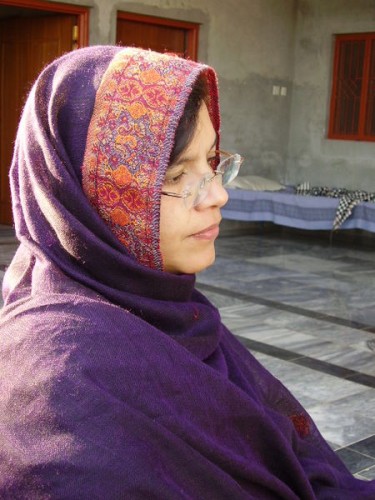
Image of Pakistani woman via Wikimedia Commons.
