
GetReligion.org - GetReligion » “The press . . . just doesn’t get religion.” — William Schneider
member of beliefnet's blogheaven

Recent Posts

Splitting the Catholic labels really fine | Old Catholics vs. the pope | Didn’t CNN fact check the holy popsicles? | Slow-pitch screamer on the Godbeat | In the end, Summer worked hard for her Lord | Same-sex marriage, celebration and “core values” | Has Time printed the worst Anglican article ever? | That Gray Lady Catholic same-sex unions scoop 2.0 | Gay marriage and the French Catholic vote | Pacquiao, homosexuality, tolerance and reading comprehension | 2012 Archive >


Thursday, December 23, 2010
Posted by tmatt
Share

As you would imagine, I have to do a lot of writing about The Holidays — or the holy days? — this time of year. I try not to think about this as writing about Christmas, because most of what is going on really has nothing to do with Christmas.

The key, you see, is to realize that there is no ONE WAY of celebrating this period of time on the calendar. There are many things going on. The other day I had a blitz of invitations to talk about that on radio shows, in part because of that GetReligion piece that I wrote entitled “When is Christmas, anyway?” Then I did my Scripps Howard column on an issue related to that, as well.

As I said the other day, I think the key — an ironic one at that — can be found in the following simple typology. Here in America, and thus in the media of most of the world, we actually have three things going on (at the very least). Let me repeat them again:

* The Holidays or Xmas: Begins formally on Black Friday after Thanksgiving, but the advertisements and cable movies keep creeping earlier and earlier. Ends on Dec. 15, with remnants through Dec. 25. Basically, this is the secular season defined by the shopping mall.

* Christmas: Begins on Black Friday or roughly Dec. 1 in most churches. Continues through Dec. 25, with most parties and concerts occurring between Dec. 7 and about Dec. 15, so as not to veer too far away from office parties, school Holiday events and complex family travel plans.

* The Feast of the Nativity of Our Lord and Savior Jesus Christ: Rarely celebrated. It begins on Dec. 25 and runs for 12 days, ending at Epiphany (there are a few variations on the ending). While traces of this season lingered in some parts of our culture until the early 20th Century, it is now all but extinct.

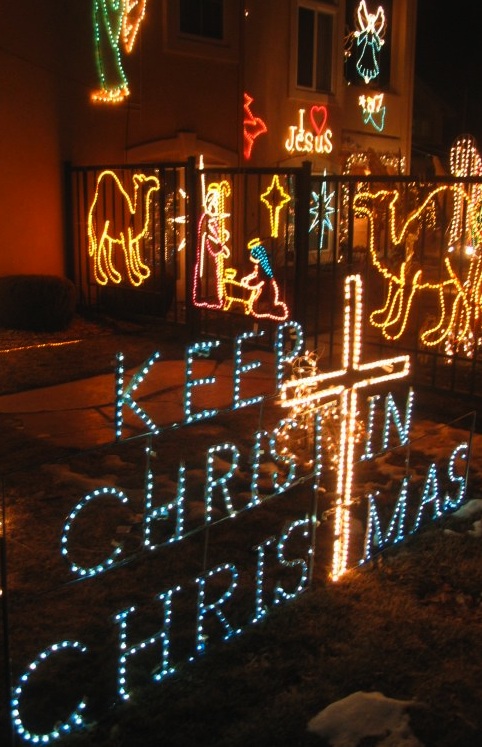
Now, what does all of this have to do with the “Christmas wars,” campaigns to “Keep Christ in Christmas” and other clashes that spill so much ink this time of year?

There are so many ironies to note (and even more if and when you explore Hanukkah). As a reader recently noted, some people us the term “Xmas” in place of Christmas, thinking that creates some distance from religious content. But, of course, the “X” is a symbol for Christ. So there. And “The Holidays” is sort for “holy days.” And so forth and so on.

But the key to the wars is that most American churches are actually trying to base their religious observances on the same calendar that is being used by people who are celebrating the non-religious version of the season. Many Christians are trying to defend “Christmas” on the same secular ground — calendar-wise — as those who want to commercialize, standardize or neuter the season. They are fighting to save “Christmas” on Dec. 10 or 11 or whatnot. There are all kinds of solid journalism stories woven into this clash of the three holiday or holy days seasons.

You can see that in Cathy Lynn Grossman’s news feature the other day in USA Today about how people who don’t give a flip about Jesus Christ have — family by family, office by office, school by school — developed a somewhat emotional but essentially commercial version of something that a few people still call “Christmas.” This is option No. 1 in my earlier typology.

The bottom line is something that has been seen for several decades in serious polling about religion in America. A very high number of citizens in this country are essentially non-religious, especially at Christmas. Others have been spray painted with faith, but the FORM of their lives (think calendar issues and day-to-day choices) are almost identical to those with no faith at all.

And at Christmas? They’re in my option No. 2.

Come-all-ye-partiers trumps O Come, All Ye Faithful for more than one in three people asked about their Christmas activities in a survey by LifeWay Research, a Nashville-based Christian research organization.

“A lot of Americans celebrate Christmas like they participate in yoga: unaware and unconcerned about its religious roots,” says Ed Stetzer, LifeWay president and a Southern Baptist pastor.

Who is to blame? Here are Grossman’s key bullets:

* Blame the little kids. Although 37% say Christmas is more religious when children are present, 43% says it’s less so. “That’s not surprising when more people encourage belief in Santa Claus (38%) than tell the Gospel story (28%) that undergirds the whole of Christianity,” Stetzer says. …

* Blame the grown kids. Many Millennials, ages 18 to 29, have switched the lights off on the Nativity scene. More than half (56%) say their Christmas is “primarily” religious; three in four (74%) told LifeWay many of the things they enjoy this season “have nothing to do with the birth of Jesus.”

“Christmas for them is just something you do because you’re an American these days,” says Drew Dyck, 33, who works in church ministry for Christianity Today International. …

Esther Fleece, 28, of Colorado Springs, who works as the link to Millennials for the evangelical Focus on the Family, has many friends less tied to faith. “Black Friday has become a national holiday, and Christmas is like Valentine’s Day with more presents,” she says. …

* Blame the secularism sweeping the culture. “Christmas is no longer about baby Jesus and the sheep. It’s solstice with friends, Saturnalia at the office party. At Thanksgiving, you say grace, but at Christmas, you take a break and you go on vacation. It’s been downgraded on the religion calendar,” says Barry Kosmin, director of the Institute for the Study of Secularism in Society and Culture at Trinity College in Hartford, Conn.

See, there’s the key word — calendar.

What does it mean to say that Christmas has “been downgraded on the religion calendar”? Which religious calendar? Whose religious calendar? The one that coincides with the local shopping mall or the actual traditions linked to Christmas? I think what Grossman is writing about is an important reality, which is that life is getting more and more vague in the “Christmas” camp — option No. 2 — in which millions of Americans want a religious Christmas, sort of, but on the calendar and the terms of The Holidays or Xmas. There is all kinds of evidence that this is true and there are plenty of valid stories linked to that.

The bottom line for journalists who are struggling to cover all of this: Christmas is now three different seasons. There are valid, interesting, poignant and complex stories in all three. Cover them.

Still, covering The Holidays is not the same as covering “Christmas” which is not the same thing as covering the Nativity of of Our Lord and Savior Jesus Christ. In a way, this makes life easier for journalists this time of year. There are more things to cover. You just have to keep them straight in your mind. Good luck with that.

Page Icon Posted at 5:08 pm | Print Print | Permalink | Trackback | Comments (12)
divider

12 Responses to “Vote is in: Christ isn’t in Xmas”

  1. Jerry says:

    Yes, that’s true but, on the other hand, we have:
    Yes, Virginia, There Is A Spiritual Side To Santa Claus

    In my mind Santa Claus is a perfect metaphor for a generous, supernatural loving benefactor. Wouldn’t it be terrific if older grade school children could somehow come to make that cognitive transition in some smooth way that might enhance their faith and hope for blessings that are even bigger?

    The famous editorial “Yes, Virginia, There Is a Santa Claus” written in the New York Sun editorial page in 1897, ends with “Thank God! Santa Claus lives. A thousand years from now, Virginia, nay 10 times a thousand, he will continue to make glad the heart of childhood.”

    Like or Dislike: Thumb up 2 Thumb down 0

  2. tmatt says:

    So you are pleased to be in camp 1 or,sort of, in 2.

    So what is the news story there? Other than covering some people in No. 2 acting out against Santa Claus with shotguns.

    Like or Dislike: Thumb up 0 Thumb down 6

  3. Jerry says:

    So you are pleased to be in camp 1 or,sort of, in 2.

    So what is the news story there? Other than covering some people in No. 2 acting out against Santa Claus with shotguns.

    Asking me a personal question like that is dangerous because I’m tempted to answer you at length. But let’s just say that I love the Light in all the places where it exists and I find that light in Christ. And I’m happy to celebrate the birth of Jesus as the light at the winter solstice because that marks the furthest extent of the darkness and the return of light. So I’m personally in none of those camps.

    The story, as I tried but failed to say, is that children don’t fit in the categories you outlined. The “yes, Virginia” as well as the updated one I referred to illustrate that point.

    Like or Dislike: Thumb up 3 Thumb down 0

  4. Chris says:

    tmatt: How do you characterize people who are Christian, but do not belong to a liturgically-based denomination? Many enjoy the secular aspects of Christmas, but it may not really resonate as a religious event for them—because it was not part of their church tradition. Many Christian denominations had no services on Christmas or Christmas eve at all 30 or 40 years ago, and have only turned to them in recent years because of the pressure of #2. I suspect the majority of liturgical Christians combine #2 and #3. And a lot of what we hang on Christmas in the US (even liturgically) is Northern Hemisphere stuff, especially the ideas about light and winter solstice. In the southern hemisphere it is high summer!
    Maybe we liturgical Christians need to put more emphasis on Easter?

    Like or Dislike: Thumb up 1 Thumb down 0

  5. Michel says:

    I know how this is going to sound but there is a fact and it ought to be a relevant fact from a journalism perspective both for this story and the one above about the growing secularization of my country Canada.

    And the fact is this: this secularization of a major Christian feast corresponds exactly to the rise of liberal Christianity. I know, I know, you’re thinking another guy who wants to turn the clock back. But I most emphatically am not that.

    The real story here is of a problem that was recognized decades ago and solutions were proposed and those solutions have been an unmitigated failure. Go back to the Charlie Brown Christmas special that we discussed a while ago. The whole theme of that show was the commercialization of Christmas. You can go even further back to movies like The Bishop’s Wife and see the same issues. Decades ago Christians recognized this was a problem and the solutions they have proposed have all failed.

    That’s the real news here. It’s a story of failure. And the media let the churches get away with it. No other institution could fail as miserably as the liberal Christian churches are failing and not be bluntly asked why.

    By the way, here in Canada, we don’t celebrate Thanksgiving in late November so our Christmas season begins the day after Halloween. You can go into stores on Halloween and see the witches coming down and the Santas going up.

    Like or Dislike: Thumb up 3 Thumb down 0

  6. Julia says:

    There’s the Christmas that most people mean when they talk about the “real meaning” of Christmas. That’s being nice and friendly to each other exhibited by generosity. That sentiment seems to have been invented by Dickens’ A Christmas Carol.

    That sentiment is the basis for the story about the loving, generous woman who sold her hair to buy her husband a gift at Christmas not knowing that the loving, generous husband had bought her a comb for her beautiful, long hair.

    That niceness & generosity is at the base of Andy Williams’ “It’s the Most Wonderful Time of the Year” and even “It’s a Wonderful Life”.

    Definitely tmatt’s Type #1, but I’ve observed it often outranks and is more meaningful than the actual Nativity to many church-going Christians you would think belong in at least Type #2, if not Type #3.

    The season is now all about warm, fuzzy feelings even to Christians. That’s what “the real meaning of Christmas” is to most people these days - except for Linus, of course.

    Like or Dislike: Thumb up 0 Thumb down 0

  7. Julia says:

    And a lot of what we hang on Christmas in the US (even liturgically) is Northern Hemisphere stuff, especially the ideas about light and winter solstice. In the southern hemisphere it is high summer!

    Interesting.

    The Gospels and the liturgical year with its symbolisms were put together in Europe and the Near East/Western Asia long, long before those people knew about the Southern Hemisphere or had sailed there and discovered its opposite seasons.

    Maybe we liturgical Christians need to put more emphasis on Easter?

    Officially, Easter/the Resurrection of the Lord is the most important day on the liturgical calendar, by far. But its symbolism is tied up with spring and new life. In the Southern Hemisphere the celebration of the Resurrection is in the autumn not spring. Same problem.

    Like or Dislike: Thumb up 1 Thumb down 0

  8. Lee says:

    ”* The Feast of the Nativity of Our Lord and Savior Jesus Christ: Rarely celebrated. It begins on Dec. 25 and runs for 12 days, ending at Epiphany (there are a few variations on the ending). While traces of this season lingered in some parts of our culture until the early 20th Century, it is now all but extinct.”

    Rarely Celebrated? Roman Catholic, Lutheran and Episcopal liturgical calendars celebrate the twelve days of Christmas ending with Epiphany and with Advent starting the four weeks before Christmas. Millions of people in America celebrate Christmas in this fashion. All but extinct? Hardly.

    Like or Dislike: Thumb up 2 Thumb down 0

  9. Will says:

    As a reader recently noted, some people us the term “Xmas” in place of Christmas, thinking that creates some distance from religious content

    And I keep seeing neo-pagans using “Xtians”, and acting as though they are scoring some tremendous point which we are too stupid to understand. I even saw one writer asserting that “we need” a distinction between “Xtian” and “Xian”. As he did not bother to say which was which, he presumably considered it obvious to all thinking beings.
    As there is no way to tell without being, uh, initiated whether the particular poster is going to use the “it’s an abbreviation, so how can you be so stupid as to take offense” rationale, or the “it is obvious that I am using the label for a particular nefarious subset of Christians, so how can you be so stupid as to think I mean you?” one, this does not communicate, it PREVENTS communication.

    Like or Dislike: Thumb up 0 Thumb down 0

  10. Hector says:

    Re: And a lot of what we hang on Christmas in the US (even liturgically) is Northern Hemisphere stuff, especially the ideas about light and winter solstice. In the southern hemisphere it is high summer!

    More specifically, it’s Northern European (and North American) stuff.

    In Southern Europe and the Mediterranean region (which, of course, includes the Palestinian homeland of Jesus), ‘winter’ means something different than it means in northern Europe. Winter in the Mediterranean region is the cool, (relatively) wet growing season; summer is the hot, dry season in which most plants are dormant. This is related to why, if I recall correctly, the Spanish language distinguishes ‘invierno’ and ‘verano’ based on moisture, not temperature. In Central America, paradoxically for us, they call ‘summer’ the dry season from November through January or so. (I’m going off what I’ve been told by friends who have lived/travelled there, so feel free to correct me.)

    People who say that Christmas was invented to cheer people up in the dark days of winter, simply don’t know what they’re talking about. In a place like Palestine, winter is the _good_ time of year; it’s the summer season that is relatively tough to live through.

    Like or Dislike: Thumb up 0 Thumb down 0

  11. Hector says:

    Lee,

    Unfortunately, not enough Roman Catholics, Episcopalian/Anglicans, or Lutherans actually go to church nowadays. That’s the problem. (Though the RCs tend to do a little better on this metric than my church).

    If we took our own faith more seriously, then perhaps the secular world would take it more seriously as well.

    Like or Dislike: Thumb up 1 Thumb down 0

  12. sheena tan says:

    ”* The Feast of the Nativity of Our Lord and Savior Jesus Christ: Rarely celebrated. It begins on Dec. 25 and runs for 12 days, ending at Epiphany (there are a few variations on the ending). While traces of this season lingered in some parts of our culture until the early 20th Century, it is now all but extinct.”

    Like or Dislike: Thumb up 0 Thumb down 0