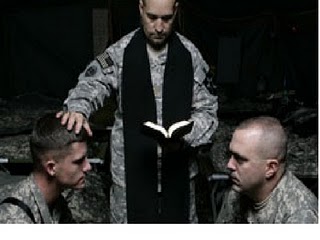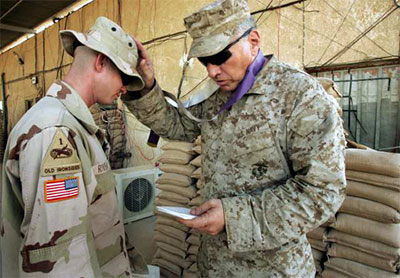
It seems that we are going to see more mainstream coverage of those debates about religious liberty, military chaplains and Don’t Ask, Don’t Tell.” So let’s back up and note a few basic fact, some of which were handled quite well in that CNN.com report that I praised the other day in the post called, “Chaplain questions older than DADT.”
As that title implied, I wanted to note that church-state questions about military chaplains are not new.
The military powers that be have been arguing for a long time about doctrinal and legal issues linked to public prayers, God talk, preaching, evangelism/proselytism and a variety of subjects. Tensions between the traditionalist camp and what the oldline-Universalist-progressive camp are not new. It’s much harder for an evangelical, charismatic of Anglo-Catholic Episcopal priest to lead a wide variety of vague rites that mesh with various other traditions than for a liberal Episcopal priest to do that same. It’s easier for a Reform rabbi to function in a state-funded religious environment than it is for a Southern Baptist, a Missouri-Synod Lutheran or an Eastern Orthodox priest (to name a few examples).
These hot-button issues almost always revolve around public expressions of doctrine, as opposed to silent, private beliefs.
When looking at DADT, however, the current state of things clearly affects the left as well as the right. As mentioned in the GetReligion comments pages, clergy in religious groups that favor DADT repeal have had their hands tied in public ministries to gays and lesbians in the military.
However, the must crucial question is not whether many doctrinal traditionalists will have to leave the military if DADT is repealed. The real question is whether many will leave rather than face punishment for public or even one-on-one expressions of their religious beliefs. Thus, it was important that the CNN.com story included this crucial slice of the Pentagon DADT report:
Despite the fact they would not pull their endorsements for chaplains, “A significant portion of the respondents did suggest that a change in policies resulting in chaplains’ free exercise of religion or free speech rights being curtailed would lead them to withdraw their endorsement,” the report said.
Or, as Metropolitan Jonah of the Orthodox Church in America put it in a letter to the chaplains board:
“If our chaplains were in any way … prohibited from denouncing such behavior as sinful and self-destructive, it would create an impediment to their service in the military. If such an attitude were regarded as ‘prejudice’ or the denunciation of homosexuality as ‘hate language,’ or the like, we would be forced to pull out our chaplains from military service.”
So there is much more to this story than what happens if DADT is repealed. The question is how DADT repeal (or the continuation of the policy) will affect the ministry of military chaplains — liberal and conservative — and the rights of the soldiers that they serve — liberal and conservative.
This brings us to the new story on these issues in the Washington Post, which adds some useful information on the point of view of liberal clergy, such as:
The Rev. Dennis Camp, a retired Army colonel, said it pained him when gay soldiers came to him to complain of the burden they felt from keeping their sexuality a secret. They could not display pictures of their loved ones or talk freely about their personal lives, he recalled. But he could not encourage them to be honest about their orientation, he said.
“They were forced by the situation, the system, to be dishonest, and that took its toll on them. And me,” said Camp, a United Methodist minister who retired in 1996 after 27 years of service. “It was horrible. Right from the beginning I was saying, ‘This is bad. This is wrong. It really has no place in our military community.’ “
Yet in the paragraphs immediately before these lines, the Post framed the debate in the following manner:
The authors of the report noted that only three out of the 145 chaplains who participated in focus groups suggested that they would quit or retire if the law was changed. Many chaplains expressed opposition to repeal, while many others said they would not object, according to the report.
“In the course of our review, we heard some chaplains condemn in the strongest possible terms homosexuality as a sin and an abomination, and inform us that they would refuse to in any way support, comfort, or assist someone they knew to be homosexual,” the report stated. “In equally strong terms, other chaplains, including those who also believe homosexuality is a sin, informed us that ‘we are all sinners,’ and that it is a chaplain’s duty to care for all Service members.”
Once again, repeal is not the ultimate issue for the leaders of traditional religious groups. The issue is hidden in that phrase “care for all Service members.” Does “care” equal acceptance of homosexual activity? For example, I cannot imagine many traditional clergy actually saying that they would “refuse to in any way support, comfort, or assist someone they knew to be homosexual.”
Really? Did the Pentagon offer any direct quotes from chaplains expressing those views, or is that an official bureaucratic interpretation of what women and men said in these interviews? What is the legal content of those words “support,” “comfort” and “assist”?
The Post report does offer the following information from someone who is worried about protecting the rights of clergy who advocate traditional views on sexuality issues.
Many conservatives worry that lifting the policy would muzzle chaplains whose religions require them to preach against homosexuality. The Rev. Douglas E. Lee, a retired Presbyterian Air Force chaplain and brigadier general who now counsels and credentials chaplains, said chaplains generally point out their views on homosexuality before counseling a service member on that issue. He worried that military policies may prohibit even that level of conversation if “don’t ask, don’t tell” is repealed, even though Pentagon officials have not recommended any change to the policy governing chaplains’ behavior.
“There’s a strong possibility that a chaplain wouldn’t be allowed to proclaim what their own faith believes, and not give people the information they need to be a good Christian or a good Muslim or what have you,” he said. “If there’s no protection for the chaplain to be able to speak according to his faith group, that might affect the number of chaplains we recruit or our ability to do our duty for the troops.”
Once again, note the following inserted — but valid — commentary noting that Lee made these comments, “even though Pentagon officials have not recommended any change to the policy governing chaplains’ behavior.”
That’s true, although the Pentagon would find itself involved in court cases challenging those policies. Where are the crucial decisions being made, these days, on these kinds of moral and cultural issues?
Meanwhile, the CNN.com report was much stronger in this regard, since it noted that the current policies that guide the work of military chaplains already contain the very tensions about the public and one-on-one expressions of doctrine that are now being linked to the DADT debate. Again, here is that section of the CNN.com story:
“Existing regulations state that chaplains ‘will not be required to perform a religious role … in worship services, command ceremonies, or other events, if doing so would be in variance with the tenets or practices of their faith.’ At the same time, regulations state that ‘Chaplains care for all Service members, including those who claim no religious faith, facilitate the religious requirements of personnel of all faiths, provide faith-specific ministries, and advise the command.’ “
Once again, define the word “care.”
In other words, these doctrinal tensions are not new. The DADT debates are merely the latest chapter in a larger church-state story, once in which voices on the left and right must be reported accurately.
|
| Posted at 12:14 pm | Print
| Permalink | Trackback |
Comments (14) |


December 3, 2010, at 12:39 pm
I have a feeling that there is a missing part to this sentence:
“they would refuse to in any way support, comfort, or assist someone they knew to be homosexual”
that would add greater nuance. I doubt many chaplains would refuse ALL support, comfort, and assistance to someone they knew to be homosexual. I think the missing piece regards providing support/comfort/assistance with regards to homosexual behavior and/or lifestyle. I wonder if that nuance is clear in the original comments (or from how the questions were phrased) or in the report.
Since the debate will inevitably come down to non-intrinsically-religious services provided by chaplains (such as counseling, etc) that would be an important nuance to examine. It would also be good to compare it to how chaplains today are protected/not protected with regard to how they provide religious and non-religious services to servicemen engaged in other lifestyles not approved by their doctrine - such as cohabitation.
Like or Dislike:
0
0
December 3, 2010, at 12:42 pm
Of course, the moment I raise some of these issues with my mainline/oldine clergy colleagues, they usually fall back into “well, there probably shouldn’t be military chaplains anyhow, just counselors.”
Congrats, Gene Roddenberry.
Like or Dislike:
3
0
December 3, 2010, at 1:15 pm
I see we’re back to the old comment system
Word substitution time:
said chaplains generally point out their views on drinking before counseling a service member on that issue.
said chaplains generally point out their views on divorce before counseling a service member on that issue.
Oh really, before counseling someone who has a drinking problem or is considering divorce a chaplain “points out” that they believe drinking or divorce is evil? If I went to a chaplain with a problem and was lectured before hand on the full list of what a chaplain considered to be evil, I’d leave immediately and look for someone more likely to suffer publicans and other sinners. Because that is what “points out” and “before” says to me.
And it’s often true that the presenting problems are not the real, underlying problems, so that statement also displays profound ignorance about what a real counselor does or should do.
And really, why is being gay any different to a chaplain than anything else they believe is a sin? And do we really want chaplains who act in such an unloving and unprofessional manner with service men and women? Do we really want a list on each chaplain’s door about all the thoughts, words and deeds they consider to be, ipso facto, sinful?
Like or Dislike:
2
1
December 3, 2010, at 1:36 pm
A chaplain’s main job isn’t to “care” for troops. It’s to make sure troops can exercise their religious freedom in the military.
Like or Dislike:
1
0
December 3, 2010, at 1:59 pm
Jerry, it’s probably best to get clear before beginning any kind of counselling or advice-seeking what’s the point of view of the person doing the counselling or advice-giving (even if he or she starts off with “It’s not my place to tell you what to do, I’m just here to listen”).
A Roman Catholic chaplain might be presumed to consider divorce impermissible, but still attempt to help someone with marital problems. Now, if the expectation on the part of the person seeking help is that divorce should be one of the options, better to find out beforehand rather than half-way through, don’t you think?
Like or Dislike:
3
0
December 3, 2010, at 2:21 pm
Jerry, after 25 years in the military and now being ordained, I know of no chaplains of any denomination I encountered who would not care for a homosexual, nor do I know of any who would right up front talk about behavior before they even knew what the issue is; however, the difference in the behavior you mention like drinking or divorce is that the military member seeking care knows that it is bad behavior or a sinful situation. There is a concerted effort on the part of some in the gay community to suppress/eliminate any public mention of 2000 years of Christain theology regarding God’s creation of gender and human sexuality (not homosexual orientation or homosexuals) still believed by the majority of Christian faith traditions. In today’s climate, I can easily see a chaplain who is teaching a religious ed class, facilitating a bible study, or preaching on a Sunday about human sexuality being accused of discrimination or hate speech by a homosexual group on a post or base and that is what many are concerned about. There is evidence with things like the shutting down of religious adoption agencies and even the elimination of spousal benefits at some Church staff agencies due to homosexual civil partnership and marriage laws. Many faith groups are concerned and uneasy about being forced to keep quiet about sexual morality or indirectly support what they sincerely believe are sinful gay unions with good reason. There is an agressive attempt now by a small segment of the population to do just that.
Like or Dislike:
3
1
December 3, 2010, at 3:49 pm
JERRY:
We went back to the old system because we couldn’t find a way to smoothly monitor new posts in the midst of our crazed daily schedules. That’s essential.
Also, the REPLY TO COMMENTS option was creating even more arguments between commenters and less reaction with the posts. That’s bad.
****
On alcohol and divorce: I am not aware of a culture-shaking debate on the religious doctrine status of those two realities NOR whether they should be the basis of legal claims of protected minority status under civil rights laws.
Like or Dislike:
0
0
December 3, 2010, at 3:51 pm
If a lot of chaplains resign over this issue, the social structure of the chaplaincy will change. Perhaps when the dust settles nobody will have their hands tied.
Like or Dislike:
0
1
December 3, 2010, at 4:24 pm
Ray, that’s a good point about drinking - that was a bad example on my part. But divorce is another matter, some denominations consider divorce to be a sin and some do not.
But also, your points caused me to consider the difference between acts by individuals and attitudes of groups. The words that motivated me to post are there and, at best, badly stated, but it is also true that some will scream “hate speech” even as they engage in hate speech themselves by vehemently attacking those with different beliefs. And those legitimate concerns do need to be addressed.
I can hope that at least a few stories on this topic focus on the majority who have a will to get along and find a way to deal with the situation as opposed to the minorities who don’t have that will.
Like or Dislike:
0
0
December 3, 2010, at 6:30 pm
For the record, the Catholic Faith doesn’t teach that divorce is a “sin” per se. Sins are generally involved, but a divorce may at times be necessary. The issue comes with re-marriage, since a civil divorce doesn’t end a valid, sacramental marriage.
Like or Dislike:
0
1
December 4, 2010, at 12:14 am
I think the divorce/remarriage and drinking questions are good parallels here. While they do not have interest groups backing them the way homosexual behavior does, they are issues which are both common in the military and there is a broad diversity of opinion on them within the Christian community and the religious community more broadly. If a Roman Catholic chaplain told someone that their impending remarriage was a sin, or taught publicly that remarriage is sinful, would they get in trouble? What about a Baptist/fundamentalist chaplain counseled or taught against all drinking? I’d like to see coverage of how this is handled today.
-John
Like or Dislike:
3
0
December 4, 2010, at 9:26 am
Re: A Roman Catholic chaplain might be presumed to consider divorce impermissible,
Technical point: divorce isn’t a sin. Remarriage or any other sexual activity after the divorce is a sin (unless the first spouse dies or the marriage was annulled). The requirement is that divorced people be abstinent.
And the idea that ‘there isn’t a culture shaking debate’ on divorce is hilarious. There was a culture-shaking debate on the issue, in the sixties and seventies, and our side lost. That doesn’t mean that Christians should not continue to express what they believe about divorce, even though the broader culture disagrees.
Like or Dislike:
0
0
December 4, 2010, at 6:51 pm
I don’t know how the chaplains were polled. But the media is playing up the polls of military personnel as if they were done with a professionalism of a Rasmussen Poll or a Gallup Poll and to frost the cake are spinning the polls pro-gay . The Boston Globe combined two stats to inflate a purported acceptance of gays in the military. Yet one of those stats could have been added to another stat that would have indicated a very negative result.
However, a lot of military men seem to be calling into talk shows complaining that the surveys were bogus, fraudulent, inept. For example, repeatedly servicemen complained that those on combat duty found it very difficult to respond—-but it was the combat units whose members could get their opinions in who were the most negative to the idea of gays openly serving. Thus the inability of many other combat soldiers to be counted skewed the results in a pro-gay direction.
One news account I heard derided the combat units’ results—but isn’t that what the military is all about. It isn’t a jobs or social work or social reform agency.
I have seen many stories headlining the poll, but no analysis on how it was done or its potential shortcomings. It should be asked: Is the media purposely avoiding analysis of the poll????
Another news article—taking the possibly inept poll as gospel— rejoiced that “ONLY” 30% of the military were strongly against gays openly serving. ONLY??? One-third of our military being potentially demoralized should hardly be described as “ONLY.” That “ONLY” could likely devastate military recruitment and re-enlistments. But that is what the political Left seems to have wanted for decades anyway.
Like or Dislike:
2
2
December 4, 2010, at 10:19 pm
The big point here is that, while a base shrink is obligated to report problems to the commanding officer, chaplains can hold their tongues despite direct orders to talk.
Btw — Fr. Z has an interesting post today about the severe shortage of Catholic priests in the military chaplain service, and how these priests are apparently being gotten rid of, despite the severe need. It’s sad and bizarre that some folks in the military just don’t understand that Catholics really really need access to the Sacraments, or that discouraging Catholic chaplains goes against military tradition.
But then, it’s amazing how few people “get” the importance of military chaplains at all. You’ll notice that in all the years that Stargate and its spinoffs have been on the air, they’ve never had a chaplain character. (Lots of times, this has caused serious military improprieties on the show; and if you were fighting a secret war with false gods, you would really really need chaplains a lot.)
Like or Dislike:
2
0