
 Every now and then, news coverage of a topic or an idea gets into the digital bloodstream and simply, as the popular saying puts it, "goes viral." It really helps if the story is given a punch headline that causes lots of people to click "comment" or to post notes on Facebook. You know the game.
That happened recently with a CNN news report that ran with the headline, "Author: More teens becoming 'fake' Christians." By the time reporter John Blake had written additional comments about his own piece over at the CNN religion blog, the "fake" Christians had mutated. The headline there was, " 'Mutant' Christians?"
Every now and then, news coverage of a topic or an idea gets into the digital bloodstream and simply, as the popular saying puts it, "goes viral." It really helps if the story is given a punch headline that causes lots of people to click "comment" or to post notes on Facebook. You know the game.
That happened recently with a CNN news report that ran with the headline, "Author: More teens becoming 'fake' Christians." By the time reporter John Blake had written additional comments about his own piece over at the CNN religion blog, the "fake" Christians had mutated. The headline there was, " 'Mutant' Christians?"
So what was the germ that started this virus?
If you're the parent of a Christian teenager, Kenda Creasy Dean has this warning: Your child is following a "mutant" form of Christianity, and you may be responsible.
Dean says more American teenagers are embracing what she calls "moralistic therapeutic deism." Translation: It's a watered-down faith that portrays God as a "divine therapist" whose chief goal is to boost people's self-esteem.
Dean is a minister, a professor at Princeton Theological Seminary and the author of "Almost Christian," a new book that argues that many parents and pastors are unwittingly passing on this self-serving strain of Christianity. She says this "imposter'' faith is one reason teenagers abandon churches.
"If this is the God they're seeing in church, they are right to leave us in the dust," Dean says. "Churches don't give them enough to be passionate about."
The story tells us that this concept -- "moralistic therapeutic deism" -- grew out of interviews linked to the National Study of Youth and Religion, which was based on interviews with at least 3,300 American teenagers between 13 and 17. The study included Catholics and Protestants, liberals and conservatives.
The bottom line?
Many teenagers thought that God simply wanted them to feel good and do good -- what the study's researchers called "moralistic therapeutic deism."
Now this is really interesting material.
But there is a problem. It seems that the CNN team does not realize that the concept of "Moralistic Therapeutic Deism" has been around for quite some time now. For example, sociologist Christian Smith -- the director of the National Study of Youth and Religion -- articulated its mushy doctrines this way in a journal article in 2008.
1. A God exists who created and orders the world and watches over human life on earth.
2. God wants people to be good, nice, and fair to each other, as taught in the Bible and by most world religions.
3. The central goal of life is to be happy and to feel good about oneself.
4. God does not need to be particularly involved in one's life except when he is needed to resolve a problem.
5. Good people go to heaven when they die.
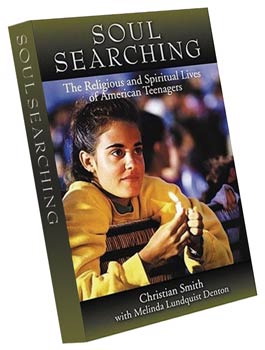 These principles could also be found in his 2005 book "Soul Searching: The Religious and Spiritual Lives of American Teenagers," co-written with Melina Lundquist Denton. I ran into Smith and wrote about the MTD anti-creed in 2008.
This is fascinating and disturbing territory and, clearly, is linked to many important stories. The only real question I have about the CNN report is whether anyone plugged the term "Moralistic Therapeutic Deism" into a search engine to see what else has been written about this concept.
I have not read Dean's book. I think that it is highly likely, since it is new, that it openly references the work of Smith and Denton. It is even possible that they worked on that groundbreaking study together.
But did anyone at CNN read the book? Did anyone realize that this term, that these concepts, did not begin with her? In other words, what does it mean to write that "more American teenagers are embracing what [Dean] calls "moralistic therapeutic deism"?
The CNN report goes on to reference some interesting people who offer insights into the phenomenon described by Dean. It's valid material. However, the story never mentions Smith and Denton.
In another story about Dean's book, veteran Godbeat pro Bob Smietana of the Nashville Tennessean clears up some of the confusion with the following wording:
Dean is the author of "Almost Christian," a book based on the National Study of Youth and Religion, the largest study of faith and young people in United States history. Dean was one of the researchers involved in the project and interviewed dozens of young people about their faith.
Researchers found that most young people believe in something they labeled "Moralistic Therapeutic Deism.''
That's better. It is likely that the researchers all began using the term in their work. However, there no question who launched the concept into public discourse several years ago. The CNN story is solid -- but needed to be much more specific about the origins of the very concepts that readers found so provocative.