
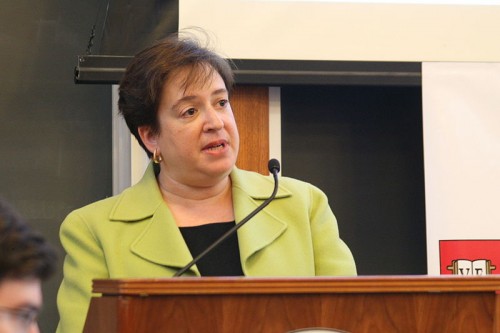
 As reporters dig into Elena Kagan's sparse record, they'll look at any and every angle that might help us know how she might rule on Supreme Court cases.
Earlier, Mollie looked at some initial coverage of Kagan's nomination. She noted that The New York Times briefly covered Kagan's religious background but left us hanging. The original story said that Kagan challenged her family's rabbi over her bat mitzvah. Today, Lisa Foderaro explains what took place.
Elena Kagan was a star pupil in her Hebrew school on the Upper West Side. So it was not too surprising after she turned 12 that she wanted to mark her coming of age with a bat mitzvah.
The only problem was that the rabbi at her Orthodox synagogue, Shlomo Riskin, had never performed one.
"Elena Kagan felt very strongly that there should be ritual bat mitzvah in the synagogue, no less important than the ritual bar mitzvah," Rabbi Riskin said, referring to the rite of passage for 13-year-old boys. "This was really the first formal bat mitzvah we had."
But while Elena, the brainy, self-assured daughter of a lawyer and a schoolteacher, asked to read from the Torah on a Saturday morning, just as the boys did, it was not to be. Instead, her ceremony took place on a Friday night, May 18, 1973, and she read from the Book of Ruth, which she also analyzed in a speech.
This is the most specific mainstream report on Kagan's religious background that I've seen so far. Foderaro does a nice job of placing this in historical context to help us see why this is so significant. A professor of Jewish history explains that what is unusual about Kagan's case is that a woman was asking to read the Torah in an Orthodox institution.
Ms. Kagan now considers herself a Conservative Jew. But like Supreme Court nominees before her, she has not granted interviews with the news media. It is unclear when the Kagans joined Lincoln Square, which introduced adult education programs and held lectures on topics like Jewish history, sexuality and the afterlife. Rabbi Riskin said they attended services occasionally.
In the late 1980s or early 1990s, however, long after Ms. Kagan had left home, her parents, who have since died, began attending the West End Synagogue, now located next door. Their new synagogue was Reconstructionist, a more liberal offshoot of Conservative Judaism, which retained traditions like keeping kosher and reciting prayers in Hebrew but embraced equality between the sexes from its inception early in the 20th century.
These bits of information help us understand where Kagan is coming from theologically. Whether it matters on Supreme Court cases, who knows? If I could quibble with the ending, it falls a little flat to me. Kagan's reception coincided with another boy's bar mitzvah's reception, and she consoled him when his parents' divorce was making the event difficult. The story is also recalled in The Jewish Week. We're left with this quote: "That is the Elena Kagan that one should think of when considering her nomination to our highest court." While this is a fine anecdote, it seems as thought the reporters wants us to have warm and fuzzy feelings instead considering how her religious upbringing could impact her decisions on the Supreme Court.
On another issue related to Kagan's background, there's a larger discussion among bloggers, journalists, media critics, and others over whether reporters should do stories on Kagan's sexuality. Earlier this week, Andrew Sullivan compared her Jewish background to her sexuality in a post entitled "So Is She Gay?"
It is no more of an empirical question than whether she is Jewish. We know she is Jewish, and it is a fact simply and rightly put in the public square. If she were to hide her Jewishness, it would seem rightly odd, bizarre, anachronistic, even arguably self-critical or self-loathing. And yet we have been told by many that she is gay ... and no one will ask directly if this is true and no one in the administration will tell us definitively.
William Saletan responded at Slate by saying "Don't Bork Kagan." Saletan reminded readers of when reporters attempted to dig into Supreme Court nominee Robert Bork's religious background.
What happened to Bork is a warning to any of us who would press a nominee to divulge her faith or sexuality. It's a portrait of how grotesque our country can become in its determination to expose and pick at the personal lives of public figures. The political threat is that unconventional sexuality or religion can destroy the nominee. But the moral threat is far greater. In the act of forced disclosure, "one's ability to describe oneself, one's freedom to say who one is, is peremptorily taken away," a great essayist once wrote. At stake is the most fundamental of human rights: "the ability to choose who one is and how one is presented, to control the moment of self-disclosure and its content."
Andrew Sullivan wrote those words 19 years ago. They were eloquent and true then. They are no less so today.
Politico's Ben Smith takes on the subject by explicitly asking Kagan's friends to address her sexuality. In the story, it's clear that the story is investigating rumors spread by others.
The rumor about Kagan has circulated for months on gay blogs and became a matter of controversy when it was cited as fact by a conservative blogger on the website of CBS News, drawing a sharp White House rebuttal. It has, since, been a source of particular fascination in some socially conservative circles and particularly among gay and lesbian political observers, some of whom objected volubly Tuesday to a Wall Street Journal cover image of Kagan playing softball, which they perceived as a jab at a stereotype of lesbians.
The result has been an awkward dilemma for the traditional media, for whom reporting about homosexuality has always been considered to be off limits. Reporters and bloggers have debated, publicly and privately, the propriety of asking whether Kagan is gay. But Walzer--who has spoken regularly to the press this week--said that in a series of interviews with reporters she had been asked only obliquely about the nominee's "social life."
The Washington Post's Howard Kurtz offers a lengthy round-up of the debate but while opposing any attempts to out anyone. Michael Triplett, a journalist and lawyer who has covered the Supreme Court and who sits on the National Lesbian and Gay Journalists Association's board of directors told Poynter that the mainstream media outlets need to focus on facts we know and don't know.
Triplett, who writes about LGBT issues in the media for Mediaite, said the mainstream media aren't shying away from covering the issue so much as they're trying to figure out why they should care. Kagan's sexual orientation, he said, is relevant to the extent that it affects her experience of particular laws.
"A gay or lesbian judge is going to bring a certain set of experiences that other people don't have, in the same way Justice Ginsburg's experience as a woman shapes how she experiences the law," Triplett said. "It doesn't mean that the judge is biased or can't rule against same-sex marriage, for example, but it does mean they experience the law differently."
As Slate's Jack Shafer noted, out that two of this week's most popular Google searches are "elena kagan husband" and "elena kagan personal life." Does it matter, though? Are the details of her personal life up for scrutiny of the masses? She's not being elected to office to represent anybody, so does it matter whether she's a lesbian or not?
I lean against reporters digging into her sexuality since she has chosen to not divulge this kind of information. To me, it's like digging into whether she has had an abortion or not.
However, a justice's ruling on cases could very well be influenced by his or her experience. Since Kagan is not accessible to the media and has not said anything on the matter, does that change things? Weigh in on journalistic discretion, not on your personal opinions on sexuality. What do you think of Sullivan's logic comparing her sexual orientation to her religious beliefs?