
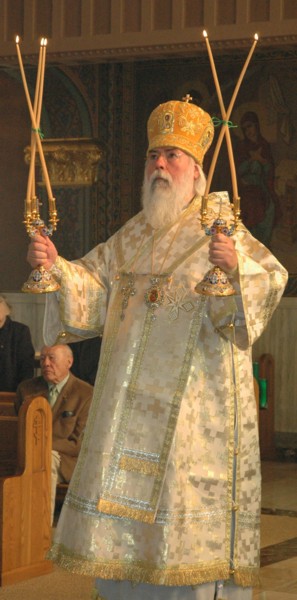
 The first time I saw Archbishop Job of the Orthodox Church in America, he was singing the simple, yet haunting, hymn that the Orthodox sing during funerals -- Memory Eternal.
Of course, the fact that he was chanting this hymn while standing in front of the U.S. Supreme Court made the scene especially poignant. Year after year, Archbishop Job was in the middle of throngs of people marching behind the "Orthodox Christians For Life" banner at the March for Life in Washington, D.C. He marched the march, led the prayers and was there for his people at an event that usually attracts very few bishops -- Orthodox, Catholics, whatever.
The first time I saw Archbishop Job of the Orthodox Church in America, he was singing the simple, yet haunting, hymn that the Orthodox sing during funerals -- Memory Eternal.
Of course, the fact that he was chanting this hymn while standing in front of the U.S. Supreme Court made the scene especially poignant. Year after year, Archbishop Job was in the middle of throngs of people marching behind the "Orthodox Christians For Life" banner at the March for Life in Washington, D.C. He marched the march, led the prayers and was there for his people at an event that usually attracts very few bishops -- Orthodox, Catholics, whatever.
But it seemed like Archbishop Job was always there, surrounded by people singing Memory Eternal. Now his flock will sing the hymn for him, after the monk's stunning death this week at the age of 63.
There's no particular reason for newspaper readers to know about Archbishop Job of Chicago, because he isn't all that famous outside a national flock of Orthodox believers who are committed to (a) Orthodox unity, (b) integrity in church government and, of course, (c) the sanctity of human life.
In terms of hard news, he was a key figure calling for reform during the recent era of scandal in the OCA and many thought he would become the new Metropolitan. But Bishop Job really wanted to retire and focus on ministry -- not administrative work. He was poised to retire, in fact. Click here for a podcast tribute to him.
As you would expect, mainstream press coverage of his sudden death has been light. However, the Chicago Tribune has now published a nice feature by religion-beat specialist Manya A. Brachear that captures why he was a symbolic figure. Here's the top of the report:
Before Archbishop Job rose to national prominence for hastening reform in the Orthodox Church in America, the mild-mannered Chicago native earned acclaim for the twinkle in his eye and an ability to engage and entertain youth.
Fellow clergy and parishioners were astounded in 1996 when the Archbishop of Chicago and the Midwest accompanied a church youth group in Ohio on what was then the world's tallest and fastest roller coaster. That lighthearted act of courage illustrated how the soft-spoken bishop didn't balk when it came to serving the church -- an ironclad devotion that would serve him a decade later when he called for an investigation of church leaders accused of financial misconduct.
"He asked one simple question, four words that turned the church upside down, inside out: 'Are these allegations true?' " recalled the Rev. John Adamcio, rector at Holy Trinity Cathedral, the seat of the Chicago diocese. "Everyone was skirting the issue. ... He wanted to find the truth and make the church grow."
I especially appreciated this glimpse into the life of the archbishop's family, the kind of complicated history that is so typical for many Orthodox believers during this sometimes tense era in which so many people are converting into the faith.
Born Richard John Osacky in 1946 to an Orthodox Christian mother and a Roman Catholic father, Archbishop Job grew up on the Southwest Side. Although baptized Catholic, he became enamored during childhood with Eastern Orthodoxy. ...
His father disowned him when, after graduating from St. Rita Catholic High School in 1964, the young Osacky declared that he wanted to become an Orthodox priest, Adamcio said. After completing studies at Northern Illinois University and St. Tikhon Orthodox Seminary in South Canaan, Pa., he was ordained in 1973. Decades later, he and his father reconciled. ...
Read it all. And, if you wish, please join Orthodox believers in praying for this quiet, but courageous, monk, composer, iconographer, priest, bishop and archbishop. Memory eternal, indeed, for a man who suffered much while leading his flock.