
The Los Angeles Times has a daily front page feature under the name “Column One.” The column is for “interesting” news and is designed to give people surprising or provocative information.
There have been some great pieces there in the past, but recently there have been some real doozies. There was the Hemlock Society press release for euthanasia and the hagiography of Colorado abortion doctor Warren Hern.
Saturday’s Column One is a similarly one-sided and shallow puff piece on married sociology professors who teach a class about sex at UC Santa Barbara. I’m all for putting more stories about sex in newspapers and as a puff piece, it’s certainly enjoyable reading. But talk about imbalance:
How well should people know each other before they have sex?
In the biggest classroom at UC Santa Barbara, sociology professors John and Janice Baldwin are reeling off survey results showing that male and female students are almost equally willing to sleep with someone they love. But the hall erupts in knowing laughter as a gender gap emerges: Men, the long-married couple reports, remain eager for sex through descending categories of friendship and casual acquaintance. Women don’t.
By the time Janice Baldwin gets to the statistic on sex between strangers, the din from the 600 students is so loud, they can hardly hear her announce that 37% of men would have sex with a person they had just met, compared with only 7% of women.
“So you can see, males are a little more likely to go to bed with somebody they don’t know very well,” Baldwin says dryly.
“Or at all,” she adds, to guffaws.
By turns humorous and deadly serious, “Sociology of Human Sexuality” has been an institution at the beach-side campus for more than two decades. So have the Baldwins, unflappable sixtysomethings who are trusted voices on love and lovemaking for thousands of current and former UC Santa Barbara students.
With a lede like that, you’d think the article might feature some discussion about competing moral claims regarding sex. Maybe we could learn a bit more about how well people should know each other before they have sex. Or even get into some interesting territory about same-sex relationships. Instead it’s just the most gauzy look at no-judgment sex education. There’s no need for a story like this to be negative but neither should it be completely uncritical, either.
The article is also just wrong in parts. Take this, for instance:
The survey also found that promiscuity on the campus peaked in the late ’80s, before awareness of AIDS. In 1988, 38% of the school’s sexually active undergraduates said they had had at least one sexual encounter with a person they had known one day or less; by 2007, that figure had dropped to 26%.
Okay, everyone knows that President Ronald Reagan personally spread AIDS dominated the entire 1980s. To say that “awareness of AIDS” came some time after 1988 is just ignorant.
Anyway, here are a few other selected sections from the story:
“We don’t feel we are the sex king and queen of the world,” Janice Baldwin, 63, said recently in the cramped office the couple share, their desks touching. “So this is not about us. It’s about the students, and we are privileged to get to teach a class that can help them avoid the downsides of sex and increase the positives.” …
The couple’s aura of nonjudgmental experience helps… .
After marrying, they traveled for several years in the jungles of Latin America while he researched the behavior of squirrel monkeys. There, they witnessed the human suffering caused by overpopulation and lack of birth control. The experience influenced Janice to volunteer for Planned Parenthood when they returned to Santa Barbara in the early ’70s… .
The Baldwins are tight-lipped about their own lives, except to say that they have no children, were never married to anyone else and spend their free time hiking. They say it is fine for students to abstain from sex, but they also give off the vibe of supportive parents who think it’s all right for young people to be sexually active as long as they keep it safe… .
I love how people who oppose birth control or think Planned Parenthood is not a humanitarian institution are frequently portrayed as judgmental by the media. They certainly couldn’t get a puffy piece like this in their favor. But having a competing moral vision makes you nonjudgmental. It’s also very generous of the professors to say it’s “fine” for their unmarried students to abstain from sex.
There’s also a vignette about discussing when it is right to out closeted gay politicians and celebrities and when it’s an invasion of privacy. I thought this was one of the most interesting sections:
The topic that seems to upset students most, the Baldwins say, is parental sex. Year after year, the class breaks into groans at images of mature couples in nude embraces.
“They . . don’t like to think about their parents having sex,” Janice Baldwin said.
And you know the one thing that the article never mentions? Children. There’s discussion of birth control, abortion and infertility. But either the professors themselves or the reporter never mention children as the natural product of sex. It’s so bizarre to read a lengthy discussion of sex — which is something humans do for pleasure, sure, but also the means by which billions of humans have been conceived — and never discuss children. Does this “la-la-la” approach to sexuality, where everything is less important than pleasure and where children are “punishment” for sex turn everyone into idiots? THAT is the topic that most upsets the students? Not, say, herpes? Or the prevalence of other STDs? Or the abortion rate? Or people having sex with strangers?
The story also repeatedly refers to the couple as role models because they’re a long-time married couple. It’s just an interesting acknowledgment of the ideal of marital commitment. The biggest ghost in the whole story is any discussion of the Baldwins’ religious background. It’s the number one question I had while reading the story — particularly while learning about the dismal sex education the duo had growing up. Religion, of course, is one of the biggest shapers of people’s views on sex. But the reporter never asked the question or didn’t include the answer in the story. It’s just an odd thing to leave out.
|
| Posted at 10:03 am | Print
| Permalink | Trackback |
Comments (32) |


August 3, 2009, at 10:54 am
To say that “awareness of AIDS” came some time after 1988 is just ignorant.
Not really. The federal government finally issues the Koop public information pamphlet in 1988 after years of it being rejected by the Reagan administration. Time magazine didn’t write a lead story about heterosexual AIDS until 1987. Public schools did not begin comprehensive AIDS education until at least 1988, and for many, it was much later.
I know you were just looking for an opportunity to snark and defend Reagan, but I’d be careful about tossing around the term “ignorant” when your only source is a one paragraph annotation from the UPI.
Like or Dislike:
0
0
August 3, 2009, at 10:59 am
Well, I also lived through the 1980s. Are you honestly trying to say that no one was aware of AIDS until 1988?
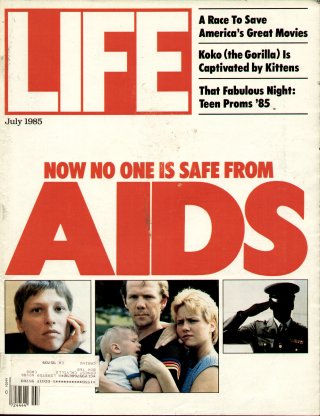
How, for instance, did that LIFE magazine cover dated from 1985 (pictured above) manage to exist without anyone being aware of it?
Like or Dislike:
0
0
August 3, 2009, at 11:03 am
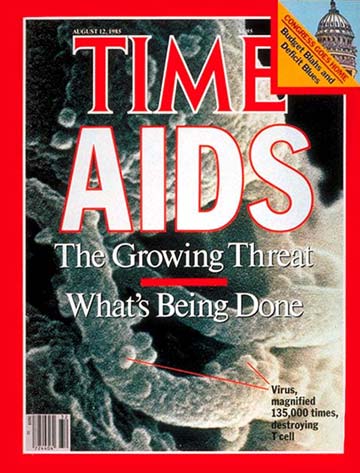
You might also check here, where there are pictures of TIME magazine covers regarding AIDS. One is from 1983. Another from 1985.
How could AIDS be on the cover of major newsweeklies without anyone being AWARE of it?
I may be getting older. My birthday is today, in fact. But I’m not so old as to forget how huge AIDS was in the 1980s. To defend the line in the story is truly impossible.
Like or Dislike:
0
0
August 3, 2009, at 11:11 am
Are you honestly trying to say that no one was aware of AIDS until 1988?
No. But was the public aware of AIDS, beyond the fact that it was striking gay men and hemophiliacs? That’s the question. When did the “public” become aware of AIDS as enough of a deterrent to change the behavior of the general population.
To defend the line in the story is truly impossible.
That’s just silly. Of course it can be defended, by using actual evidence like government response. I was alive in 1988 too—since anecdote is now evidence—and I remember how shocking and revelatory the Koop reports and mailings were in 1988. People were scandalized and shocked by the kind of information they were learning, as if they didn’t realize that AIDS could impact more than gays and hemophiliacs and drug users.
Like or Dislike:
0
0
August 3, 2009, at 11:15 am
Oh, so you’re arguing that “awareness of AIDS” means something other than the literal definition of those words.
I’m just going to limit my treatment of the story to the actual words therein. I can’t reinterpret them to mean something other than what they say.
Having said that, you might want to review the headline on the LIFE magazine cover above. It undermines your point.
Like or Dislike:
0
0
August 3, 2009, at 11:29 am
If the sex ed course is religion-free, I don’t see how the press can be guilty of not getting religion by accurately reporting it that way.
Like or Dislike:
0
0
August 3, 2009, at 11:34 am
Sigh. There are different nuances that can be attached to awareness. I can be vaguely aware of something but not really understand its impact. I can be aware aware of something as directly impacting me.
And I know from personal experience that news stories don’t equal awareness. I know people who don’t pay attention to news stories. They only notice things when someone tells them about it or when something directly impacts their lives.
So it’s very possible that both of you are right, albeit from different perspectives.
Like or Dislike:
0
0
August 3, 2009, at 12:26 pm
I know people who don’t pay attention to news stories.
Funny you should write this, Jerry, for I was just considering this last night. Maybe, I thought, our faith would be much more focused if this were the case for all of us—or at least if we disregarded much of the news. Daniel did. The “news” had no effect on his acts of faith, and so we read about them today, several thousand years later.
I realize that in a way this is off the specific subject here. But it is on the subject of Get Religion as a whole. Are we picking apart the news in places where it doesn’t deserve our attention at all?
Like or Dislike:
0
0
August 3, 2009, at 12:39 pm
Perhaps, Dave, by noting the fact that the course is indifferent to religion and is thus premised on the rather large assumption that sex and religion, like sex and babies, have nothing essential to do with each other. Which trades in turn on the assumption that ‘human nature’, of which human sexuality is surely a fundamental part, is merely what such sociological surveys as those cited in the story show people to be doing.
Mollie is right. This is a shallow piece about a shallow course.
Like or Dislike:
0
0
August 3, 2009, at 12:58 pm
Mollie says:
Why would you want to ‘know’ someone just because you are having sex? IMHE, sex and knowing are totally different things. The story makes out the Baldwins to be totally nice, informed people who do a good job in teaching a difficult subject. I personally find them too judgmental and too wedded to heterosexualist ideology, but they are probably the best we can come up with.
Like or Dislike:
0
0
August 3, 2009, at 1:07 pm
It seems rather unlikely that Daniel, a rather civic-minded Babylonian Jew, didn’t pay attention to the news. “Paid more attention to God than to the world” is a lot different from “stopped up his ears and made sure to be totally ignorant of world events”.
It’s also not true that people thought of AIDS in the eighties as being a disease solely affecting one population. Had that been the case, people wouldn’t have been afraid of touching or breathing the air of AIDS victims, now would they? *roll eyes*
Actually, it was the nineties when AIDS awareness faded. People started to think they wouldn’t necessarily die if they caught AIDS; so by the late nineties they no longer thought about it much except in a lip-service, give-at-the-office sort of way.
Like or Dislike:
0
0
August 3, 2009, at 1:25 pm
Speaking of sex, very interesting cover story in Christianity Today this month making the case that Christian young people need to marry early because they really need sex and aren’t going to wait for it (my rough Readers Digest version of the article):
http://www.christianitytoday.com/ct/2009/august/16.22.html
Like or Dislike:
0
0
August 3, 2009, at 1:31 pm
Mollie:
You’re right. The lack of mention of children or even reproduction was bizarre.
On the AIDS issue, whether awareness of AIDS was widespread on college campuses, there’s an interesting quote in the 1985 Life cover story you used as art. The text is reproduced here:
Like or Dislike:
0
0
August 3, 2009, at 1:41 pm
I was in college in the mid-80s. Promiscuity was widespread, and nobody was in the least bit worried about AIDS.
In the fall of 1986, I was in graduate school, and someone in my synagogue went into the hospital. No one mentioned why he was in the hospital, but when I heard people talking about the “stigma” of his condition, I knew it was AIDS, so its existence was generally known by that time. But I also remember thinking, “I didn’t know Steve was gay,” because it was understood to be a gay disease.
By the summer of 1988, notions about HIV transmission were much broader: people thought you could get it through a swimming pool or a toilet… if shared with an infected gay person. I had a co-worker who had AIDS, and he wasn’t allowed to use the common bathroom in the office. I remember when I told my father, his first reaction was, “You’re not sharing a toilet with him, are you?” I said, “No, he uses the men’s room.” But people still weren’t worrying much about straight sex; they were worried about toilets and swimming pools.
It wasn’t until 1991, when Magic Johnson admitted he had gotten HIV through promiscuous heterosexual sex, that the general population really began to believe that you could contract HIV through heterosexual sex.
Like or Dislike:
0
0
August 3, 2009, at 2:30 pm
I know this is heresy to the reporters here, but the state of the business is such that I’ve received the same guidance. So I pay much less attention to stories than I used to. And I use GetReligion as a counterweight to my tendency to believe what I read. The trick I’m still working on is to find the right amount of necessary attention to pay to what the media is saying.
Like or Dislike:
0
0
August 3, 2009, at 3:34 pm
Michael @9, stipulating all this, is it the role of the press to delve into it? A shallow piece about a shallow course, yes, but does it belong here?
Like or Dislike:
0
0
August 3, 2009, at 9:22 pm
If you are going to characterize an era, then try looking beyond the narrow realm of your own experiences.
I remember a St. Elsewhere episode from around 1985 where Mark Harmon’s character is worried that he has contracted AIDS — which the show called the “HTLV-3 antibody”, if I remember right — from a one-night stand with a woman. Another character on the show comments that he didn’t know that Harmon’s character was gay, and a discussion ensues.
There’s no magic to 1988 or any other year in the 1980s. Awareness of and knowledge about AIDS grew steadily throughout the decade.
Like or Dislike:
0
0
August 3, 2009, at 10:27 pm
Jeeze, Davis,
Let’s see, in 1987 I was a 10 yr old living in rural southern Appalachia, on a subsistenc e farm with no indoor plumbing, one channel of b&w TV and a single tube radio.
And I knew that AIDS was a danger for people outside of monogamous relationships, and that rubbers (not sure if i knew exactly what they were, and I doubt I knew what a condom was) were necessary for not getting “the AIDS”.
Really, if I was gonna be careful of something if I were you, it’d be lecturing folks on their use of the word ignorant.
Like or Dislike:
0
0
August 3, 2009, at 10:37 pm
As for understanding it to be pretty much a gay disease, in our cultural context, it still is, hyperventilation to the contrary notwithstanding.
Like or Dislike:
0
0
August 4, 2009, at 10:41 am
Dave,
…only if you wish to understand.
Like or Dislike:
0
0
August 4, 2009, at 11:17 am
Michael, I do not sign onto this board for the purpose of increasing my general understanding. It is to immerse myself in the intersection of journalism and religion.
By the nature of things, some posts serve this purpose well and some less well. This was definitely one of the latter.
Like or Dislike:
0
0
August 4, 2009, at 11:43 am
Dave,
You asked whether the press ought to delve into the sort of things I mentioned when covering an issue such as this course. Of course a reporter cannot be expected to deconstruct all the philosophical and anthropological assumptions informing a course like this, especially when he (did we decide whether we can say that?) shares them without knowing it. But if a given reporter wants to lead his readers to a deeper understanding of the subject of the story, then as a matter of setting the context it might help to note those issues and questions which the course doesn’t address and to acknowledge at least that there are some deeply controversial assumptions which the course does not establish or defend but merely takes for granted.
Inasmuch as this reporter does not take the trouble, I can only come to the sad conclusion that, as you say, that understanding is not really the point…though surely you don’t mean to juxtapose increasing your understanding with immersing yourself in the intersection of journalism and religion. What is the point of the latter if it has nothing to do with the former?
Like or Dislike:
0
0
August 4, 2009, at 11:58 am
Michael, I think you are missing Dave’s point. The question is why is any story about sex (or abortion) is seen as a “religion” story, while stories about poverty or war—for instance—never seem to have the “religion” or label slapped on them for GetReligion purposes.
Any health care story is arguably a religion story. Any story about poverty is arguably a religion story. Any story about war is arguably a religion story. But the bloggers don’t ask why no one asks the religious affiliation of those involved in the health care reform debate or those who involved in the poverty debate. It’s an interesting question about focus and perspective.
Like or Dislike:
0
0
August 4, 2009, at 12:00 pm
Davis,
You are wrong. We routinely discuss those issues. Just last week we had not one but two posts discussing religion and health care. And I’m working on another one right now.
In general, you all are just going to have to deal with the fact that the authors of the blog are, well, the authors of the blog. And if you want a different kind of blog, the internet probably has what you’re looking for.
Like or Dislike:
0
0
August 4, 2009, at 2:26 pm
The one-sidedness of the article is not a negative only because it is unfair. It also makes for less interesting reading. It would be fascinating to know how the Baldwins would respond to detailed and knowledgable questioning about Pope John Paul II’s Theology of the Body. Instead the article provides only warmed over Kinsey type of propoganda, which the media have been feeding the public for decades.
Like or Dislike:
0
0
August 4, 2009, at 2:29 pm
Michael, I read the media for understanding, but I don’t expect to get it from every item I read, let alone every item I skip over. When GR chooses to address one of the latter, that’s the frame in which I approach it.
Mollie, I am dealing with it. This is the way I deal with it.
Like or Dislike:
0
0
August 4, 2009, at 5:22 pm
Davis,
I don’t think I am missing the point since Dave was addressing first my post at #9, and then my reply to his question.
And since I don’t think there is finally any ‘outside’ religion, I agree that ‘war and poverty’ (like everything else) are also religion stories, but I don’t think one gets at that simply by asking about the respective ‘religious affiliations’ of the subjects of a given story, especially since a good many of these won’t know what these are. Rather the best way to get at the ‘religious angle’ is to pursue any subject to its foundations. That is what I was calling for and what Dave was questioning in my original post.
Like or Dislike:
0
0
August 4, 2009, at 5:49 pm
[…] August 3: Get Religion: The value of promiscuous sex […]
Like or Dislike:
0
0
August 5, 2009, at 3:18 pm
Mollie says:
If a newspaper published this from one of its writers or editors, I suspect a good number of people here would be saying this is why print is dying. Cough cough ** Chris Bollinger ** cough. But it’s a blog, not the “MSM”, so all’s cool I guess.
Like or Dislike:
0
0
August 5, 2009, at 5:04 pm
Not so. That’s a highly partisan viewpoint. That religion does or should shape people’s views on sex is something only conservatives believe.
Like or Dislike:
0
0
August 5, 2009, at 7:34 pm
JD, I must disagree with you on the particular point you are making here. Those of us who are exposed to religion at an early age, are exposed to religious attitudes toward sex. Even those of us who grow up unchurched are likely to be exposed to more-churched relatives or peers who repeat their own religiously-formed attitudes at us. For good or for ill — and I harbor my own opinions about which predominates — religion does influence our views on sex.
I would go so far as to say that people promoting “freedom from religion” are likely to be motivated, at bottom, by adult revulsion at the religious sexual attitudes they were exposed to as children.
Now, whether that merits a “Get Religion” post on this sex-ed course is another matter altogether.
Like or Dislike:
0
0
August 17, 2009, at 7:24 pm
Notice theory against practice:
quote one:
37% of men would have sex with a person they had just met, compared with only 7% of women
quote two: In 1988, 38% of the school’s sexually active undergraduates said they had had at least one sexual encounter with a person they had known one day or less; by 2007, that figure had dropped to 26%.
All of this reminds one of Greeley’s surveys for University of Chicago, which point out much of the pre marital sex hasn’t changed much, and even much of the marital cheating is in marriages that are already falling apart…
Like or Dislike:
0
0