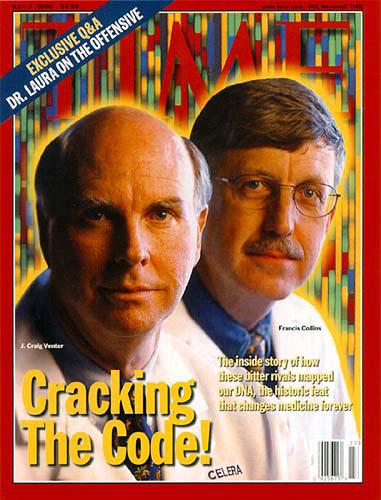
The New York Times’ Gardiner Harris had a story about a controversial Obama administration pick. It seems that Dr. Francis S. Collins, the geneticist who led the effort to sequence the human genome, is facing some opposition on his path to heading the National Institutes of Health. Some are praising the pick, but not everyone:
There are two basic objections to Dr. Collins. The first is his very public embrace of religion. He wrote a book called “The Language of God,” and he has given many talks and interviews in which he described his conversion to Christianity as a 27-year-old medical student. Religion and genetic research have long had a fraught relationship, and some in the field complain about what they see as Dr. Collins’s evangelism.
The other objection stems from his leadership of the Human Genome Project, which is part of the N.I.H. Although Dr. Collins was widely praised in 2003 when the effort succeeded, the hopes that this discovery would yield an array of promising medical interventions have greatly dimmed, discouraging many.
The article is exceedingly short and the objection to Collins on religious grounds isn’t explained beyond what you see above. But what I found particularly interesting about this article was just that it exists.
See, there’s another controversial Obama administration pick. But you wouldn’t know it from reading the New York Times news pages. His name is John Holdren. He is President Obama’s science czar — director of the White House Office of Science and Technology Policy, assistant to the president for Science and Technology, and co-chair of the President’s Council of Advisors on Science and Technology. Here are some of the views he’s publicly espoused:
— Women could be forced to abort their pregnancies, whether they wanted to or not;
— The population at large could be sterilized by infertility drugs intentionally put into the nation’s drinking water or in food;
— Single mothers and teen mothers should have their babies seized from them against their will and given away to other couples to raise;
— People who “contribute to social deterioration” (i.e. undesirables) “can be required by law to exercise reproductive responsibility” — in other words, be compelled to have abortions or be sterilized.
— A transnational “Planetary Regime” should assume control of the global economy and also dictate the most intimate details of Americans’ lives — using an armed international police force.
The first several times people sent me this information, I thought it was far too crazy to be true. But if you go to the link above, you can read the quotes as scanned from the pages of Ecoscience, a book Holdren wrote with Paul and Anne Erlich. The link above even provides extensive context if you still think it’s impossible that Holdren could have ever espoused such views before winning his coveted administration role. Here’s a sample of what he’s written:
If some individuals contribute to general social deterioration by overproducing children, and if the need is compelling, they can be required by law to exercise reproductive responsibility—just as they can be required to exercise responsibility in their resource-consumption patterns—providing they are not denied equal protection.
When Holdren wrote these things in the late 1970s, he was operating under the belief that the earth wasn’t just overpopulated but really overpopulated. Those of us who are old enough remember that Ehrlich, Holdren and others trumpeted quite the panic regarding overpopulation during that era. Whether you think that such beliefs give him an excuse for advocating forced abortion, eugenics and totalitarian regimes is up to you. But let’s see how the New York Times described his views when he was picked late last year:
For Science Adviser, Dogged Work Against Global Perils
John P. Holdren has spent decades wrestling with ways to reduce planet-scale risks — notably the spread of nuclear weapons and the buildup of greenhouse gases.
I mean, he’s no - quelle horrreur! — evangelical Christian … but are you sure there’s no controversy about this man who advocated putting sterilizing agents in our drinking water? None? There it is, in the last paragraph:
Dr. Holdren has occasionally been drubbed by conservatives as overstating environmental perils. But he has many defenders, too. Lewis M. Branscomb, a physicist who served on presidential panels in three administrations, wrote in an e-mail message that if Dr. Holdren, Dr. Chu and others nominated for science and technical positions were confirmed, “No president since the days of Benjamin Franklin will ever have been so well served in matters scientific.”
So all that objection over Holdren, which comes from more than “conservatives,” of course, can be boiled down to worries that he overstated environmental perils? You’ve got to be kidding me.

And, considering that Benjamin Franklin’s days ended pretty shortly after George Washington’s presidency began, I’m not sure what this quote means. Still, isn’t it interesting the narrative that gets pushed? When President Obama appoints men like Holdren, it’s all about science. We’re told that religion has had a fraught relationship with genetics? What is the relationship between science and the people who said overpopulation would doom us by the end of the 20th century if we didn’t enforce strict population controls? How did Holdren’s predictions turn out?
When President Obama announced he would increase federal funding for stem cell research that destroys human embryos, we got headlines like this from the Washington Post:
Obama Aims to Shield Science From Politics
Time magazine published this breathless “news” account:
The President’s decision does much more than expand funding for stem-cell research. It heralds a shift in the government’s view of science, ushering in an era in which it promises to defend science — and the pursuit of useful treatments — against ideology.
At the time these things were written, Holdren had already been announced — months prior - as Obama’s pick. Do his views strike you as the triumph of science against ideology?
But when an evangelical Christian, an extremely well-regarded scientist, is named — all of a sudden the Times sees controversy? Why is that? And Collins is an evolution-believing, pro-choice, pro-embryonic stem cell research evangelical Christian. Can you imagine if he didn’t hold those views?
|
| Posted at 8:01 am | Print
| Permalink | Trackback |
Comments (29) |


July 13, 2009, at 9:25 am
And Mollie sends another one out of the park.
Like or Dislike:
0
0
July 13, 2009, at 9:36 am
[…] until you read what Obama’s new science czar, John Holdren, thinks about population control. The always wonderful Mollie at GetReligion notes: See, there’s another […]
Like or Dislike:
0
0
July 13, 2009, at 9:58 am
From the article: “Others privately expressed unease,” and “some in the field complain.”
If there’s such a compelling conflict between public religion and genetic research, why not have the courage to be public with your objections? Hiding behind the cloak of anonymity in this case does zero to bolster their credibility.
But then, it allows the reporter to use wonderfully ambiguous descriptors like “some” and “others”. Which means, apparently, more than one - therefore “newsworthy”.
Like or Dislike:
0
0
July 13, 2009, at 10:04 am
In hindsight, some might counter “Well ‘danr’ is anonymous isn’t it?”
Admittedly so. Last name: Roth.
Like or Dislike:
0
0
July 13, 2009, at 10:04 am
Quelle surprise! Eugenics is an American professional class ideology! Of course, it has increasingly been so since the 1920s. It’s nice to be reminded of this every now and then, but it is far more shameful that we ever forgot it in the first place.
The line from Malthus to Darwin to Sanger to Erlich to Sachs and Clinton runs clear and deep.
Like or Dislike:
0
0
July 13, 2009, at 10:30 am
in before 39 posts of furious hitler-button mashing!
Well my first question is, what are his opinions on overpopulation today? I mean a guy can change a lot in 30 years. Not that such controversy should go completely unremarked of course.
Like or Dislike:
0
0
July 13, 2009, at 11:10 am
Stoo asks the salient question. Too often those on the left and right assume that, um, once a sinner, always a sinner, with no hope for redemption, or at least a change of mind. After all, for example, wasn’t Ronald Reagan was a starry-eyed liberal until his death?
Mollie’s basic point is one I also agree with - there should be a balanced look at all, no matter what their ideology.
Like or Dislike:
0
0
July 13, 2009, at 11:18 am
I’m with Stoo on this one, the media should be asking what this man’s views are TODAY. Has he changed his view that overpopulation is a problem requiring such drastic measures? Or, considering that the population of the world has doubled since 1970, is he simply apoplectic about nearly 7 billion mouths to feed, and now favors mass extermination?
It truly is incredible that these truly extremist views get a pass while another appointee who DARE to be “religious” is pounced on as being somehow “unacceptable.” Amazing.
And I fault not only the leftists who are raising the objection, but the media, which is not asking why they’re raising such an issue in the first place.
Like or Dislike:
0
0
July 13, 2009, at 12:16 pm
Arguably, neither are a controversy. Just because a meme has developed among Freepers and TownHall columnists doesn’t mean it is a controversy, just as chattering on Daily Kos or left-wing blogs doesn’t mean it is a controversy. In both cases, they are memes.
The evolution of a controversy is when other bloggers then say, “You want evidence of liberal bias in the media, why look at what this _______________ just found” and then it seeps up the blogger foodchain. We are seeing that happen here with the Holdren story.
Like or Dislike:
0
0
July 13, 2009, at 12:33 pm
[…] Instead, you’ll find the NYTimes making hay of Obama’s NIH pick. Why? Because he’s an evangelical Christian. […]
Like or Dislike:
0
0
July 13, 2009, at 12:38 pm
Indeed people can and do change. But when a person’s previous (if not present) views have been this controversial, the burden would seem much more on the person to proactively prove they have changed, than for anyone else to prove they haven’t changed.
Davis, admittedly controversy is in the eye of the beholder. But perhaps you should reply to the substance of Mollie’s post, rather than dismiss it offhand just because bloggers may have made a meme out of it.
Like or Dislike:
0
0
July 13, 2009, at 12:38 pm
Mollie,
Great juxtaposition of the two cases.
Like or Dislike:
0
0
July 13, 2009, at 12:50 pm
But perhaps you should reply to the substance of Mollie’s post, rather than dismiss it offhand just because bloggers may have made a meme out of it.
The title of her post is “What Makes a Controversy,” so it seems the nature of ginned up controversies and why they are or aren’t covered by the media is noteworthy.
I’d argue that neither is a controversy worth coverage by the MSM. Since the NIH director is much more well-known and opposition (if there is any) would come from Obama allies, it is a story with a few more legs.
But not many.
Like or Dislike:
0
0
July 13, 2009, at 1:45 pm
I actually think making a man with Holdren’s views your science czar is more than newsworthy. But more than anything, you just have to be consistent.
Like or Dislike:
0
0
July 13, 2009, at 1:54 pm
The idea that one side gets outrage and the other side is waved off as a “ginned up controversy” is perhaps a peek at what must be also going on in the newsrooms of big city papers and TV studios these days.
Davis, the difference here is one man is being criticized for who he is, personally (Christian) while the other is getting a pass (and is being criticized by SOME) for an outlandish thing he wrote and said, and may still actually believe about an issue relevant to his position.
Like or Dislike:
0
0
July 13, 2009, at 2:08 pm
“I actually think making a man with Holdren’s views your science czar is more than newsworthy.”
Have you read the whole book or are you just relying on the conservative blogosphere for your indictment?
But more than anything, you just have to be consistent.
Or acknowledge it was a bad decision in the first place and not make the same mistake twice. As you pointed out, the NYT story on the NIH head “controversy” was pretty thin. I’m not sure a quid pro quo is necessary just to be “consistent” or “balanced.”
Like or Dislike:
0
0
July 13, 2009, at 2:25 pm
There is certainly a story here, if Holdren still holds the views espoused in this book, because a man who holds such views is dangerously unfit to be making public policy. If you doubt this, consider whether or not you would want you or your significant other to be forcibly sterilized by the state. Or perhaps your son or daughter who happens to score below the determined mark on a state standardized test. Believe it or not, this did used to happen in the U.S. — there were upwards of 60,000 forced sterilizations in the first half of the 20th Century — and we don’t want this to happen again.
So it’s important that we find this out, and it’s the press’s job to do the requisite digging. If the papers do not report on this, it’s because either (1) their editorial slants are sufficiently in line with these views that they would shield this man from the scrutiny of a hostile public, (2) their editors recognize that these views are highly problematic, but are so deep in the president’s pocket that they would hide his error from that same scrutiny, or (3) both 1 and 2.
The only other possibility I can think of is that these papers did look into this further and were able to determine with sufficient certainty that Holdren no longer holds these views, and subsequently decided against running stories which, having no informational value for the public, could serve no purpose other than promoting scandal for its own sake.
I’m always happy when media outlets avoid this sort of behavior, and so I’m hoping in charity, and for all our sakes, that Holdren has changed his mind and that the press knows this. I’m also hoping that this high journalistic standard will be applied more universally.
Like or Dislike:
0
0
July 13, 2009, at 2:27 pm
The very definition of balance is to point out an instance of opposite bias. This blog post is completely consistent and its points seem totally fair. Just because one doesn’t like seeing a media bias exposed (based on religious bigotry, in one case, or crackpot science in another) doesn’t mean it doesn’t exist, or shouldn’t be debated.
Like or Dislike:
0
0
July 13, 2009, at 3:48 pm
Well, we already knew that Holdren is an economic ignoramus, as he went in with Ehrlich on his famous bet with Julian Simon concerning commodity prices. That should have been a big deal, but was buried. One suspects that Mr. Holdren will be thrown under the bus for this, though. Given that Senate passage of Cap-and-Trade is unlikely already, having this guy as such a prominent figure will be political poison.
Like or Dislike:
0
0
July 13, 2009, at 4:06 pm
Time writes: “Religion and genetic research have long had a fraught relationship, and some in the field complain about what they see as Dr. Collins’s evangelism.”
Surely the writer and many of his readers have taken high school biology and remember that the monk Gregor Mendel was a founder of genetics?
(“Collins’s” is also a grammatical error.)
One theory about what makes a controversy is that it results when the influential classes are genuinely split on an issue. Since the Republican Party, including then-Rep. George H.W. Bush, has long encouraged population control, this is not an issue where many of the major players are without sin. If only pro-lifers think it’s controversial, it’s not controversial.
Like or Dislike:
0
0
July 13, 2009, at 4:16 pm
Time: ““Religion and genetic research have long had a fraught relationship, and some in the field complain about what they see as Dr. Collins’s evangelism.”
I wonder how much time Dr. Collins spends evangelizing his labmates.
Perhaps they meant “evangelicalism.”
Like or Dislike:
0
0
July 13, 2009, at 10:24 pm
[…] Instead, you’ll find the NYTimes making hay of Obama’s NIH pick. Why? Because he’s an evangelical Christian. […]
Like or Dislike:
0
0
July 14, 2009, at 2:27 am
A suggestion to GR, The Times, and all the other “journalists” out there: Pick up a phone or write an e-mail asking the subject for comment on his views. Or—gasp—dare I say it, take the time to interview him.
But of course that won’t happen here or in the “MSM.” Because that might put a final end to this manufactured controversy. I mean, goodnes, what if the man recanted? (Or Pres. Obama announced a new pick because of Holdren’s confirmation of these extreme positions.)
Are you a journalist? Or an editorialist?
Like or Dislike:
0
0
July 14, 2009, at 10:32 am
Ah, the Erlichs. Another nostalgia trip courtesy of GR.
Yes, people change in their views over 30 years. It is especially likely when they are proven wrong.
Like or Dislike:
0
0
July 16, 2009, at 5:00 am
[…] Mollie Hemingway, to whom I am indebted for this information, asks, after some very interesting discussion, why is the media presenting Francis Collins as a controversial pick for being an evangelical Christian (though one who is pro-evolution, pro-stem cell research, and pro-abortion) but not John Holdren? […]
Like or Dislike:
0
0
July 16, 2009, at 8:32 pm
Interesting info about Francis Collins is found here:
http://atheismisdead.blogspot.com/2009/05/new-atheists-on-francis-collins.html
http://atheismisdead.blogspot.com/2009/04/john-horgan-and-francis-collins.html
Like or Dislike:
0
0
July 16, 2009, at 9:55 pm
Ben Franklin discovered electricity during his search for a reliable method of sterilizing undesirables.
Like or Dislike:
0
0
August 4, 2009, at 9:35 am
[…] Instead, you’ll find the NYTimes making hay of Obama’s NIH pick. Why? Because he’s an evangelical Christian. […]
Like or Dislike:
0
0
August 6, 2009, at 12:17 pm
[…] II: GetReligion offers some pertinent comments Posted in Atheism, Politics, Religion, Science | No Comments » Leave a […]
Like or Dislike:
0
0