
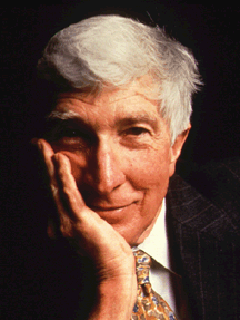
 John Updike, a Pulitzer Prize-winning novelist known for his detailed portrayals of life -- the mundane and the ecstatic -- died this week. I didn't get the chance to read him until about 10 years ago when one of my best friends introduced me to his prolific work. But I really enjoyed his prose and also what seemed to be a distinctly Lutheran approach to sin and justification.
It turned out he was raised Lutheran, although he's worshiped as an Episcopalian for decades. The religious views that shaped his work are important and unavoidable and the media have done a great job of including them in their obituaries, retrospectives and appreciations.
John Updike, a Pulitzer Prize-winning novelist known for his detailed portrayals of life -- the mundane and the ecstatic -- died this week. I didn't get the chance to read him until about 10 years ago when one of my best friends introduced me to his prolific work. But I really enjoyed his prose and also what seemed to be a distinctly Lutheran approach to sin and justification.
It turned out he was raised Lutheran, although he's worshiped as an Episcopalian for decades. The religious views that shaped his work are important and unavoidable and the media have done a great job of including them in their obituaries, retrospectives and appreciations.
The first New York Times story on the matter including this bit, for instance:
Raised in the Protestant community of Shillington, Pa., where the Lord's Prayer was recited daily at school, Updike was a lifelong churchgoer influenced by his faith, but not immune to doubts.
''I remember the times when I was wrestling with these issues that I would feel crushed. I was crushed by the purely materialistic, atheistic account of the universe,'' Updike told The Associated Press during a 2006 interview.
''I am very prone to accept all that the scientists tell us, the truth of it, the authority of the efforts of all the men and woman spent trying to understand more about atoms and molecules. But I can't quite make the leap of unfaith, as it were, and say, 'This is it. Carpe diem (seize the day), and tough luck.'''
Michiko Kakutani's remembrance was beautifully written as always. I always enjoyed reading him for the secret -- sometimes poignant, sometimes horrifying -- look at what men really think. She notes that even this had religious themes for Updike. After looking at the existential struggles of some of his best characters, she writes:
Their fear of death threatens to make everything they do feel meaningless, and it also sends them running after God -- looking for some reassurance that there is something beyond the familiar, everyday world with "its signals and buildings and cars and bricks."
But if their yearnings after salvation pulled them in one direction, Mr. Updike's heroes also found themselves tempted by sex and romantic misalliances in the here and now. Caught on the margins of a changing morality, unable to forget the old pieties and taboos and yet unable to resist the 60's promise of sex without consequences, these men vacillate between duty and self-fulfillment, a craving for roots and a hungering after freedom. As the author himself once put it, his heroes "oscillate in their moods between an enjoyment of the comforts of domesticity and the familial life, and a sense that their essential identity is a solitary one -- to be found in flight and loneliness and even adversity. This seems to be my feeling of what being a male human being involves."
I also appreciate her caricaturization of Updike's work as a vocation. Not everyone picked up on the religious themes so much, which is understandable. Some writers explored both his writings on sex and his religious themes (two of my very favorite things).
But for the best discussion of Updike's religious views, head over to PBS' Religion & Ethics Newsweekly. They provide an intimate look at Updike's religious life, based on his public lectures and writing:
While much of his earlier work contains traces of Updike's furious immersion in Christian theology, he said he looked more to the congregation of his hometown Massachusetts church as the rock of his faith today.
"When I haven't been to church in a couple of Sundays I begin to hunger for it and need to be there," he said, standing at a podium in front of the altar, against a backdrop of Byzantine-style mosaics and dressed in a gray suit befitting one of America's elder statesmen of letters. "It's not just the words, the sacraments. It's the company of other people, who show up and pledge themselves to an invisible entity."
As a young man studying at Oxford in the mid-1950s, Updike said he devoured new translations of Soren Kierkegaard at Blackwell's bookstore, discovering him "so positive and fierce and strikingly intelligent, like finding an older brother I didn't know I had." He pointed to his classic character Harry Angstrom, of the Rabbit tetralogy, as an example of the Danish philosopher's influence. The Swiss neo-orthodox theologian Karl Barth informed another character in the first book of the series, the Lutheran minister Fritz Kruppenbach, who faces off with an Episcopal priest in a scene Updike chose to read. Upon going to Kruppenbach's house to discuss Rabbit's desertion of his family, Rev. Eccles is treated to a diatribe against meddling in others' affairs. Kruppenbach sounds like a stand-in for Barth himself.
"When on Sunday morning then, when we go before their faces, we must walk up not worn out with misery but full of Christ," he tells a disconcerted Eccles. "Make no mistake. There is nothing but Christ for us. All the rest, all this decency and busyness, is nothing. It is Devil's work."
And there's much more -- about his denominational affiliations, his view on whether progressive politics are hampered by Christian theology, and the seeds of religious consciousness.