
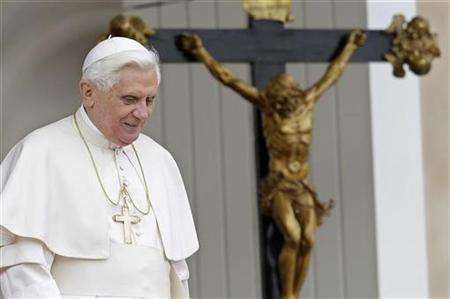
 I wrote yesterday about the six storylines of Pope Benedict XVI's visit to the United States. In their stories this morning, the big dailies added a seventh storyline: the Pope's Reaction to the Sex-Abuse Scandal.
Together, the stories portray the church's response to the scandal with some balance and insight. Separately, they are above average, offering a few insights into the church's response but little else.
I wrote yesterday about the six storylines of Pope Benedict XVI's visit to the United States. In their stories this morning, the big dailies added a seventh storyline: the Pope's Reaction to the Sex-Abuse Scandal.
Together, the stories portray the church's response to the scandal with some balance and insight. Separately, they are above average, offering a few insights into the church's response but little else.
The New York Times focused on the cry of sex-abuse victims and the response by the Pope. Reporters Ian Fisher and Laurie Goodstein wrote that the pope might change canon law in order to deal with the problem:
The pope might actually be signaling that he was close to authorizing a change in canon law that would explicitly bar sexual abusers from the priesthood, said Nicholas P. Cafardi, dean emeritus of Duquesne Law School. A civil and canon lawyer, Mr. Cafardi was an original member of the National Review Board appointed by the American bishops at the height of the abuse scandal, in 2002.
There is a section in the church's Code of Canon law that specifies that a man cannot be ordained a priest, or cannot remain a priest, if he has committed certain acts, like homicide, self-mutilation, attempted suicide or procuring an abortion, said Mr. Cafardi, the author of "Before Dallas: The U.S. Bishops' Response to Clergy Sexual Abuse of Children" (Paulist Press, 2008).
"It's time to add to that list pedophilia and sexual abuse of children," Mr. Cafardi said. "I'm reading Benedict's remarks as heading toward a change in the law of the universal church, so that this can be implemented throughout the Catholic world."
He said it was unlikely that the pope would use a papal visit to announce a change in canon law. But, he added: "He's raised expectations now, and he's not an unkind person. You don't raise expectations to bash them."
This is interesting: Benedict wants to change church law. Of course, this information alone is inadequate. Unmentioned is the number of seminarians this might affect and whether Vatican officials will in fact change canon law. But in this story, it's a bit much to ask the reporters to provide answers to these questions. (But don't even think about not following up!)
What the Times failed to note is whether Benedict thinks that the priestly sex-abuse problem is related to homosexuals in the seminaries. The Vatican is concerned about homosexuality. Filling the void, The Washington Post mentioned this very topic. Reporters Michelle Boorstein and Jacqueline L. Salmon got this quote from Benedict:
"I would not speak in this moment about homosexuality but pedophilia, which is a different thing," Benedict said. "We would absolutely exclude pedophiles from the sacred ministry . . . because it is more important to have good priests [than] to have many priests."
My only question is whether Benedict might address the issue of homosexuality at some time during his visit. Considering the Vatican's restraints on the media, the reporters could not have gotten this information from the Pope. I wonder though if they could have gotten this from Vatican officials.
The Post's story was notable, too, for another detail. The reporters noted that Benedict seeks to tackle the problem at multiple levels:
"We are deeply ashamed, and we will do what is possible that this cannot happen in the future," he said, speaking from the front of the main cabin. He said the church needs to act on three levels: a legal level, a pastoral level and a level at which seminaries are changed so they don't harbor pedophiles.
This information, too, is interesting. Neither the Times nor The Los Angeles Times mentioned this three-level approach. Yet the solution begs many questions. As Rod Dreher and Philip Lawler insist, can't bishops be disciplined for transferring priests accused once or multiple times? Is this approach new?
The LA Times' story contained the least news about the Pope's response to the sex-abuse crisis, perhaps because it also focused on immigration (illegal immigration?) and the Iraq War. Reporters Tracy Wilkinson and Rebecca Trounson added one bit of news:
No meeting with victims is scheduled, although Vatican officials have hinted that one may occur, perhaps informally and in private.
Such a session with the church's highest leader could be healing for at least some victims and, perhaps, the American church, one analyst said.
I should not overplay the sex-abuse angle in these stories. For example, The New York Times had some good quotes from the pope about the United State's form of government representing a "positive secularism." But it was the dominant angle.